

 Apple Podcasts
 PocketCasts
 Overcast
 Spotify
 Podcast Addict
 Amazon Music
 iHeartRadio
 PlayerFM
 TuneIn
 Audible
 Castbox
 Podchaser
 Goodpods
 Pandora
 Audacy
 Deezer
 Spreaker
 Building Your MSP Marketing Engine (EP 1015)
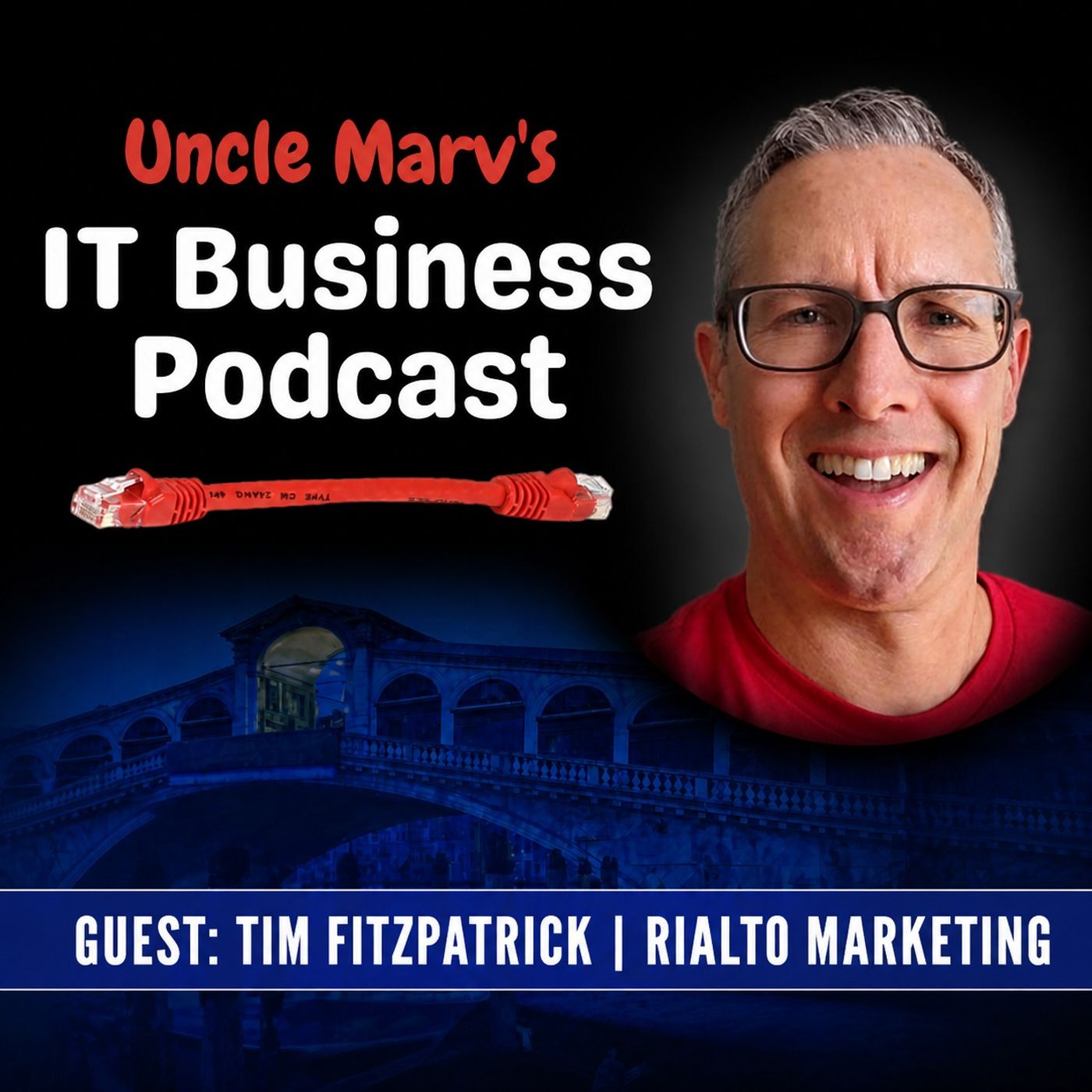
I sit down with Tim Fitzpatrick from Rialto Marketing to talk about why most MSPs don’t really have a lead problem, they have a broken marketing engine problem. We get into strategy vs tactics, niching, referrals, and how to stop leaving money sitting in your existing client base.
I brought Tim Fitzpatrick from Rialto Marketing back because too many MSPs keep telling me the same thing: “We tried marketing, it doesn’t work.” Tim breaks that thinking apart and explains why most of us don’t have a lead problem, we have a strategy problem. We dig into why “strategy before tactics” is the real fuel for your marketing engine, how to get specific about your ideal clients, and why your generic website hero section is quietly sending good prospects to your competitors.
We also talk about where the easy money is hiding inside your business right now. Tim walks through smart referral systems (not just client referrals but true referral partners), tapping MDF without the usual friction, and a real example of a 2M MSP that accidentally niched into healthcare but never built a plan around it. We wrap up on paid ads, SEO, and AI, and Tim explains why those tools only work when you already have an engine in place, plus how to use AI for data and research instead of just cranking out more weak content.
Chapters
- 00:37 Money Marketing Series
- 04:40 Referral Partners Matter
- 06:45 Build the Marketing Engine
- 09:06 Strategy Before Tactics
- 21:22 Website Hero Matters
- 23:38 Avoid Premature Paid Ads
- 27:29 Why Campaigns Fail
- 29:47 Manage Marketing Closely
- 32:54 Simplify the Growth Plan
- 36:22 AI as an Accelerator
- 39:43 Growing MSPs with Data
=== Guest: Tim Fitzpatrick, Rialto Marketing
- Website: https://www.rialtomarketing.com
- LinkedIn: https://www.linkedin.com/in/timpfitzpatrick
=== Companies / Vendors / Products / Books
- ACES Conference: https://acesconf.com
- Microsoft 365: https://www.microsoft.com/microsoft-365
- Apple: https://www.apple.com
- Amazon Web Services (AWS): https://aws.amazon.com
- Google Ads: https://ads.google.com
=== SPONSORS:
- Livestream Partner, ThreatLocker: https://www.itbusinesspodcast.com/threatlocker
- Technology Partner, NetAlly: https://www.itbusinesspodcast.com/netally/
- Technology Partner: Bvoip: https://www.itbusinesspodcast.com/bvoip
- Travel Partner: TruGrid: https://www.itbusinesspodcast.com/trugrid
- Digital Partner, Designer Ready: http://itbusinesspodcast.com/designerready
=== SHOW MUSIC:
- Item Title: Upbeat & Fun Sports Rock Logo
- Item URL: https://elements.envato.com/upbeat-fun-sports-rock-logo-CSR3UET
- Author Username: AlexanderRufire
- Item License Code: 7X9F52DNML
=== Connect with Uncle Marv
🌐 Website: https://www.itbusinesspodcast.com/
🎙 Host: Marvin Bee
🛒 Uncle Marv’s Amazon Store (gear & tools I recommend): https://amzn.to/3EiyKoZ
☕ Support the show: https://ko-fi.com/itbusinesspodcast
If you found value in this episode, share it with another MSP, IT provider, or tech entrepreneur. Your support helps keep practical, no-nonsense IT business conversations coming every week.
[0:24] Hello, friends. Uncle Marv here with another episode of the IT Business Podcast, the show for IT professionals and managed service providers where we help you run your business better, smarter, and faster.
[0:37] Well, folks, we are coming up to the end of May, but that does not mean that we are done with our money marketing and growth series. We've got a few more shows lined up for you here to close out the month real strong. In fact, we're actually going to extend that into June. So a lot will be coming up there. So that means if you are an MSP owner, or even if you're doing, you know, Ops Lead, or you are the accidental sales and marketing person at your IT company, you already know this one thing. The tech keeps changing. AI is everywhere, and buyers are more skeptical than ever. Yet somehow, your website, your referrals, and that random Google Ads campaign are supposed to magically keep your pipeline full. So today we're going to dive into that chaos and talk about how to build a marketing engine that actively works for MSPs in 2026. Our discussion continues today with Tim Fitzpatrick from Rialto Marketing. Tim helps MSPs and B2B service firms escape what he calls the marketing maze and turn scattered tactics into simple, repeatable systems that drives leads, closes deals.
[2:00] And keeps clients around longer so to the stage here Tim Fitzpatrick Tim how are you I'm great Mark thanks for having me man it's uh what is the second or third time I appreciate you having me back yeah well you know there's one thing to be said if a guest is good I'm going to keep asking them back of course they have to say yes so you've said yes each and every time well it's a pleasure to be here yep uh and it's the second time in a month because we had a quick little sit down while in Minnesota at the aces conference yes we did it was great to finally meet you face to face yes absolutely and I m going to bring up uh because this is video I m going to actually bring up a quick little photo here i grabbed this snapshot of you on stage and uh i actually tried to get one more but I missed it. But basically, stop leaving money on the table. 10 fast-track revenue opportunities hidden in your business right now. I was going to ask you a whole bunch of questions about that. But just real quick, I mean, what are some of the things we're doing to leave money on the table? Yeah, it's, you know, one of the, one of the first ones that I always look at is.
[3:18] Look at what's already working. You know, when business slows down or things aren't, you know, going at the trajectory that we would like, we immediately look at new tactics. And we don't. There's something already working within, in the business. We need to maximize that first. You know, so one of the examples I always use is referrals. Most MSPs are growing primarily through referral. yet. There's no system, there's no referral program to proactively encourage referrals. It's just happening passively, you know, so that, that is a big one. The other one, uh, is what used to work that you stopped doing, right? We always, we, we always get off track, right. And try new things and we stopped doing things that used to work. And so let's get, Let's get back to those things.
[4:14] Another one is MDF. Marketing development funds, right? When was the last time you approached your top three vendors to ask them about marketing development or co-op funds? That's money that is there if they have a program. And most MSPs just either don't know what's there or don't go through the process to actually do it and make it happen.
[4:37] So those are three that come top of mind.
[4:41] Yeah. So referrals always gets a bad rap because people always say, well, your referrals are going to dry up at some point and you know if you're just doing referral the same way that you know talk to friends you know and that sort of thing well yeah you're going to run out of referrals but you talked about having a system in place and you know it's i see multiple stages in that system one you've got to actively stay engaged with those research referral sources you know yeah for me my referrals actually most of my referrals did not come from clients they came from other consultants yeah out in the industry and you know i just realized a while back i had kind of lost touch with a couple of them and i was on the phone with one uh was it last week and we were talking about a particular uh client thing and they had left their company or whatever and i made a comment i was just asking about, you know, what the new company does. And immediately, the first thing she said was, well, so we don't do managed services. So if there's ever anything that, you know, we need help with, I'll remember you.
[5:55] It was something where I didn't prompt her for that. I didn't say, hey, I need a lead. But the idea was she recognized me as somebody that she could refer to clients when she needed them. So. Yeah, I think it's awesome you bring that up, Marv, because so many MSPs are focused on client referrals. But I think the real power is in referral partners, people that are in front of your ideal clients that can send you deals over and over again. I think a lot more time and, you know, call them strategic partners, referral partners, centers of influence. You know, people call them all kinds of different names, but that deserves a heavy focus in your referral activities in your system. Yeah.
[6:46] All right. So let's do a shift here because I know we're going to run out of time. So I want to get this one question asked. So it seems as though the buzz phrase this year is marketing engine.
[7:00] And almost everybody I've talked to, I'm not going to say everyone, but it's always focused on MSPs don't have a lead problem. They have a broken marketing engine problem. So the first question I'm going to ask, and I'll ask you because I didn't think of it in time to ask the others, is that a buzzword that just popped up that everybody hopped on this marketing engine? Oh, boy. I don't see it as a buzzword. I've been talking about it for a while.
[7:31] But I'm honestly not quite sure where that's coming from, but I think it's a good thing. The more people that are talking about it, the better. Because it is true. It needs to happen. There, there's so much marketing information out there, Marv, yet MSPs are still struggling with marketing. And that's not a coincidence. It's, it is because they are focused on the wrong types of activities or there are things that are out of alignment or missing. And those things need to be in place. If the marketing activities you take are going to work. So it's yeah you've got to have a think about like think about on the MSP side like you guys have put systems in place right it's no different on the marketing side you need a system if you want it to work consistently and repeatably over time.
[8:32] So, so we've talked about the system and we've talked about the engine. Everybody's kind of got a little different idea, but I always understand that, you know, before we hire a salesperson, you've got to have a process in place for that salesperson. You've got to be able to give that salesperson something to go out with that, you know, talks about your business in the right way. They've got to be able to communicate it properly. You've got to have something in the back end that when that person comes in with those leads, that they're put into the system the right way.
[9:06] Where do you see us missing the boat still?
[9:13] Biggest gaps I see in building an engine on the front end are with strategy. And when I think about strategy, I always talk about strategy before tactics, always. Because the way I view it strategy is the fuel for the engine the activities you're taking to market and sell are the parts to assemble the engine so if you jump right into the tactics without strategy you have an engine but you have no fuel so when i think of strategy i think of three things one is your target market and your ideal clients within that market and this is nothing that and MSPs haven't already heard before, but it's a fundamental that continues to get skipped. You have to narrow in on who your ideal clients are because once you understand them and the problems they have and how you can solve them, then you can create the second element of strategy, which is your message. Your message should attract and engage those ideal clients. It should also help differentiate your MSP from all the other ones that are out there.
[10:26] And then the third is your services and your offers. How are those positioned to make them easy to buy, to make them something that your ideal clients want to buy, and they make you positioned different in the market? Those three things you have to have in place. And those three things drive what activities you do from a marketing and sales standpoint. Right? Because what I do to get in front of or where I go to get in front of an attorney is totally different than where I go to get in front of an accountant.
[11:08] Right? And so if I don't understand those things, I'm just kind of picking tactics randomly, hoping that I'm going to get in front of the right people. Well, I was just in my head, I just started thinking, okay, tactics versus strategy. How are those different? Because I think people think a tactic is a strategy. They get used interchangeably all the time so the way i think of it is strategy is that higher level like what are we doing why are we doing it the tactics are the day-to-day activities that you're taking to accomplish that strategy so when you think about marketing strategy it's you know So our ideal clients are these types of people. This is the message that we're using and this is where they are. Okay. And then the tactics are the things you're going to do day to day to get in front of those people.
[12:11] So it's the higher level, what is strategy and the tactics are the, are the day-to-day activities and the how, how you're actually going to implement and execute on that strategy. Did I communicate that clearly? If I didn't keep digging. Well, so it's the short answer is yes. Okay. But in my head, I keep thinking that everybody just thinks that the strategy is I need to set my ideal customer profile, my ICP. I've got to narrow my niche. And I want to say I want businesses between 10 and 200 seats or 10 and 100 or whatever the number is that's all for them. That's it. And then we start going after our tactics. And so I think we always get hung up with, okay, what tactics are we losing money on?
[13:10] But I almost hear you say it doesn't matter about the tactics if you have the wrong strategy. So if those two pieces alone aren't the strategy, how do they strengthen the strategy to make the tactics fit? Does that make sense? Yes. So, and with strategy, you, you nailed the first part of it, right? Which is who are my ideal clients? Okay. Right. I think the simplest way for MSPs to differentiate niche is to go, is to focus on a specific industry vertical. Okay. It's not the only way to do it. Right. You could specialize in, in a certain compliance, right? You could specialize in a certain platform, right? You could be the AWS expert, you could be Microsoft 365, you could be an Apple. Consultant, right? We were just at the ACES conference, right? That is an example of specializing in a specific platform type, right? You could specialize in a geographic area, which is, to me, is probably the worst way to specialize because it's a really hard moat to defend. People don't care.
[14:33] People don't care if you're local? No. I mean, don't. I know people that still care. They want to be able to see somebody as opposed to thinking that your remote health has to be across the street or across the country or in, I was going to say a country.
[14:52] But they're thinking if I've got to talk to somebody who's out of this country, that's a problem. That's different, right? I would say out of this country, but within the country, I don't think the majority of the market cares. The only thing they care about is are you credible and trustworthy and can you solve the problem they have and help them get the outcome that they want? That's really all they care about. And so I'm not saying that you can't specialize by geography. It is just the least defensible way to niche and differentiate in the MSP space. There's one other common way you can niche and differentiate, which is to pick one main vertical and then choose complementary verticals, one or two other complementary verticals within that. Or you can combine any of the ones I just mentioned.
[15:49] But picking a single vertical is the simplest and the most defensible way to differentiate in the MSP space. Here's another reason why. Most MSPs are unwilling to do it. Well, of course. I mean... Why not take the money that is coming to the door? And you can. But when you market, you should market specifically to people. You can target, right? Narrow down your target and you can still sell broadly. If you specialize in working with registered investment advisors, you are still going to get referrals that are not registered investment advisors. I guarantee it. See it happen all the time. You can then choose Whether you're going to work with them or not.
[16:38] Right. But if they're not a good fit, you can say no. Right. You can always shoot. You can refer to another MSP and make a referral fee off of it. Right. If they're not a good fit, there are, there are benefits beyond marketing for niching like this. Because on the operation side, things become a lot more efficient. You can standardize a lot more things and you're not reinventing the wheel each and every time. Right. So it's, but that's, once you know who your ideal clients are, the rest of strategy, you can't just do that and expect to jump into tactics because what about your message? Your message is what attracts and engages those ideal clients so if your message isn't specific to that ideal client type it's not going to resonate either right that's another real challenge in the MSP space go to five websites MSP websites take the logo off, most of them say the same flavor yeah because message because our clients all need the same thing. They all need cyber protection. They all need help with AI. So we're all going to say this same similar message.
[17:57] But when you hone in on who your ideal clients are, you can get much more specific. Okay. Right. So for example, does a healthcare practice care about the things you just mentioned? Yes, they do.
[18:16] But they don't care about the IT. They care about what the IT can do for them. So in the example of like a healthcare practice, they don't care about IT. What they want to do is they want to be able to serve patients uninterrupted.
[18:33] Right. That's what they care about. Yep. They want their trays to upload without any issues. They want their iPads to work everywhere on the floor. Yeah. They want their physicians to see patients on time. Right. And if IT is creating roadblocks there, that ain't going to happen. So that's an example of, yes, they care about those IT outcomes, but they care about what the IT outcomes do for their business. And unless you hone in on who your ideal client really is, you can't speak to those specific business outcomes that they actually care about. What do attorneys care about? Billable hours.
[19:19] If IT is down, it impacts billable hours. So if I'm an attorney and I go to an MSP site that talks generally about, hey, we can uptime and yada, yada, yada, or you land on the homepage and you specialize in working with attorneys and you are talking about maximizing billable hours. And you're talking about how you help integrate with the tools that they're already using and you're referencing all the specific software that attorneys use, totally different experience. I mean, don't you think that that's going to resonate a whole lot more with an attorney that goes to that second site? Well, I was just thinking, yeah, if an attorney is looking for a specific piece of software and they just type in that software name in Google and your page pulls up, yeah, that makes a lot more sense. You know, and they're going to say, oh my gosh, like Marv gets me. He works with attorneys, right? He understands how to integrate and leverage the software tools that we're already using, right? He knows the business outcomes that I want to accomplish. And he's going to do what he can to make sure that the IT is supporting me in that process.
[20:44] One of the things that always resonated with me, somebody shared with me a long time ago, was specificity cells. The more specific we can get, the more it's going to resonate with your ideal clients. So the only way to get more specific is to really hone in on who your ideal clients are. Right. Right. So it's, you know, again, this is nothing new. These are, these are the fundamentals. They're the principles that just don't change no matter what's going on. The tactics are changing all the time, but the fundamentals don't.
[21:22] Which is why i and other people continue to talk about it they're important, so you mentioned websites so let me reverse the division of it um if you look at a lot of websites which I m sure you do what instantly tells you this site won't generate.
[21:50] The hero image. That's the first. So the top of the website. With a cape on the back. Yeah, the top of the website where, you know, you typically see an image at the top and then there's content right at the top. If that message is not specific and where it needs to be with a clear call to action. I would bet. I can't say for sure. I got to look at the rest of the site. But that is the single most important part of your website because it's where everybody lands. And think about it, Marv, we're all super short attention spans at this point. We're so used to getting the information we want at our fingertips. If I land on a website and I can't understand really quickly what you do, who you work with, and how I might benefit and what I need to do to take the next step. If I can't understand that in five to eight seconds, the vast majority of people are not going to take the time to scroll down the rest of the page. So that is the single most important part of a website.
[23:02] Otherwise, they're not going to stay on the site. They're going to move somewhere else. If it's good, then now you've earned the right for them to actually spend a little bit more time to dig deeper. To find what they're really looking for. But if that part, the top of your website is like the subject line on an email. If the subject line doesn't grab people, they're not open in the email. So it doesn't matter what the hell is in the rest of the email. Same thing on your website. All right.
[23:39] Let me go back to strategy and tactics real quick. Okay. What are some tactics that you see, and I'll just say over the last year, since the last time we chatted about this, what do you see as tactics that we are jumping in way too early without having earned the right to use them? Does that make sense? Yeah, it makes perfect sense. And this is a great question.
[24:08] The biggest one, paid ads. Paid ads is a really, it can be a really good way to generate leads. But if you don't have that strategy in place, you can burn money fast with paid ads. So whether it's Google search ads, whether it's paid social ads on Facebook or Instagram, you got to have that strategy in place. Because when you start to think about things like paid ads, you're targeting with paid ads. You have the ability to say, hey, I want to target these types of people. If you if you don't know who you're targeting and your message you don't have a proven message that works with that audience you're just throwing money out there and you're going to burn it, because it's not going to work well so it's and this is why and it doesn't really matter what the tactic is without the strategy in place it's not to say that it's not going to work it's not It's not going to work long term.
[25:21] So, but paid ads, there's a difference between paid ads and email marketing, right? Email marketing, maybe me as the MSP owner, I'm creating some emails that I'm going to send out. Eh, okay, so what'd you lose? You lost some of your time. But paid ads, you're most likely paying somebody to do it for you. And you're then paying for your ad spend. Okay.
[25:51] Does SEO fall under that category as well? I would say SEO, yes, because SEO also, with SEO, it's not just one thing. It's multiple things you're doing to try and rank higher in search, which at this point, SEO has really shifted more to generative engine optimization or AEO, which is answer engine optimization. So with the advent of AI, SEO has really shifted to AEO and GEO. Are you showing up in AI chats? Right. Google just made up is starting to make shifts in how search results are showing up in Google. And it's, you know, the big talk in SEO over the last couple years has been zero click. People are going to do searches and then they're not clicking on the results because they're getting the information that they need right there.
[26:58] So, the biggest drain on budget that I see where you're putting the cart before the horse is paid ads. But if you are paying anybody to implement tactics for you and you don't have strategy in place, there's a very high likelihood that it is going to fail. And you're not going to be happy with what happens.
[27:30] You just got to have strategy first okay so this is where I m going to ask you the question I ve been asking everybody, and I ve rephrased it this year and made it a little bit different because everybody has at this point tried some sort of marketing program marketing agency or whatever and they're just simply saying, these things don't work. So I'm asking you, if somebody says that to you, what's your response to them? My response to them, first off, is I'm going to ask them what they did. And I'm going to ask them how they did it. And again, it just, I'm going to sound like a broken record. It comes back to they didn't have strategy in place. Okay. I tried.
[28:23] I tried. I tried cold outbound. Okay, great. Who are you targeting? Well, we were targeting small businesses with 20 to 100 seats. In the greater Tampa, Florida area. Not specific enough. Message and the message was too generic. They sounded like every other MSP. So, you know, they didn't respond. Because you weren't different, right? Or they didn't respond because I was going after the 5% of the market that's looking to buy IT at any point in time. What about the other 95%? They're still valuable people to connect with. They're just not ready to buy right now. So it always comes back to what did you do, how did you do it, and where were the gaps? It's not that the tactics don't work because you could take an example of any tactic and find an MSP where it's working. Why is it working for some and not for others? The vast majority of the time It's not that the tactic's being implemented incorrectly, It's that the tactic doesn't have the fuel that it needs to actually work.
[29:47] And that's the problem, right? Now, the flip side of that, though, is let's say you do have strategy in place, okay? And you did implement it, but it didn't work. The opposite side of that is the leadership side of it, which is the third component I look at when we're building an engine, right? You have strategy, you have planning, and you have leadership. What ends up happening with leadership is a lot of times MSP owners are trying to manage marketing and they don't understand it. It's not their area of expertise. And it's really hard to manage and guide someone to market effectively for you if you don't understand it.
[30:34] I'm sorry, just for some reason, I'm thinking most MSPs aren't managing their marketing. They're handing it off and not managing it all and then upset. Yes, and that is my point. You can't just hand it off and say, oh, I hired an agency. Hands are washed. I don't need to worry about marketing anymore. No, you still need to hold. you still need to guide them and you still need to hold them accountable for what they say they're going to do. This is why I have conversations with MSPs who say, yeah, I just canceled the marketing contract that I was 12 months in on. I spent five grand a month and I generated no leads. You know why? Because they didn't manage that agency. They didn't know how to, they didn't know what waypoints or metrics to put in place to help to hold those people accountable.
[31:33] And that's why it didn't work, right? But there are, and I will be the first to say this, marketing takes time. You can't invest in this and go 30, 60 days in, say, oh, it's not working. I'm doing something different. It takes time. But what you can do is you can have waypoints at 30 days, at 60 days that you're looking at to see, are we trending and headed in the right direction? And if we're not, what adjustments and course corrections do we need to make? But I don't think you can say at 30 or 60 days that it doesn't work.
[32:10] So you, you have to manage it, whether you hand it off or not to an agency or an internal marketing, you know, coordinator or marketing manager, somebody still has to guide those people strategically. Gotcha. If, if not, it's like throwing somebody in the middle of the ocean without a life preserver and just going, okay, swim. You know, you touched on this early on, Marv, like I hire a salesperson, but I don't have a sales process. I don't have my ideal client profile. I don't have my message. It's like, hey, I hired you to sell. Just go sell. That person is going to fail every time because you haven't set them up for success. And you need to do the same thing on the marketing side.
[32:54] All right. Well, so I didn't ask you for this, but I was wondering, do you have some sort of example that you can give where you were able to help an MSP tighten up their offer, figure out their strategy, figure out the tactics and, and make that impact. Do you have anything? I have, I have one right now, top of mind that I'll just tell you that I just started working with, but I'll share with you how we started, how we started this process. Okay. Cause they, they approach and said, Hey, we're, you know, we're there at about $2 million. They are not generating new leads, right? Their retention's great, but they're at an inflection point where they know that if they don't start generating more leads more consistently, they're going to, they're going to have a hard time staying where they are because of attrition. And, you know, they're seeing like, Hey, some last year we lost a client, not because we were doing a bad job, but because they were acquired.
[34:00] So they said, we don't know, what should our next steps be? Okay, so with this particular client, I asked him, I said, tell me about your existing client base. Who are you working with? Guess what they said? 60% of their business is in healthcare. 60%. And I said, how did you get that business? Well, we have two referral partners in that space that really helped us get things going and referred us most of that business. Okay, well, you don't need a gazillion new tax. Okay, you don't need to start doing five different things. Keep this simple. You've got traction in healthcare. You can get testimonials. You can get case studies. When was the last time you talked to either of those two referral partners? It wasn't any time recent.
[35:08] We need to be in front of those people more. How can you get in front of more of those same referral partners? They're out there, right? That's how we started to put the plan together and simplify it. So they went from, what do we do? We have all these options to, oh, this is a lot simpler than I really thought it was going to be. The answers were already in my business. I just needed to focus and go down that path. So now what they're in the process of doing is, one, reconnecting with those referral partners. They're in the process of interviewing their healthcare clients to gather additional information to get really strong messaging elements that they can leverage so that they can create their messaging playbook. And then from there, they'll start to jump into tactics that are going to get them in front of those people. That's where you start. It's all, for most MSPs, it's right, it's in your business already.
[36:17] All right. Part of that stop leaving money on the table thing. That's it.
[36:23] All right. I can't believe we went this long and we're almost out of time. But I'm going to ask the question about AI because, you know, that's the thing. Everybody's using AI. We're being told to help our clients with it. We're being told to use AI to streamline our operations. A lot of people are using it to do their marketing. Where do you stand on that? I use it every day uh as my guess is you are as well and it's changing its evolving rapidly right but when i think about ai i think about three levels of it i think about we use ai to get answers right similar to what we did with search right you have ai as a daily thought partner right bouncing ideas off of it getting feedback and then you have ai actually working for you, which is, you know, automations, um, to do research, those types of things. AI for answers is, is, is at the base and AI working for you is at the top. Most people are not at the top yet. They're either using AI for answers and they might be using it for daily, as a daily thought partner, but to leverage AI within marketing effectively.
[37:45] It goes back to having a marketing engine in place. If you don't have an engine in place, all AI is going to do is help you do more stuff that's not working. So it is an accelerant. It creates efficiencies, but you need to make sure that it is accelerating and creating efficiencies for the right things. So it still comes back to, I have to have my engine in place. Then i can layer ai on top of it to enable that engine even more that's how i think about it okay so I m going to ask this last question here in terms of ai what can we do with ai except have it help us generate content because i think that's what almost everybody that I ve talk to, that's what they're using it for. Yep. That a lot of people are using it for that.
[38:43] AI is great at analyzing data. You can leverage it to analyze data. Throw in, you can put your marketing metrics in there and ask it to evaluate those metrics. You can leverage it for deep research, you know, perplexity, deep research is fantastic, right? So if you're looking for information, let's say you're looking, let's say you're thinking about adding a new product or service, or you're thinking about shifting, you're thinking about shifting your, your target market, right? You need to home in on your target market. And you're wondering whether a specific market would be a strong market. You can leverage deep research. Marv, the data that you get back from that in less than 15 minutes used to take hours of people's time.
[39:44] To put together so those are two really good ones on the marketing side you know as we get into more agentic and automated things i think you can do that but i think most MSPs need to walk before they run so i would leverage it on the data side and i would leverage it for research, Okay. Simple enough. All right, Tim, what do you have on the docket for the rest of 26?
[40:15] Just continuing to talk to more MSPs and helping them build their engine. That's what I've been doing for a long time now. So has it been 15 years?
[40:28] Oh, God. It's 2013. So 13 years-ish. Um that I ve been in in marketing so there's you know Marv there's still there's so much opportunity in this space things are things are changing a lot in the MSP space but what you guys, what you guys do the need the needs there right there's no it's not going away no it's i mean there's if anything there's more cyber-attacks happening uh they're getting smarter and smarter with it. Like you guys are needed.
[41:04] We just need to, I just want to help, help you guys market more effectively so you can get in front of more ideal clients and increase revenue and continue to grow. All right. All right, folks. Um, Tim Fitzpatrick, Rialto Marketing, uh, and the website is RialtoMarketing.com. I have the information in the show notes and, uh, should be good and uh did they tape your presentation at aces and is that available or is it just for attendees i believe they taped it but i don't know if i don't think it's readily available i think it i think it was just something they recorded for attendees okay because the second screenshot that i got let me see if i can pull it up real quick this is not going to uh there was uh but something like 10 things...
[42:01] 10 fast track revenue opportunities. Yeah. Here's what I'll say. If, if anybody that is listening to this wants those, send me a, send me an email at info at Rialto marketing.com info at Rialto marketing.com. That's R I A L T O marketing.com. And just put uncle Marv fast track tactics. And I will send those to you directly. Okay. Cool. Yep, that works. That's what I was going to ask you about. But yeah, thank you very much. We'll put that link in there. So folks, go get that and find out how Tim can help. So Tim, thanks a lot.
[42:44] And I think all of that moves the business forward, right? Yes, it does. I appreciate you having me, Marv. It's always a pleasure. All right. All right, folks, if you got value from this conversation, do me a favor, share the episode with another IT pro or MSP owners who's struggling with marketing and make sure that you are subscribed to this. We're on, I don't know, I don't know, we're on all the pod catchers. Go find us, go to itbusinesspodcast.com. Make sure you don't miss the next one. And if you're ready to tighten up your own marketing engine, the phrase we're all using, take one idea from Tim today, put it into action this week, and don't just let this sit in your podcast queue. So thank you to Tim and Rialto Marketing, information in the show notes. Thank you again for listening. And as always, we'll see you soon. Alla.

B2B Revenue Accelerator
Tim is an entrepreneur/business owner with marketing and growth expertise. He has 25+ years of entrepreneurial experience with a passion for developing and growing businesses. That passion served him well in operating and managing a wholesale distribution company he co-owned for nine years before being acquired in 2005.
Since then, he’s had failures and successes. He started Rialto Marketing in 2013 and has been helping MSPs & B2B professional service firms build and manage their marketing engine to get where they want to go faster. He believes marketing shouldn't be difficult. But, you must remove your revenue roadblocks to grow consistently and predictably.


