

 Apple Podcasts
 PocketCasts
 Overcast
 Spotify
 Podcast Addict
 Amazon Music
 iHeartRadio
 PlayerFM
 TuneIn
 Audible
 Castbox
 Podchaser
 Goodpods
 Pandora
 Audacy
 Deezer
 Spreaker
 MSP Branding In An AI World (EP 1005)
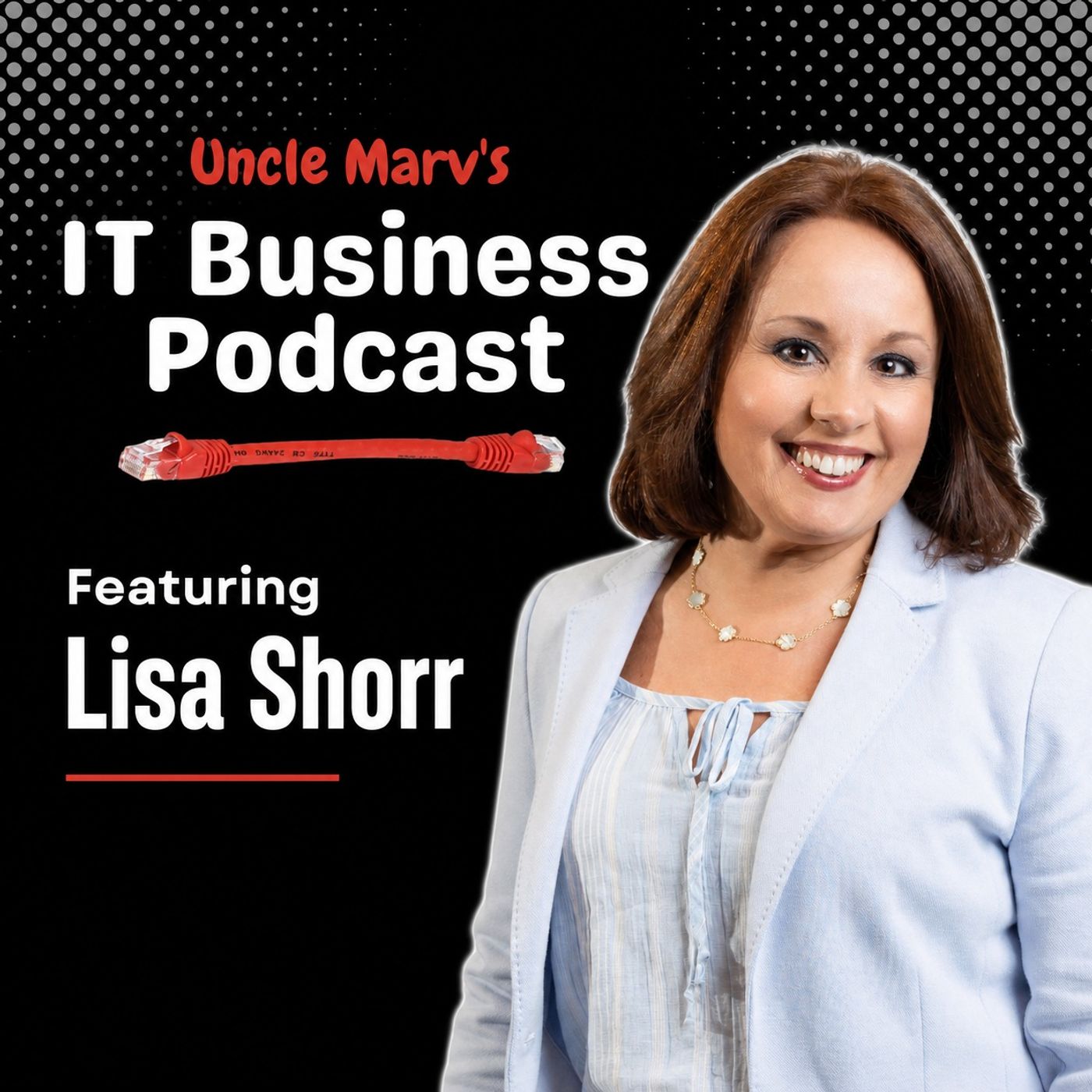
Clients are not firing MSPs because of bad tools; they are walking away because they feel ignored, unseen, and “not important.” Lisa Shorr joins me to show how better soft skills, branding, and intentional AI use can turn your team into high‑trust, client‑facing pros who keep MRR growing instead of leaking out the back door
Most of us put huge effort into our tech stack and very little into how our team actually shows up in front of clients. In this conversation with MSP owner, branding coach, and author Lisa Shorr, we talk about why a “solid stack” is not enough if your clients experience you as slow, unresponsive, or robotic. We dig into real stories from the field, including a law firm that fired their IT provider for being “not responsive,” and how simple shifts in communication, presence, and expectations can completely change that story.
We also tackle the AI rush head‑on: how to decide whether a new automation actually strengthens or weakens client relationships, where QBRs and client touchpoints fit into a more automated world, and why empathy, adaptability, and critical thinking are still your unfair advantage. If you’ve ever felt the tension between “being efficient” and “being human,” this one will hit home.
Chapters
- 00:32 Introduction to Money, Marketing, and Growth
- 02:56 The Importance of Human Connection
- 03:23 Navigating AI and Automation
- 05:51 Workshops and Trends in MSPs
- 08:37 Balancing AI and Client Interaction
- 11:09 Building a Framework for AI Implementation
- 18:09 The Role of Empathy in Client Relationships
- 20:55 Success Stories and Client Experiences
- 23:55 Internal Branding and Image
- 30:30 Consistency in Branding
- 35:14 Challenges Faced by MSPs Today
- 41:42 Unleashing Your Brand with Shore Success
=== Guest: Lisa Shorr
- Company: Shorr Success – https://shorrsuccess.com
- LinkedIn: https://www.linkedin.com/in/lisashorr
- Your B.R.A.N.D. Unleashed (book): https://amzn.to/4tqZXOi
=== Companies / Vendors / Products / Books
- Pax8: https://www.pax8.com
- Claude (Anthropic): https://www.anthropic.com
- Microsoft Copilot: https://www.microsoft.com/copilot
- Gamma: https://gamma.app
- The Managed Intelligence Provider Playbook (Pax8 report): https://www.pax8nebula.com/m/47ae41fea05803a4/original/The-Managed-Intelligence-Provider-Playbook.pdf
=== SPONSORS:
- Livestream Partner, ThreatLocker: https://www.itbusinesspodcast.com/threatlocker
- Technology Partner, NetAlly: https://www.itbusinesspodcast.com/netally/
- Technology Partner: Bvoip: https://www.itbusinesspodcast.com/bvoip
- Travel Partner: TruGrid: https://www.itbusinesspodcast.com/trugrid
- Digital Partner, Designer Ready: http://itbusinesspodcast.com/designerready
=== SHOW MUSIC:
- Item Title: Upbeat & Fun Sports Rock Logo
- Item URL: https://elements.envato.com/upbeat-fun-sports-rock-logo-CSR3UET
- Author Username: AlexanderRufire
- Item License Code: 7X9F52DNML
=== Connect with Uncle Marv
🌐 Website: https://www.itbusinesspodcast.com/
🎙 Host: Marvin Bee
🛒 Uncle Marv’s Amazon Store (gear & tools I recommend): https://amzn.to/3EiyKoZ
☕ Support the show: https://ko-fi.com/itbusinesspodcast
If you found value in this episode, share it with another MSP, IT provider, or tech entrepreneur. Your support helps keep practical, no-nonsense IT business conversations coming every week.
[0:24] Hello friends, Uncle Marv here with another episode of the IT Business Podcast,
[0:28] the show for IT professionals and managed service providers. And we are continuing our series for the month of May, money, marketing, and growth. All three go hand in hand. But today, it's not just about the way your tech stack or the latest shiny tool is. We're talking about something that, in my mind, quietly decides whether your MRR grows, stalls, or walks out the door. It's how your people show up in front of your clients. So I asked Lisa Shorr to come on the show again. Shorr's success, not only is she the co-owner of an MSP, but she also is a branding and communications coach who has spent years turning tech-heavy teams into high-trust, client-facing pros. Lisa, welcome back. I am so thankful to be back here. Love, love, love your show, and I love this topic of money, marketing, and growth. Soft skills couldn't go hand-in-hand even better than anything else. So I'm so excited to talk. Yeah, this is one of those things. I mean, you and I have talked about it, and I don't know that it gets communicated enough, but how we look.
[1:45] How we act, how we present ourselves from the first time a customer or prospect sees us, our everyday interaction, that plays almost as much a part of our success as everything else. People sometimes don't even care about the tech tools, but they care about how a tech treats them when they walk into their office, right? So they don't know that. I think that a lot of clients don't realize, or maybe a lot of IT business owners should say, don't realize that it's not the technical skills that really make an impression on a client. They want to see that you have technical abilities. So please know I'm not discounting that. But really what makes the difference is how you make people feel and how that connection is impacting. You know, we signed on, my MSP signed on a new client the other day.
[2:44] And it's a law firm. And I'm very happy about it. But when I peeled back the
[2:50] onion and we really got down to why, what was their initial reason for calling us? And they said, because my current IT provider isn't responsive. They're not making us feel like they care. I mean, literally not responsive was the words. And so that's not a technical stack. That's a human connection. And that's something that we need to continue to really hit home. We have to talk about this.
[3:23] So let's talk about that from a different perspective, because we've gone through, you know, the era of cybersecurity and breaches and all of that stuff. We've gone through cybersecurity.
[3:37] An automation phase which is now only being amplified or exasperated by ai and that human interaction is being taken away even more right um so let me ask you this how much have you talked about ai as a part of your brand so i have built a workshop around this now So I actually have a whole workshop and I have been touring around literally the country as well as Canada talking about soft skills that AI cannot replace.
[4:16] And we are in an era of, I mean, I'm looking at everywhere we go, like PAX 8 has their managed intelligence provider report. We're not even, we're evolving to not even being called managed services providers. We're managed intelligence providers. So that's requiring us to help clients guide them into how to do, how to implement AI in automation, how to augment their processes that they have already existing, how to make their time more efficient. All of that could easily distance ourselves from the client interaction. And so I have been doing several workshops with technical teams on, take a step back a moment, technical is critical, AI and implementation. We have to do it but we also have to be mindful that that is going to distance ourselves so I'm trying to say okay well here's some of the soft skills that AI cannot replace.
[5:26] And infusing that into this conversation so when people are adopting AI and building out processes and augmenting they're seeing they're saying okay well where is the human connection impacted connected. Because responsiveness and attentiveness is what we're hired for. Now, in those workshops, I assume you've probably done a ton because I know
[5:50] you're out there all the time. But have you seen a trend or have you seen a grouping of things that we as MSPs are doing that is kind of taken away from what we've been building all these years? Because a lot of people are complaining about, you know, they don't feel connected to their clients anymore. Have you seen anything that correlates to us trying to do AI and what we're experiencing? It's new to see all of the impact, what's really happening. Okay. What I'm seeing is the adoption rate.
[6:34] Is fast and furious. Absolutely. Sign on to Claude. Sign on to Copilot. Sign on to Gamma. Oh, wait, you have Claude? So you're going to record this call? Oh, wait. So we're just, we're running fast. And I think what I'm seeing more is not having a strategy around what soft skills are needed in each step of the way.
[7:01] We're building and we're moving forward We're building agents for marketing. We're building agents for a process flow. We're asking Copilot to analyze our email and give me a summary, which is amazing. When I was at boot camp recently, we were talking about people were telling me that they were building their own CRMs. And so they're getting rid of their current CRM or they're building a PSA ticketing tool. And great, I guess. I don't know. It remains to be seen. But what about the human connection? Where does that support your human connection versus is it going? And also, you're building all of this. When are you spending the time doing what we can call QBRs or, you know, employee, not employee, team business, I mean, strategy business review meetings, excuse me, I'm thinking on the fly here. But like, we need to also, while we're building out AI, we also can't forget that we need client maintenance. We need client touch. We need to have client meetings. You can't be everywhere. So are those critical QBRs, quality business meetings, quarterly business meetings, strategic business meetings, technical business meetings, whatever you call them, meeting with your clients.
[8:30] At the expense of getting lost at the expense because you're building and you're
[8:35] exploring and expanding. And so that's where I'm seeing more concern. It's great that you're spending all this time building and creating and exploring AI, but are you doing it at the expense of learning what's happening in your client offices? So that leads me to a question that I think, so I've only partially addressed this myself because I'm in that same boat. I'm like, how can I use AI to make my business more efficient? I've got customers that have already asked about it.
[9:11] And I've got one in particular where we actually had to go back and tell them, AI can't help you because your office procedures and your office framework and stuff, their data is all messed up. And so you've got to get all this cleaned up before you can ask AI to start helping because AI doesn't know where to look for stuff. But that leads me to the question of one of the things I see us doing is we're just implementing stuff to implementing as opposed to putting together a framework with which to start. So are you helping people at least, you know, put together a starting framework with, you know, maybe compartmentalizing what AI things to implement? You talked about the why. Why are we implementing them? But what is guiding us? I think we have this discussion often around where is your data held? How is ai going to be able to pull that data so that it is helpful and efficient and you're not alone in and saying to a client you've got data in six directions you know you either need one central composite you know one central place where ai can pull from or you build it into the instructions you know if you're building an agent for marketing a ghost writer for example we just we've actually been doing a lot of that in my MSP we've held two lunch and learns.
[10:39] With clients as a great client relationship builder and so everybody out there this is a great marketing idea as a relationship builder but also to start getting our clients using ai and, And, of course, we have a slide, a really critical component of the workshop to say, it's not, you have to be careful what you're uploading. And, you know, we talk about security parameters. We have a whole conversation about that.
[11:10] But we're teaching them how to build an agent, what data to pull from, how to parse that through, and how to not, you know, support building the model, you know, the bigger LLM models and all that. Right. But in terms of really helping clients' strategy and really creating that framework, yes, we are starting with, okay, what do you have? Let's look at some of the processes that you're doing. A lot of it stems in the beginning around analysis. What kind of data analysis can we pull from what you have? And that's a great place to start is analysis. says give me a summary or give me um and I m about to go into a meeting give me five talking points that you'd like me to see here that kind of stuff but the other piece we have to really talk about with our clients and communicate and this is again where soft skills are critical is what are you uploading and having some parameters around that private information client information if you're a medical office you've got HIPAA compliance you have to think about, you have to, if you're a financial firm, FINRA, and some of those compliance needs and being very mindful of that.
[12:28] All right. So we just spent, I don't know, 10 minutes talking about technical stuff, which, you know, you're a branded image consultant and stuff. So how do we translate that into what we're doing with our automation and AI and correct the very thing we were talking about, you know, of losing the human touch? The first question, and I build this into my workshop, is ask, well, first of all, it's a mindset. We have to have a mindset. I'm so glad we're talking about this. And I hope everybody who's listening walks away today asking a critical question. Does this AI that I'm implementing strengthen or weaken the client relationship? Ask that question first. Does it strengthen or does it distance ourselves, which could potentially weaken the relationship? What will it do? And that's a critical component to then saying, well, if it seems like it's going to weaken, like, okay, well, I'm going to have clients do their own password resets. They're not going to need to call me anymore. They're just going to log in. They'll talk to a chatbot or however it works.
[13:41] Okay, well, now we don't have, now the MSP has lost a little bit of touch with the client. So how are you going to make it up in other ways? How are you going to show? And that's going to have to be through meeting with them and scheduling time to meet with them or scheduling opportunities to do client appreciation events, do the lunch and learns like we're doing and doing small components and micro learning. So you still stay connected with your clients. They need to see that you're still available and you can still connect with them. Who likes being put, you know, calling a vendor and then having to talk to a chat bot? And then, you know, and then you never get it right because you're asking a question. Oh, I don't have the answer to that. Or do you mean this? Or do you mean this? And you and I were chatting about that, right? I was going to say. My show last night, I did a rant on this very thing as a tech calling a tech company, wanting to find out about a product, talk to somebody. And basically, I got redirected to a virtual agent. And I'm like, why? You did that already. You're a technical person. You know how to call tech support. So, yeah.
[15:05] So that's where leadership comes in. So that begs the conversation of leadership and what tone is leadership setting for leadership? Process of how someone gets transferred throughout their company and at what point do they get escalated and where was it okay to escalate that they thought they were to another chatbot you had a human voice for a reason where did they think that it was okay to escalate to a chatbot and saying why was that chatbot going to answer a question that a human couldn't right so that's a problem that's a well the other problem too is and we probably got a little off track but you know in my mind it's like i yeah i can go through a chat bot but I ve got questions that i know a virtual agent isn't going to be able to answer right because what is it what do they always end up doing well for a representative i mean i would have been back in that vicious circle So it's something where our clients are going to be in that same position because they're smart. They're not dumb. They're going into Google. They're using, you know, ChatGPT to see if they can fix the printer before they call us.
[16:28] So, you know, that critical thinking aspect is something that I think we need to keep in mind. Yeah, we can use it to make automation better and more efficient, but we can't stop talking to people. We can't stop. I love that you said critical thinking because this is one of the risks of AI adoption and reliance on AI. So a lot of people are starting to use AI, and I'll just give a very easy example, and that's social media. You can tell often when AI wrote a post or maybe it's a newsletter, you can see it. And maybe someone who used to be a great writer...
[17:16] It's now just relying and using AI as a crutch. And we're going to lose our critical thinking and our ability. And so that becomes a risk to credibility and to relationship building. I mean, AI, there's a few. In my workshop, I talk about a couple of key soft skills that AI cannot replace. And one of them is empathy. And had that vendor yesterday or the other day when you called had any sense of empathy for you, they would have said, let me, I don't have the answer, but let me talk to a couple of my colleagues and get back to you or let me put you on hold and let me see if I can get you that answer.
[18:04] Instead, they put you over to a non-emotional computer. Yeah that maybe it's not going to maybe the answer isn't in their llm you know maybe it wasn't already fed in and how do you know you know you just don't know but empathy is one of them and then being adaptable adaptability to when clients have change in their organization, whether it's a cloud migration and that's a big change for someone who's used to on-premise a non-premise network and now you're telling them trust the cloud ai might say let me get this all set up let me but that's not going to be it's going to be very robotic where you have an opportunity as an as a as an engineer as an owner as a account manager and, To put that client at ease and to say, hey, we've done hundreds or thousands of migrations. We're, you know, we've been around 34 years. This is what you're going to experience. This is what you'll feel. This is some of the downtime that may happen. These are some of the questions we're going to ask. But we'll be with you every step of the way. Yeah. How beautiful is that? It sounds wonderful. Wish you'd have taken my call the other day.
[19:32] Me too i would have directed you different so let me let me change gears here because i want to make sure we get a good discussion in on this next question um, When we talk about the soft skills, we talk about the branding, the imaging and stuff. Do you have anything you can tell us about what the successful ones have done? You know, maybe some client stories you have that, you know, it's one thing that, you know, we lowered our pricing or we got a new client to onboard at full price or whatever. But, you know, do you have any stories around, you know, maybe out of your book, you know, that you launched that people said, hey, I read your book and this helped me get this client or whatever. Do you have any examples of that? So I have a client who was very nervous and skittish about hosting a quarterly business review meeting with a client. They held very few of them, and they were very nervous, and they had to ask for a massive price increase. The price increase, they hadn't asked in years, and truthfully, it's a very difficult conversation to have. And it's nerve-wracking because, well, think about all the different scenarios,
[20:53] right? They could be leaving you. They don't want to pay it. Maybe they don't see your value.
[20:57] All the scenarios that run through your head. But we coached through it. We talked about tone of voice. We talked about the language to use. And they got that price increase. They got exactly what they asked for the price increase, which was really wonderful. And had they kept in their head that the client wasn't going to be responsive, they were not going to be happy, they weren't going to do it, they're going to leave us. But instead, we walked through, first of all, booking the meeting. That's half the battle, is getting it on the calendar. And then secondly, how to approach the meeting. Having a process. We role-played how to say it, what to say, what some of the objections and some of the scenarios could be.
[21:47] And so then that then led to multiple quarterly business review meetings that surrounded around having to ask for price increases because they hadn't done it in years. And our prices go up as an admit, right? All of our vendors are charging more. Our employees need raises. Our prices go up. But yet we're not asking our clients to pay more because we could be afraid. It could be, but so that's one amazing success story. Another thing to look for, how do you know your soft skills are impactful is you, you can do surveys. You can certainly do surveys and see what your, what your, what your clients are saying. Ask for testimonials, ask for Google reviews.
[22:36] And many of them, when you provide that level of service, will give you easily. The other thing is to look at how long have employees stayed with you, because that demonstrates a great culture. And how long have clients stayed with you? What's your churn rate? So those are some of the metrics you can look at to know that you're providing a level of service that meets a standard. That your clients are craving. They're craving customer service, the client experience. Customer service, you're answering a call, you're putting in a ticket, you're closing the ticket. Client experience means you're going that extra mile. You're thinking about aligning with their brand in some way, whether it's teaching them, doing some micro-learning sessions, hosting QBRs, hosting those business review meetings with clients and sharing with them. Not everyone is an opportunity to sell, but some of them are just an opportunity to check in. How are you doing? Tell me what's going on in your business. Connecting with their families and how are they doing? What's new with them?
[23:52] So having those conversations are so critical to success.
[23:56] Now, a lot of what you mentioned is kind of an outward facing, you know, brand and image and stuff. What about inward? Have you talked or had any discussions about how that looks for, you know, positions that are inside the organization from, you know, the technician, the dispatcher or anything like that? So it's funny you ask that. So when I was at boot camp, somebody stood up in my audience and asked me. So I did the whole workshop and someone said, you know, this is not an engineer's love language. Soft skills and talking soft skills is not really an engineer's love language. How do you teach soft skills? How do you do this? and the way that you do this is every day the answer is literally having discussions just like you and i are talking about these client success stories having sales share with service.
[24:55] Why a new client signed on so if it was a responsive issue so like that law firm i was you about that we just signed on, it was because of a response, it was a response issue from the old IT provider. I made sure that our service delivery team knows that one of the pain points of our new client is responsiveness. So we already have that conversation. Well, what does responsiveness look like in our MSP? So we have discussions every week.
[25:32] On different types of soft skills. But we also, we make it a point to talk about our company core values internally. We have uniforms that if you're going on site or we have client meetings, we talk about what, you know, the logo shirts and what to wear. I'm purposely wearing a red blazer today because I was just working with a client who in their logo is red. So they had a lot of their company colors were red and so i wanted to align with them and show them that i was aware of their brand and all of this is described and i know you do that for all your visits do you align your image based on their colors i as an image consultant.
[26:22] And a business coach i do i try to if I m having what about your image though because you're this My image is a blazer, but my image is showing when I'm at it, when I spoke at bootcamp or when I spoke, you guys, you can see on my social media channels, I wore a lavender purple suit. I wore, I'm always in a suit of some sort. I love, that's my brand, the structure of a blazer. But when I'm working with clients, I want to demonstrate what branding looks like. So I become their billboard. I become a representation of their company.
[27:05] And so, yes, so, but when I'm sending an engineer to a client site, I'm not having them wear their logo colors. I'm having them wear a logo shirt. No, I didn't expect that. Yeah, and when I did my Lunch and Learn the other day with my clients, I had a Secure Future shirt on as well, a logo shirt, because I wanted to align with my company brand. But your clothing and what we wear absolutely impacts. Impacts. And I try very hard when I'm working with clients to show them I'm a branding expert, that I am very well aware of their brand, their brand colors, what it looks like in clothing, what also what an outfit looks like that could be, if you're, for me, it was, I'm the authority figure in this space. So what is an authority where? What is an authority, how do they present themselves. And this is my brand. Mm-hmm.
[28:05] For some reason, you're right, I didn't notice, but for some reason I thought, well, your colors are blue, but beside the point. My colors, my logo colors are blue and gold. You're absolutely right. That's my logo colors, which is why my book is a shade of gold. It needed to be a little bit brighter than gold, so it popped on the bookshelf and stuff. But it's blue and gold, essentially. Absolutely. That was very intentional when I wrote my book because I wanted to align with my branding. And if you go to my website, you will see the blue and gold. Absolutely. Yeah. So I should probably ask you for a branding audit because I don't have a standard colored shirt that I wear. I just make sure that every shirt I wear has my logo on it. That's great. And I do remember a client years ago asking me, and I don't know why that came up, and I don't know if I've seen them like outside of their office. But they basically they just they're like.
[29:07] Does every shirt you own have your logo on it see then I m like I m like uh I m working why wouldn't, my logo on it but uh but they didn't say anything about the color of my shirt because that changes i mean that's fine that's totally the color of the shirt it's the logo but notice, that they noticed you see they said does every so they we don't realize we make.
[29:38] I say this with love, but we make value judgments based on what we see. And those judgments come up based on our upbringing, based on our surroundings, based on how we were trained, our family dynamics. Even the places within the country, the regions of the country where we live, create those perceptions. And so somebody, so that person recognized you as someone in a logoed shirt. How powerful is that? How powerful it is that we wear, that we're known for not only our technical knowledge, but how we present ourselves. People love consistency.
[30:31] Consistency in our branding is often overlooked, and I'm inviting everybody to consider how consistent is your brand.
[30:41] Your humans, your website, and now I'm wearing my marketing hat because my degree is in marketing, but all of that from the clothing to your invoices to your website to, so there's your branding audit right there, your LinkedIn profile. How many LinkedIn profiles have old, old headshots so that when a prospect or somebody meets you for the first time, they're like, that's not what you look like or okay now you're now you're making that comment that we always say about realtors all the time where it's like that picture is 30 years old it's every industry it's every single industry i you know I ve done some work with a bank recently and training their gen z population And what an opportunity to teach the younger generation who are now future leaders to.
[31:41] About branding and the power of perception. And what does that mean? What does professionalism mean in the workforce? What does branding mean? How do we align that? And you put that in context of a board meeting, a dinner meeting. We actually went to dinner together and I taught them about table manners and the nuances of conversations around a dinner discussion to any difficult conversations happens all the time so okay so gen z you didn't say alpha but they're coming up next as well yeah so we are now in this influencer world where people are taking what they see on YouTube and influencers. And everybody's got that certain type of, you know, holding the camera, holding the mic and equating that to success. But that's not what we want inside of our MSP. So did you have discussions around that with those Gen Zer s?
[32:51] We did. We did talk about the power of technology and what we see online needs to match what the service and the service that you're delivering. And so if you're, and so the bank, they have, they do a lot of great social posts and social media that promote social activities. So we talk about what posts are going to be most impactful to grow the brand of the bank. And so, and then we did talk about some of the actions that can be detractors, that maybe a broker is not going to want to work with them or partner with them or a borrower is going to go to another bank because they feel.
[33:41] It has to be consistent. What's online, just because someone's posting something and they're an influencer, doesn't mean it's right for that particular brand. And we talked about what happens at your particular brand, your bank, your internal values and mission, because everyone is different. And so a lot of the influencers are blanketing a concept, but my mission and my coaching surrounded around what was important to align with that particular bank. And how do you take social media? How do you take trade show and trade show etiquette and all of that and circle it around the core values of the bank? So influence are tricky. They're very tricky. Oh, yeah.
[34:29] You know, absolutely. they influence it. I mean, I'm hoping that in the IT world, I'm an influencer for positive communication. I hope that the conversation around soft skills and communication, people say, oh, let me see what Lisa has to say about that. So I'm, but my mission is to show positive behavior. I'm sharing some of my stories and some of my vulnerabilities that happened within my own IT company and my experiences. So, and hopefully that grows. All right. Let me ask you, this is going to sound negative in the way I ask it, but I hope that it helps. But where do you see MSPs.
[35:14] Losing money, degrading their image in today's world. Just not. It's happening because, primarily because of soft skills and communication, not putting an emphasis on what the client experience sounds like, looks like, feels like. And it starts with leadership. If you look at your churn list, when you look at clients that you lost, and hopefully you're tracking it and you're tracking why they left you, there's a lot of M&A happening, and so a lot of that you can't control. Then there's retirement, and what a nice, you hate to lose the client, but if they've been with you for 20 years or 10 years, how nice that you've gotten them to the point where they can retire. So pat yourself on the back. Then there are those who left you for another IT provider. Why? Why did they leave you? What was the experience that really set them over the edge?
[36:27] Nine times out of 10, I'm going to say, I'll be pretty bold out there, it's because of how you made them feel. Not because, it could be that you maybe screwed up a service delivery something, a ticket, but really what it was is you didn't handle it well. You didn't take the high road. You didn't take ownership. You did blame instead of ownership. you sounded apathetic or disinterested in your tone and somebody misunderstood that, we just talked about that when i was coaching an MSP just before this call which is why like i say I m in the red jacket we talked about we did a little role-playing section and we talked about being monotone on the phone and how misunderstood that monotone.
[37:20] People hear first. They hear when it's only the phone. All they have to go on is your tone of voice or inflection in your tone or are you using any melody in your voice? And that perception then starts to build over time. And we may not realize, the client might not be able to say it. They might just say, you're too expensive.
[37:43] Or I don't like that. I can find it cheaper somewhere else. We default to that. Yeah. But it's not that. I was going to ask you in terms of earlier, I was thinking if we had time for it, but you brought it up, so I'm going to go with it. I was going to ask if you guys ever did exercises with companies on how the company sounds as a whole, meaning from the time, you know, if you've got a receptionist or an auto attendant, from the time a technician picks up or the time a salesperson, do you talk about, you know, trying to have one voice across the north? organization? So there's two chapters in this book, in Your Brand Unleashed, that focus on that. D stands for dynamic dialogue, and that's where I talk about our tone of voice. I talk about the impact for every department, and then within that workshop, we actually do role-playing for different departments. So the dispatcher sounds different than a service technician, than somebody in sales. A dispatcher, when they're answering a call, has to be jovial or interested, curious, we're a service business.
[39:01] But then when they hear that there's a problem, that there's an issue and they're struggling, the client is struggling, that tone of voice has to shift. So that they sound empathetic, they sound urgent.
[39:18] When the engineer gets the call, then they need to sound, they have to make sure that their voice shows confidence. They need to sound also urgent. I totally know you need to get into the boardroom and you're going to court in three hours and you can't find this document, this client document. I'm on it. Let me work on it. So you have to have that tone of voice that shows.
[39:48] But when you're selling initially absolutely we can do that absolutely i hear you know so many of our clients come to us because they're not getting the response that they deserve you deserve it, now you have conviction in your voice yeah so yes so the life your voice her department absolutely varies and it needs to and that's a tricky thing as an engineer we're trained to fix not to guide but as the evolution is happening and as ai and this evolution of really becoming that trusted advisor we have to be advisor so that means we have to now shift, our language our vocals into what that means and so each client is different the energy of each client some clients are jovial and you got to meet them there some clients are very monotone and very, so you have to meet them there so it's a tricky thing to hear it and identify it in yourself because you're running fast you guys are running fast i get it i mean I m almost 30 years and owning an MSP, I've seen the run, the run, run, the run, run. And then the ticket queue, which has 10 tickets in it. And there's so much to do.
[41:16] The last thing you want to think about is, oh, my God, I have to vary my voice. I have to be friendly. I've got so much on my plate. I don't want to do this.
[41:23] So I get it. You take this call. You be friendly. You be friendly. You do it. I don't want to do it. So I empathize with that. I mean, yeah. All right. We got a couple minutes here. So I want to make sure we, I mentioned at the beginning, Shorr Success, the name of your company,
[41:40] Shorrsuccess.com, your book. It's time to unleash your brand. And we didn't talk about it much, but let me give you a quick elevator pitch amount of time to talk about that. This book is a guidebook. You either bring me in personally to coach you or start with the book. And this book is step-by-step all of the different strategies that I use to coach a business owner and their teams on how to build lasting client loyalty.
[42:12] It's not something that just is a one-and-done workshop, everybody. It is something that is a consistent effort. And this is full of, I call them success exercises and success tips to make sure that you run a successful business focused on communication first, service delivery first, and then technical second. And that's what will enable us to continue to grow and thrive and compete and stand out so that clients stay with us and they're not looking for the next IT provider that's responsive to their needs. You be that person.
[42:57] You be that provider. Fantastic. And folks, check the show notes for the links to her place, because if you go look her up and you don't spell Shorr correctly, because A-I will spell her name wrong. It is S-H-O-R-R. Right. Not Shore like the Shoreline. I do love the beach. I do love the beach. It's fantastic. All right, Lisa, thank you very much. And thank you folks for tuning in for this episode of the Money Marketing and Growth Series. We are doing this all May. And if you've been listening and you're thinking our stack is solid, but it's not a soft skill, you need to make it work. So your client experience is hit or miss. And Lisa explained that to us. She explained, we've always talked about before, you know, your brand is just as important as your tech skills. So it's not your logo. It's not your logo. It's your behavior, right? I would say 60-40. Your technical skills are critical to be able to do the implementations and all of that. But it's our ability to master that relationship and maintain that trust that will then enable you to do the technical stuff that you love so very much.
[44:22] All right, Lisa, thank you very much. Huge thanks. And folks, if you're listening, make sure you connect with her, grab her resources, and think seriously about how you can build emotional intelligence and executive presence into your MSP just like you would any other system. Thanks for tuning in, listening to the show. We will continue these all May. Of course, you can head over to itbusinesspodcast.com and catch all of the other content. But turn whatever you do into real money, better marketing, and long-term growth. I will see you on the next episode. And until then, Holla!

Image and Personal Brand Strategist
Lisa Shorr owns two successful businesses: Shorr Success and Secure Future Tech Solutions. Certified in Advanced Image Consulting and Corporate Consultancy, Shorr has spent more than 26 years in the sales, marketing, personal branding and, cybersecurity arena. Using her proprietary “Shorr-to-Shine System,” she has coached hundreds of businesses worldwide to build a stronger brand. A sought after speaker, Shorr has delivered professional development and corporate branding workshops and seminars across the country for notable brands including Connectwise, Nextiva, ChannelPro, Kaseya, ASCII and Bryant University Women’s Summit. Her articles on style, career development, and technology have been published in notable publications including PC World, ChannelPro Magazine, MSP Success Magazine, Providence Business News and more. Shorr has styled many professionals on photoshoots, television, and in private settings. Lisa is a Member of The Association of Image Consultants International.


