
 Apple Podcasts
 PocketCasts
 Overcast
 Spotify
 Podcast Addict
 Amazon Music
 iHeartRadio
 PlayerFM
 TuneIn
 Audible
 Castbox
 Podchaser
 Goodpods
 Pandora
 Audacy
 Deezer
 Spreaker
 Zero Trust, Conferences, and Swag (982)
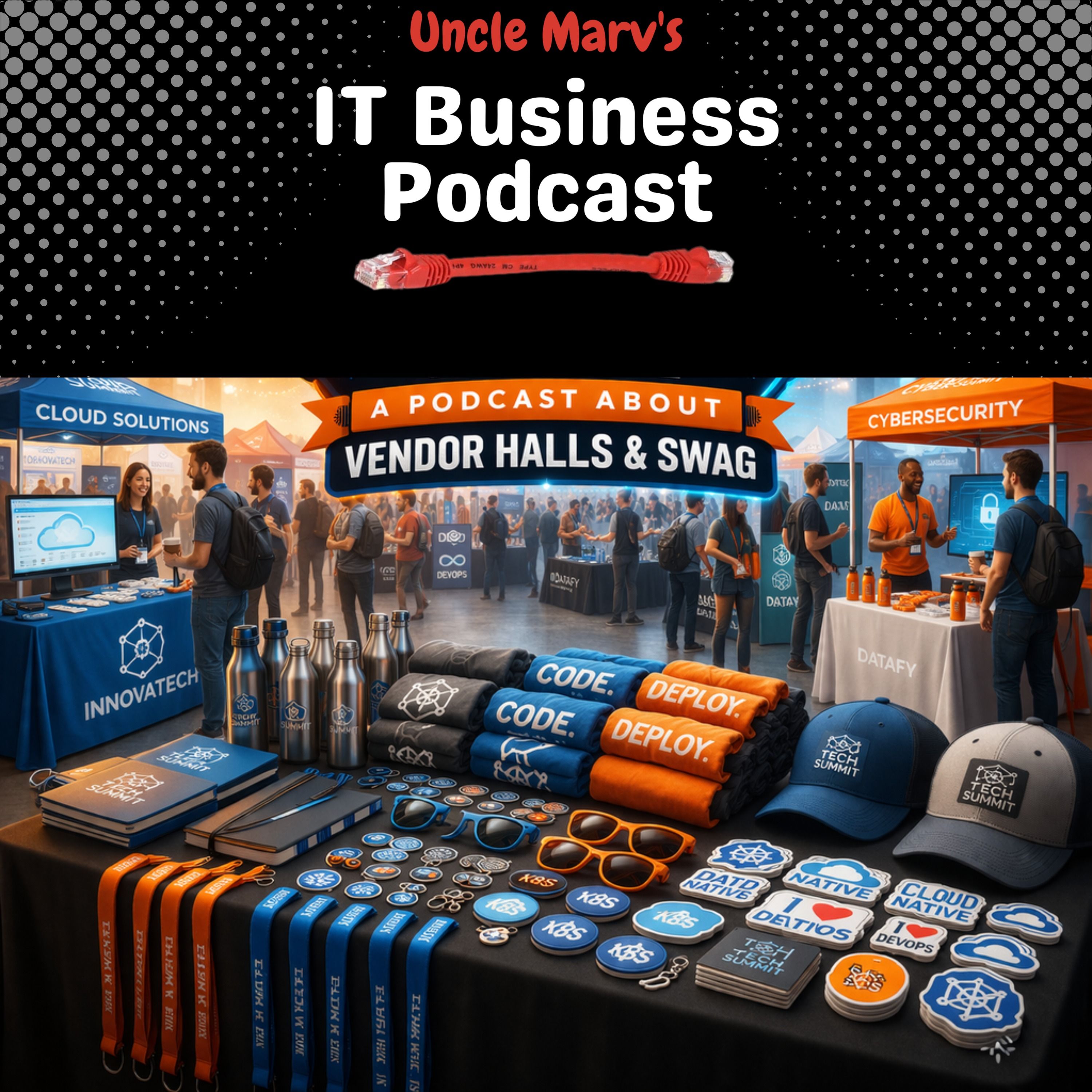
I walk through real‑world stories from my MSP, including how ThreatLocker helps me shift clients from “right of boom” to proactive, left‑of‑boom security thinking, and why guardrails matter when they start playing with AI agents and tools like Tailscale and Super Whisper. I share a conference recap from Channel Pro Defend and ThreatLocker’s Zero Trust World, dig into cyber insurance and MSP risk trends, and wrap with a practical look at swag, gear, and how we can make security both responsible and profitable for managed services providers and IT pros.
If you’ve ever had a client’s “other vendor” show up, hit a wall with your security tools, and then blame IT, this episode is for you. I share fresh stories from the field on using ThreatLocker to enforce guardrails, manage AI agents and VPN tools like Tailscale, and keep control of your 365 tenant and endpoints while still letting clients get work done. Then we shift into my recap of Channel Pro Defend and ThreatLocker’s Zero Trust World, talk cyber insurance requirements, hardened RMM and identity controls, and yes—take a fun detour into the best swag, socks, hats, and gear I picked up along the way.
Florida Man - ATM “jackpotting” mastermind: https://linkly.link/2eWRW
=== Chapters
- 01:37 MB Systems Updates & How ThreatLocker Changes the Security Conversation
- 11:02 Vendor Pushback, Client Guardrails, and AI/VPN Tools Under Zero Trust
- 18:23 Why These Conferences: ChannelPro Defend, Zero Trust World, and Travel Load
- 21:24 Zero Trust as the Default Security Model & From Theory to Execution
- 24:52 Building Your Stack Around Real Incidents, Labs, and Cyber Hero Training
- 28:14 ChannelPro Defend: Security, Profitability, and Bourbon Icebreaker Panel
- 31:16 Networking Wins, Quotes from Griffin IT & Bell Tech, and MSP–Vendor Mix
- 32:15 Swag Philosophy Shift: Food, Socks, Shirts, Hats, Pens, Tiles, and Mugs
- 44:48 Studio Plans, Episode 1,000 Milestone, and Supporting the Show
- 48:59 Florida Man ATM Jackpotting Story & Closing the Episode
=== Shout-Outs
- Danny Jenkins, ThreatLocker: https://www.linkedin.com/in/dannyjenkinscyber/
- Brian Weiss, iTech Solutions: https://www.linkedin.com/in/brianjweiss/
- Reagan Roney, SolvereOne: https://www.linkedin.com/in/reaganroney/
- Marissa Maldonado, Proda Technology: https://www.linkedin.com/in/marissamaldonadoproda/
- Frank Marino, Forthright Technology Partners: https://www.linkedin.com/in/frankmerino/
- Bradley Gross, Attorney: https://www.linkedin.com/in/bradleygross/
- Matthew Dwyer, Griffin IT: https://www.linkedin.com/in/matthew-dwyer-bb968b36/
- Ali Johnston, BelTech Services: https://www.linkedin.com/in/ali-johnston-a38a27220/
=== Companies / Vendors / Products Mentioned
- Super Whisper: https://superwhisper.com/
- Tailscale: https://tailscale.com
- Microsoft 365 (M365): https://www.microsoft.com/microsoft-365
- MSP Channel: https://msp-channel.com
- Acronis: https://www.acronis.com
- Channel Pro Defend (Channel Pro Network): https://events.channelpronetwork.com/in-person-events/
- Zero Trust World (ThreatLocker event): https://ztw.com/
- NinjaOne: https://www.ninjaone.com
- Zaun: https://zaun.ai
- Cork / Cork Cyber: https://www.corkinc.com
- Infima: https://www.infimasec.com
- Cavelo: https://www.cavelo.com/
- Monjur: https://monjur.com/
- Kipling Secure: https://kiplingsecure.ai/
- Kaseya: https://www.kaseya.com
- Life360 Tile Tracker: https://amzn.to/3NDYq91
- N-able: https://www.n-able.com
- MSP Process: https://mspprocess.com
=== SPONSORS:
- Livestream Partner, ThreatLocker: https://www.itbusinesspodcast.com/threatlocker
- Technology Partner, NetAlly: https://www.itbusinesspodcast.com/netally/
- Technology Partner: Bvoip: https://www.itbusinesspodcast.com/bvoip
- Travel Partner: TruGrid: https://www.itbusinesspodcast.com/trugrid
- Digital Partner, Designer Ready: http://itbusinesspodcast.com/designerready
=== SHOW MUSIC:
- Item Title: Upbeat & Fun Sports Rock Logo
- Item URL: https://elements.envato.com/upbeat-fun-sports-rock-logo-CSR3UET
- Author Username: AlexanderRufire
- Item License Code: 7X9F52DNML
=== Connect with Uncle Marv
🌐 Website: https://www.itbusinesspodcast.com/
🎙 Host: Marvin Bee
🛒 Uncle Marv’s Amazon Store (gear & tools I recommend): https://amzn.to/3EiyKoZ
☕ Support the show: https://ko-fi.com/itbusinesspodcast
If you found value in this episode, share it with another MSP, IT provider, or tech entrepreneur. Your support helps keep practical, no-nonsense IT business conversations coming every week.
Welcome to the IT Business Podcast, the go-to show for IT professionals and managed service providers who want to run their business better, smarter, and faster. Each week, Uncle Marv brings you real-world insights, proven strategies, and stories from industry experts, vendors, and fellow MSPs, all designed to help you stay ahead of the curve and thrive in today's tech landscape. So plug in, power up, and let's dive into another episode of the IT Business Podcast with your host, Uncle Marv.
Hello friends, Uncle Marv here with your weekly live stream of the IT Business Podcast, the show for IT professionals and managed service providers, where we help you run your business better, smarter, and faster. Welcome to the show, folks. This should be a short one tonight.
I do not have a guest, and I did that intentionally because I needed to bring you the conference recap and swag show, so we're going to talk about that tonight. Before we get to that, I want to share a couple of stories of what's going on with me and my business, because sometimes you guys like to know. You've asked me about it, so I'm going to tell you, and a couple of quick little news stories.
So first, about MB Systems, we are in the swing of things just like everybody else, so I've got a few weeks before I go to my next conference, and I'm actually going to tell a couple of stories that are going to help you understand why I went with ThreatLocker. Yes, they are the presenting sponsor of the live show each week, and I'd probably talk about them even if they weren't, so let's get that record straight. But one of the things that ThreatLocker does for me is it changes the conversation.
So of course, when you go in to talk with a customer about, you know, protecting them from threats and cyber-attacks and things like that, they just think that that's all stuff that's done easy. And of course, they're familiar with the antivirus and malware scans and stuff, and those are things that come in after the fact. And if you're talking, you know, left of boom or right of boom, most customers are used to right of boom thinking.
Now, when I start talking to my customers, I actually transition them to left of boom thinking, and I tell them, you know, think about this like your house. You know, you're going to, you know, turn your locks, lock your doors, shut your windows. You're going to get an alarm.
You might get a, you know, camera system for the house. You might live in a gated community. All of those things are done in prevention mode.
You don't wait until after somebody breaks in to do those things, although a lot of people do. But most people that are forward thinking, that's how they look at it. They do those things to prevent stuff from happening.
So that's how I've been presenting ThreatLocker and my security stack. And two times this week already that has happened, and the first time, real short, real quick, we all know the other vendor that comes into our client space and wants to do stuff without engaging us, telling us. Well, that happened with the camera guy at one of my clients.
They showed up on Monday to install some new cameras, and they needed to do an installation because one of the things that I did with them when we first moved into the space was, one, the system that they were using, they wanted to simply open up ports on the firewall so that they could do remote access and view the cameras. And I said, no, that's not going to happen. So we made them actually put a workstation inside the network without any open firewalls, and we made them install all of our software on it, our full stack, our remote management tool, endpoint protection, which included ThreatLocker.
And they were there trying to install some new software and kept getting blocked, and they were frustrated. And they called me with the customer, and once we told the customer, yeah, that's ThreatLocker, is he not clicking the button to request elevation or request permission? And they're like, oh, yes. And the client was, you know, not a problem.
It was the vendor that was the problem. And once they explained to him, that's the way it's going to be. So basically, it took him an extra couple of clicks, and we got the software installed.
Well, he got the software installed because all I had to do was look at the program, figure out what it was. I did not have to run it in the ThreatLocker sandbox. I already knew the program, so I just approved it, and they were on their way.
So easy-peasy. The second story, a little more complicated, and I haven't told a junior story in quite some time. This isn't exactly junior, but you can think of it as a junior.
A client called me up. Well, let me rephrase that. A client emailed me and had a set of instructions to create an email and to give this email API access in the 365 tenant.
And I said, oh, well, can you please tell me what you're doing with this? Oh, it's an AI agent, and I'm just going to hire them and do this, then that. The next email was, hey, I'm trying to install these programs, and your computer won't let me install. And I'm like, well, what are those programs? So they sent me the programs.
One I knew nothing about. It was called Super Whisper. Turns out that it's an AI dictation software.
And the second was Tailscale, which many of you know Tailscale. Many of you use Tailscale. But I was not about to let a customer put this on without having that discussion.
And basically, that was how I framed the next email that I sent him is, we need to have a chat. I need to understand what it is you're doing, why you're doing it, and why are we setting up a VPN? Where are you trying to get to that you need a VPN? Because if you need extra security, then we need to talk about that. So this is a client that has been with me for quite some time.
I'm probably guessing somewhere between 15 and 20 years. He actually was next door to one of my other clients. They referred me to him.
He had about 10 people in the office at the time. He has since downscaled. It is just him, technically.
Although he has a person out of Texas that he works with, but he gave that person an email on his system. And now his sons are working with him. And turns out his son is the one who convinced him that he should start using AI agents.
And that's where the junior comes in. Because now, oh, I see, your son is all about IT, so you're going to just listen to him and do whatever he wants. So we have the call, we have the conversation, and I explained to him, I have no problem with doing a lot of this stuff as long as we have the guardrails and protections in place.
The software, if you remember, we put that in for a reason, because we don't want things to get installed without both you and I knowing what's installed. He understood, and he was fine. So we went through the whole exercise.
And by the way, he needed tail scale to get to a Mac mini machine that they had put in his office that was going to actually run these AI agents. And the only way to do the connection was through tail scale, even though the machine is sitting on a desk on the other side of his office. I said, okay, that's fine.
We'll figure it out. But it led us to go through his computer. I showed him because apparently this computer, he's had this computer for probably two years.
And I put ThreatLocker on maybe a year ago. And so as we were going through and showing him again how when a problem comes up and a program doesn't run, how we can, you know, click on the ThreatLocker and request permission, request elevation, all of that. We then went through his software.
And he had a couple of programs that he didn't recognize. I had heard of them before. And I just basically was like, he had three different PDF programs on, one of which was Soda PDF.
And I just asked him, I said, Where did that come from? He's like, oh, I don't know. I said, are you sure? Because that has to be installed. That's not something that just shows up.
And he's like, I don't know. Can you get rid of it? So we had the conversation where, okay, this was put on before I had the ThreatLocker on. And going forward, nothing like this is going to be able to happen because ThreatLocker is going to block it unless it is on a pre-approved list.
So that's one of the things in two instances that basically ThreatLocker allows to happen is it allows for that conversation. And I think as long as you frame it in the proper manner, most customers are going to be okay. Now there's some.
I have AJ who just is frustrated as heck because he cannot install what he wants, when he wants. And I just have to remind him, AJ, that's not his name. I can't install stuff either unless I give myself permission.
So we have those discussions. So that's my commercial for our good friends over at ThreatLocker. Another thing that happened is I order product from Amazon unless it's for our business or our home.
I don't order stuff for clients through Amazon. I still go through the disties unless it is just simply not available. And with the high price of memory, it turns out that a computer that I wanted to upgrade, I actually had the computer here in stock, but instead of 16 gigs, I wanted 32 for this customer.
And when I went to go look at memory prices, holy cow, you've seen the prices. You know that they're high. It was actually cheaper for me in the long run.
Not exactly, but it was just as much for me to order a computer off Amazon than it was to order a single stick of RAM. So I did that. And we got the tracking from Amazon, and then we got a notice that it was delayed, and then we got a notice of a refund, but yet the tracking still moved forward.
And so for three days, we kept getting updates on the tracking, and I thought, okay, certainly they're not sending us a computer that they've already refunded. So it showed up today, and this is the package that I got. As you can see, if you're watching the video, this is not the size of a computer package.
And for those of you that are listening by audio, we're talking about basically a four by six size envelope. And in that envelope was this letter. Now, mind you, this was shipped UPS.
And in the letter it says, Dear Customer, we are sorry to inform you that your order was canceled by us because the product you ordered was out of stock. We sincerely apologize that this issue was found after the shipping label was prepared. At this moment, the full refund has been issued to your original payment card, and please allow three to five days for the refund to be reflected on your bank account.
Once again, please accept our sincere apologies for the inconvenience this order caused, and kindly send us an email to email address if you have questions. Best regards, Best regards, Customer Service Department. Again, so they made the label, stuck it on an envelope, put a letter in here, and shipped what it cost to ship this four by six envelope, which by the way, I don't know if you can see this, it still says 15 pounds.
So they actually did use the label that would have been for the computer to send something that was supposed to be 15 pounds with a dimension of 19 by 16 by nine to send me a letter. Hope you're having that kind of fun as well. So, that is that.
Let's see, I've got a couple of new to tend to, if you've, if you by any chance are caught up on the shows, then you know I just did a show yesterday about cyber insurance. This falls right in line. MSP Channel, which is a internet news site, analyzes how cyber insurers are tightening requirements around RMM, MDM, and identity security, making hardened MS pool, can't read, can I, making hardened MSP tooling a prerequisite for coverage.
Using recent breaches as examples, it highlights mandatory controls like enforced MFA on RMM, no exposed RDP, granular RBAC, and multi-person approvals for high impact actions. This was a story that was released yesterday at msp-channel.com. I will have the link so you can read the full story yourself. I'm just giving you the quick highlights.
And then there is another story from our friends over at Acronis. The title of the story, what is an MSP in 2026? Why basic IT is a 4.88 million dollar liability. And to sum up what they have here, Acronis argues that traditional basic IT support is no longer viable as ransomware and credential abuse drives up breach costs, pushing MSPs to become security first providers.
This article blends market data with prescriptive guidance on modern MSP services, including continuous monitoring, integrated backup, and advanced protection. So we are going to hear a lot more about these things ramping up in 2026. We thought the last couple of years were bad.
It's going to get worse. So all right, we are going to continue on with the show and talk about the conference recap and swag right after this message. Is your business truly protected from cyber threats? ThreatLocker is the gold standard.
Zero trust endpoint protection, trusted by IT professionals everywhere. ThreatLocker blocks everything that is not explicitly trusted, denying all applications and scripts from running unless explicitly allowed, and also includes ransomware. Easy to deploy, easy to manage, and backed by a 24-7 support team that is lightning fast with response times around 60 seconds.
Stop cyber-attacks before they start and sleep easier at night. Lock down your endpoints and say goodbye to ransomware. Click on the ThreatLocker link in the show notes and start your free 30-day trial today.
Be sure to also check out our other amazing sponsors, NetAlly, whose handheld network test and analysis tools give IT pros fast, easy visibility into wired and Wi-Fi networks so they can quickly find and fix problems. OneStream, a unified communication and integration platform that centralizes voice, messaging, and contact center tools for MSPs with deep CRM and PSA integrations and automation. And TruGrid, your secure remote access platform designed to simplify delivering remote workspaces without VPNs or exposed firewalls.
For more details on these partners, check out their links in the show notes. Okay, I know that I told everyone that there was a period between February and March where I did three conferences in four weeks. What I also did not mention is that one of those weeks that I did not attend a conference, I actually still made the trip.
So two of the conferences were in Orlando. So those were the Channel Pro Defend and Zero Trust World presented by our friends over at ThreatLocker. The client trip that I had to make was in Lakeland.
So no, it is not Orlando, but it is in between Orlando and Tampa. So those were my three trips that I made during those four weeks. So I just want to give a little bit of a recap.
I know I did a very quick recap on the IT slash MSP slash AI slash telecommunication conference that was here in Fort Lauderdale. But I did not talk yet about Channel Pro Defend and ThreatLocker, Zero Trust World. So the Channel Pro Defend was held in February.
That was the February 17th and 18th. It was at the Hilton Orlando in Altamont Springs, hosted by our good friends at the Channel Pro Network. And the focus of that conference, cybersecurity, business growth, incident response, legal risk, AI automation, and profitable service design for MSP.
So very good conference, well-rounded, hit all the spots and stuff. Zero Trust World was held March 4th through the 6th. And that was at the Rosen Shingle Creek Resort in Orlando, Florida.
Again, hosted by our good friends at ThreatLocker. And the focus was on Zero Trust as a practical control strategy. At that conference, you got hands-on cyber defense labs and MSP-centric security execution.
So the first question that usually comes up and has been a big question of late is, why do you go to the conferences that you go to? And we know that there are tons and tons of conferences. Almost, well, not almost, too many conferences is basically the bottom line. There's no way that any one person can attend all of the conferences.
I myself scale back. I'm trying to attend 10 only. It used to be that it was one conference or more per month.
That's too much for me. Too much travel and too much time away from work and home. But both of these conferences, if you had to choose, I think are good conferences to pick.
Both conferences frame Zero Trust as the default model for today's MSP security practice. It's not a futuristic ideal, not something we're striving for. These are things that we need to be doing now.
Both conferences shared a strong bias toward practical content. There was a lot of war stories, demos, labs, frameworks, real-world playbooks. And listen, a lot of conferences, yes, you sit in sessions and people are on stage.
There's nice panels and stuff. Both of these had some really good sessions. And most people, most people, I think, would say they went away with some very good practical knowledge stuff that they would implement pretty much right away.
Going to, or basically from theory to execution is probably the biggest thing that comes to mind. Cybersecurity has moved beyond theory. So let me try to scrooge through some notes here.
Let me see what I want to talk about. So ThreatLocker actually did a couple of great things. So of course they had product and product announcement, not that it was any big secret, is they've got this new Zero Trust network access, so ZTNA slash cloud access.
They introduced features that are designed to move customers away from the traditional VPN model toward a more granular identity-centric access. So these are basically designed to help us with credential-based lateral movement. They also talked about some announcements zeroed in on account takeover, mailbox compromise.
Danny Jenkins, the big quote that I remember for him saying is, bottom line, if you've got a customer who keeps getting phished and someone's getting in the mailbox, this solves their problem. It's highly probable that somebody is going to get into their account. So they did several lab topics there.
They showed Windows and Active Directory exploitation, SQL injection, malicious USB stuff, quotes rubber ducky. They had, and I don't know how many people they did this with, but they actually brought on stage some people. Each person had five minutes to show an attack and show how quickly that could happen in real time.
I think all of them were successful except for one, and I think just because they ran out of time and had issues with the computer connecting to the display. So we had that. But what it does is it showed us a way to understand not only how attacks work, but also how to detect them and stop them in real environments.
So it wasn't something where they just showed screen images and PowerPoint presentations. These were computers connected to the network in real time. Let's see here.
So both conferences also considered the idea of having us build stack and services around real world problems. So, you know, ThreatLocker basically as their own example, their platform evolution aimed at starting from specific MSP pain points like ransomware, app control, remote access, and now they're building on all of these targeted controls. So they've added the EDR, they've added the user store, they're adding the ZTNA, all of these things that they're kind of building around based on what they're seeing out in the real world.
The advice that was given is to basically make a list of your incidents that happened at your clients in the last year and design your stack and processes to solve those problems instead of just chasing what's new every year. So instead of doing that shiny object syndrome, you know, look at what you're actually dealing with and build your stack around that. ThreatLocker, of course, continued with the Cyber Hero certification courses.
They could earn a certification, which would reinforce skill building as part of adopting Zero Trust. Let's see, here's a quote by Reagan Roney, who is the chief experience officer at SolverOne. Also a ThreatLocker board member said that what I love about Zero Trust world is that it brings both sides together.
Omniscience can continue to learn and grow within the platform and those of us who have to sell it learn more about the products and what's coming next. Staying with ThreatLocker, you probably by now have seen or heard my interview with Brian Weiss, CEO and chief AI officer of iTech Solutions. He's also a ThreatLocker board member.
What I enjoy about this event is I don't come here feeling like I'm being sold ThreatLocker. Now, I know he said that he's all in on ThreatLocker, but I get what he's saying. He continues a lot of the good technical content, talks about the threats we're seeing in the landscape and how you might mitigate them.
Even someone who doesn't use ThreatLocker can come to this event and walk away learning quite a bit. And that was something that I saw. So this year, different than the previous years that I've attended ThreatLocker, I believe this was the first year where there were probably more system admins, IT pros that were not MSPs.
Now granted, there were still a lot of MSPs there, but it certainly felt like there were a lot more outside of our space. And that just shows ThreatLocker's reach. And yes, it doesn't make it an MSP-only product, but listen, cybersecurity does not care.
So it was good to see some of those people coming there. They actually were engaging MSPs with how we do things. And it was actually a good mix.
I'm going to skip a lot of these notes because I wanted to keep this short. Let me say this about Channel Pro Defend. One of the things that I think was different about that is that while it was a deep dive into cybersecurity's growth, and they talked about strengthening our security options, they really talked more about sharpening operations and uncovering new revenue streams.
It was about how to make security both responsible and profitable rather than a cost center. So a lot of us that look at our stack, and it's how can we roll this up into our prices? It's more of how can we add this on as a revenue generator? One of the things that was interesting about the Channel Pro Defend program is that I believe it was the first session, it was called the Bourbon Icebreaker. And it had Marissa Maldonado, Frank Marino, and our good friend Bradley Gross.
They sat up on a panel, but it was a little different. It was a little laid back panel. They had a real world discussion on choosing security tools, alignment with stack.
They actually talked about budget reality, which is something that doesn't happen a lot. Integration and client value. There was a big discussion on why tool sprawl hurts margins, and of course, hurts our clarity in what we're doing for their clients.
So there was some good discussion there. See, I'm going to skip that. Both of these programs also talked about the fact that we are now the first line of defense.
So I think Channel Pro probably did it a little better than Zero Trust World, but it focused on attractive targets and provided steps to harden our own accounts, our internal systems. Yes, ThreatLocker does that if we adopted ourselves, but Channel Pro actually had more discussions on that because they just simply acknowledged more the fact that MSPs are under attack. We've got so much information that is in our stack, in our RMMs, that we need to find a way to rally and harden our own stuff.
Security frameworks, blah, blah, blah, legal sales, business maturity, all of that stuff. I do want to... Oh, here's my... I did want to do this. I'm doing a bunch of shout outs, as you can see with what I remember from the show.
The Channel Pro Defend had a networking friendly design. Matthew Dwyer, sales executive with Griffin IT, I actually spoke with them. And this will be your first look at Swag.
They have their Griffey. And I'll be honest, I don't know what movie this is from or what this is supposed to represent. All I know is that it's a stuffed animal that doesn't exactly always stay upright because of the big head, but I'll figure that out.
So there's your Swag item from Griffin IT. And I believe we're going to be having them on the show soon. But Matthew Dwyer said, it's great.
I love the way it's built because Channel Pro incentivizes the MSPs to not be so shy and come and talk to you. Since everything's been essentially taken care of, the MSPs haven't put much risk into it. It incentivizes them to come and talk to the people who brought them here.
So that was good. And then on the other side, my good friend Allie Johnston, CEO of Bell Tech Services in my hometown of Satellite Beach said, I love seeing that there are so many different vendors around here that I haven't seen before. I'm actually excited to go walk around and meet them.
That's where it's at. Let's see. And that's probably about it.
I mean, I can talk more about stuff and go anything, but you get the idea. These were both good conferences. Channel Pro Defend.
Channel Pro Defend, by the way, is actually going to be in other cities around the country. So it might be called something different in those cities, but Channel Pro is doing that. So I'll have a link over to their page so you can go and see which one is coming up near you.
You can sign up. And then Zero Trust World has already been slated for next February this time. So I'll have the dates for that as well.
And you can come to Florida and have a good time. So when it comes to SWAG, first thing I need to say is I've had a little bit of change of heart on how I view SWAG. If you watched the show last week, I talked to you about MSP Process and their chips and how I'm kind of moving away from my food isn't SWAG perspective, because apparently if you've got a highly sought after piece of food, it must be SWAG because that's what happens with everything else.
Things become highly sought after. One of the things I've also changed my opinion on is socks. I used to think, come on, how can socks be SWAG? But there were a couple of socks previously that I thought, okay, I could wear these.
And at first they were going to be cabin socks. But then I found socks that kind of fit my style. And one of which I'm going to show here, these quarter length socks.
I don't like the knee high thingies, but these quarter length socks are just right for my style of shoe and boot. Ninja One is the company that provided these socks. The tag is still on, yes.
And another thing is apparently the memo was out that if you get socks from the sock club, they're nice. They're not too thick, not too thin. And they've got a little bit of reinforcement on the toes, probably not going to last too long.
A little bit stretchy. So Ninja One is being added to the personal sock collection. Staying on the garment side.
Oh, let me do this first. Two shirts that are going to be going up into the rafters. And I'm actually going to show you pictures instead of holding them up because I always have a hard time holding up shirts and stuff.
But this is a shirt from a company called Zaun. It is Zaun.ai. It is a cybersecurity company and not one that you would know because this actually came from the MSP Expo here in Fort Lauderdale. So the front of the shirt just has a little nice pocket logo on.
It is a champion shirt which has the customary logo on the side. And on the back is this weird little dragon design. Now, that's what kind of caught my attention because again, if you're going to wear a shirt, it's got to catch your attention but not be too flashy.
The second thing that caught my attention that you can't see in this picture is that this is a heavier shirt. Most of the time, I don't like heavy shirts. But this shirt is, it's thicker than that, you know, 50-50 heavy weight shirt that Hanes used to do.
This is a shirt that could be worn over another shirt in the Florida winter. So there are those days here that, and people, you know it if you were down here, that it gets into the 60s and 50s. And for us, that's cold.
And I don't want to have to pull out a full-blown jacket or coat. But I may want to throw over one of these shirts. So I actually, this is how you know it's good.
I actually got an oversized one for me. So I might be wearing this shirt out in another shirt that will be going up. You can't see the logo on the front of that shirt, but it has our good friends over at Cork.
And they've got their back click happens, Cork Cyber. So two shirts will be going up into the rafters here. And then I'm showing you this picture only to let you know, some of you have not been to the office, you've not seen the pictures.
I have a hat wall that I started. And as you can see some of the hats there. So I will be adding hats to the hat wall.
And I'll go through some of these here, not in any particular order. But of course, there is the Cork Cyber hat. I just, I like the simplicity of the design there.
There's our Infima hat with the Boy Scout sign and the nice little pink logo. Our good friends over Cabello has a nice hat here. And our friends over at Monger has their hat.
And I'll tell you this, Rob actually made it a point to try to impress upon me how great this hat was because it apparently is a Fury Athletics. And this is a wick resistant or like a dry fit material, but for hats and it's supposed to do whatever I don't. I mean, it feels nice, but the hat that I'm actually going to highlight the most is this hat by Kipling Secure, AI driven security.
And yes, it looks like a nice little subtle hat. The difference is it's not as big and bulky as these other hats. These are those, you know, those huge baseball hats, but this has got the nice little softness to it.
To where I put it on it, it kind of fits the head nice. And if I wore hats, I'd wear something like this. So if you're watching the video here, you can see I have it on.
Yes, it's over the earhead. But yeah, I like it. I like the fit.
I like the mold of the brim and softness of the hat. So good job by our friends over at Kipling Secure. Again, not a vendor that you would recognize and know.
Let's see. Pins. I got to give for ingenuity.
This company called Big Tail. So I know I should have taken a picture of this. You're not going to be able to see this pretty good.
This is not just a pin. It also has a ruler along the side. It's got a straight edge.
And on one side, it's got inches. On the other side, it's got centimeters. And it also has a level in there as well that you can stick this on something and see if something is level or not.
Now, mostly we're computer people. The only time we're going to see if things are level is if we're putting up racks or something in a server closet. But this was a nice little attempt.
I mean, it doesn't write very well. It doesn't click like I like pins to click. You have to twist it.
I don't like that. But good effort for the pin there. The pin that I did like the most, actually, a very simple design, Infotech.
It's a little thinner than I normally do. But it is the click pin with the knob at the top. And this was the smoothest writing pin of all the pins that I tested.
Remember, it's not always about the feel and the weight and the clicks. It's also how does it write. And I hope that this pin writes for a very long time because I like the smoothness of the ink when it comes out.
Now, this is a two-part because I first want to say Cabello provided this tag. Although it's not, I don't think it's an Air Tag or whatever. It's a different company, but they had that.
But I just want to mention them to then get you to this. Kaseya, our good friends at Kaseya also have an Air Tag. This one, though, is not by Apple.
It is a tile. And the reason this caught my attention is I actually purchased my own tile tag, oh, I don't know, about a year ago. And I stuck it inside of my go bag with my NetAlly tools because with the cost of those tools, I did not ever want to risk leaving them anywhere.
So I got a tile tag. Kaseya, this is tile. So I literally just added it to my account, and I wish I had gone back to get more.
And yeah, you heard me say that about Kaseya. And I think this is the last swag item. Your simple cup, your travel mug, and these are from our good friends at Enable.
And not that it's anything magnificent, but here's one of the things that I'm liking. The size of the lid is perfect, because it's a little bit smaller than what I've been doing. And why you've heard me, I don't want to say trashing mugs, is that a lot of them come with these little sippy cup tops, where they actually don't have a lid that closes.
Or they might come with a flimsy plastic one. What I've been doing is I've been just simply purchasing these Yeti libs and replacing the sippy cup lids. Now, Enable did not have a sippy cup lid.
It had an actual plastic lid. But it fits perfectly the Yeti lid. And that's what I want.
I am so happy with any mug that has the same size opening, where I can replace the lid with the Yeti one, and it actually makes these mugs. So some of these mugs, when you actually get down to it, they actually have good insulation. They're actually good for hot or cold.
But the lid is where it fails. So all I have to do is upgrade the lid, and we're good to go. So for a lot of the vendors that are so upset, where they think they have to get the Yeti mug, and they're so expensive.
No, you don't. Just get the right style mug. I can put my own Yeti lid on it, and we're all good to go.
So yahoo. All right. That is it for swag.
I showed you the Griffey. Oh, and by the way, I'm probably going to be redoing my shelves here. I've already put a call in to the brother-in-law, and what we've got to do is we're going to have to cut out these little slats and then get a board to go across so I can put more stuff on there.
And then more of this swag can sit behind me. And then of course, I'm going to redo the studio so you can see more. We'll figure it out.
But it won't be anytime soon. But that's something we'll probably work on probably sometime this summer. Right now, I've got client projects.
And if some of you have not been keeping track, we are... This is going to be, I believe, episode 981 or 982. We are getting close to 1,000 episodes. Now, they all have not been the IT Business Podcast.
Yeah, this will be 982. This show started out as a program called Podnutz Pro. I was not the original host, but I took over at show number 81 with some co-hosts, and those have gone on to do bigger and better things.
And I rebranded to the IT Business Podcast, but I kept the same numbering. And at some point in the future, we are going to be doing something special, I just don't know what it is, to celebrate 1,000 shows. I hope you will join me.
It's going to be, I don't know, probably the same type of deal as a holiday party, of course, with a little bit more significance, because even I did not think I would get to 1,000 episodes. So thank you guys very much for continuing to watch, listen, and lie to me about how good a job I'm doing. All right, with that, let us... Oh, I should tell you this.
I should have done it after the commercials. One of the things that I have been bad at, you know, is to invite you to support the show. And the easy way to do that is at the end of every show notes and on the support page on the website, there is a place where you can go to Ko-Fi and do a donation there.
There's actually a little picture of a coffee mug on the website where you can buy me a coffee. You can do that as well. Either way, you can do a one-time donation or you can do a monthly subscription, which is what our friends that I acknowledge, you know, almost every episode, Jason, Tom, and Grant, do provide monthly donations to help support the show.
I thank you very much for doing that. And then, of course, what I would love for everybody to do is when you shop Amazon, click on the link on the website as your starting point, save that as your starting Amazon link. I am going to do better at some point with updating the homepage that shows you tools that I use, products that I use, products that other listeners use, things that you would find helpful if you were to go look for something.
And that's anything from cables to tools to NetAlly tools that I talk about. I just did a show on this little product here, which is the newest in the NetAlly family. This is the 1500.
Let me throw the... Yeah, there we go. There's the QR code for that. If you're watching live, just click on that link and that'll take you right there.
This comes in at $14.95. Actually, it's less on Amazon. If you need a starter tester tool that will validate network connection and then do basic testing of cables, whether they're patch cables or cables in the wall to the patch panel, this will do it. It's a pretty good starter kit to get started with.
But use the Amazon link to shop on Amazon. You shop as you normally do. You don't have to pay more or anything else.
Amazon gives me a little bit of commission on the back end, somewhere between 1% and 3%. So it's not a lot, but it does add up. So put a note on there to remind me to do that.
And we are going to end tonight with the Florida man story. And I've not done a Florida man story in quite some time, but I wanted to do this one. And I have another one that I'm actually going to end up doing an entire episode on because you will not believe that story when I tell you.
But tonight, let's see. A more sophisticated Florida man made news in a federal courtroom. So prosecutors say a Miami-based man led a crew that specialized in ATM jackpotting, which is a type of cyber-enabled hype where criminals infect ATMs with malware or specialized devices to force them to spit out cash on command.
So instead of the crude smash-and-grab tactics, they allegedly targeted the machine's software and security vulnerabilities, allowing them to drain more than $2.6 million from financial institutions across multiple states. The operation reportedly involved coordinated trips to the bank, late-night withdrawals, and careful attempts to avoid detection while the machines distorted money much more than the normal transaction amount. So there was a ringleader here from the state of Florida.
He pled guilty to conspiracy, bank larceny, and accessing a protected computer in furtherance of fraud. So that plea ties him directly to a broader multi-state scheme that required technical knowledge, planning, and logistical support. Let's see.
Authorities have highlighted the case as an example of how traditional bank theft has evolved. Instead of masked robbers storming a branch, you have small teams with laptops and custom hardware quietly coaxing ATMs into jackpots. Now, for all the jokes about Florida Man, this one underscores a serious trend.
Financial crime that straddles the line between street-level theft and full-on cybercrime. So that story was first released March 22nd with a press release updated on the 23rd. I will have a full link to that, and you can follow the adventures of Florida Man.
And Michael Matthews, thank you for saying hello there. Yes, we did see each other at Zero Trust World. Thank you for joining me here tonight from over on the LinkedIn.
That is going to do it, folks, for this episode of the show. Thank you. I will be back.
Let's see. I think I've got two or three audio episodes that will be released. And then next week, I have a live guest.
I just want to confirm. I'm not going to tell you who it is. I don't want to jinx it.
So I believe for all of April, we are booked with guests for the live show. So it should be a great little show, a great little month for us here. Again, that's it.
Thank you very much for checking us out. We'll be back soon. Remember to go out there and keep your margins high and your clients happy.
We'll talk to you later. Holla.