
 Apple Podcasts
 PocketCasts
 Overcast
 Spotify
 Podcast Addict
 Amazon Music
 iHeartRadio
 PlayerFM
 TuneIn
 Audible
 Castbox
 Podchaser
 Goodpods
 Pandora
 Audacy
 Deezer
 Spreaker
 Stop Losing Money On Clients (EP 998)
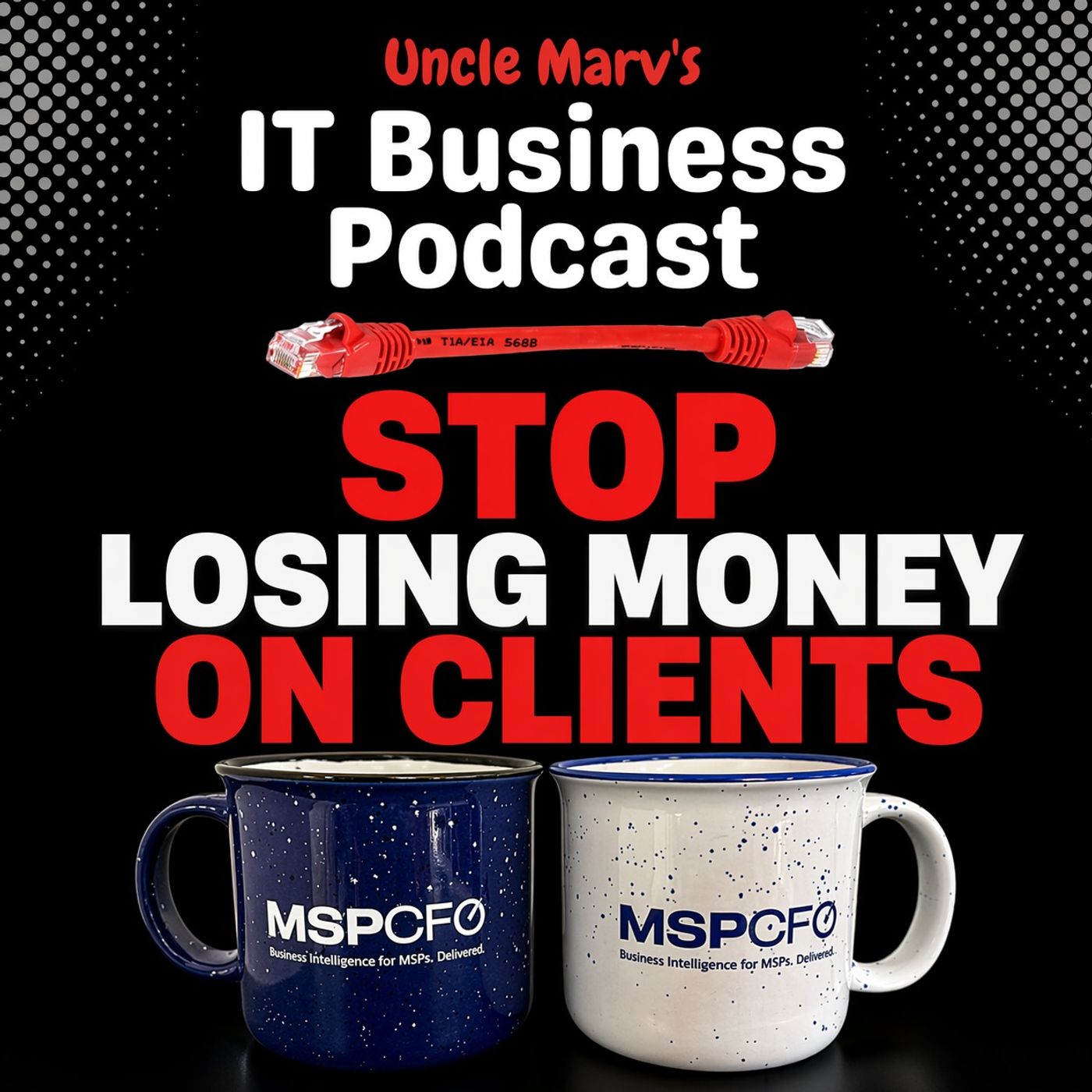
A candid conversation with Larry Cobrin from MSPCFO on what your PSA is really telling you about client profitability, contribution per hour, and which customers you should probably fix or fire. We also dig into AI, private equity expectations, and why bad data can still wreck your decisions even with the best tools.
I sat down with Larry Cobrin, founder and CEO of MSPCFO, to unpack how MSPs can turn messy PSA data into a clear picture of which clients are actually profitable and which ones are quietly draining the business. Larry broke down the idea of treating clients like a portfolio, normalizing profitability with contribution per hour, and using that lens to decide whether to improve, protect, or let go of certain accounts.
We also talked about how this ties directly into EBITDA and exit planning, especially as more private equity money flows into the MSP space and buyers expect real, reliable reporting instead of gut feel. I shared my own story about firing my largest client when the time and revenue just didn’t line up, and we connected that experience back to the numbers Larry sees every day inside MSPCFO. From there we shifted into AI, the risks of “DIY analytics,” and why confident answers from dirty PSA data can be more dangerous than having no data at all.
Florida Man Working as a Ransomware Deploys Ransomware and Extorts U.S. Victims https://linkly.link/2hlAQ
Chapters
- 00:30 Welcome to the IT Business Podcast
- 00:59 Beyond the Buzzwords
- 04:53 Shout Outs and Announcements
- 06:38 Introducing Larry Coburn
- 08:24 Understanding Client Profitability
- 12:57 Contribution Per Hour Explained
- 17:09 Internet Issues and Client Stories
- 23:38 Florida Man Story
- 27:30 Returning to Larry Coburn
- 34:53 The Value of Client Portfolios
- 38:23 AI and MSP Profitability
- 43:35 Larry's Journey to MSP CFO
- 50:24 Upcoming Events and Appearances
- 53:29 Closing Thoughts and Thanks
Guest: Larry Cobrin, MSPCFO
- Website: https://www.mspcfo.com
- LinkedIn: https://www.linkedin.com/in/larry-cobrin/
Shout-out
- Jason Miller: https://www.linkedin.com/in/jason-miller-32a03530/
- Kyle Kenyon: https://www.linkedin.com/in/kkenyonprotechguy/
- Tom Wyant: https://www.linkedin.com/in/thomaswyant/
- Mike Smith, Mike Tech Show: https://www.linkedin.com/in/smithmh/
- Martin Obando: https://www.linkedin.com/in/mobando/
- Amy Babinchak: https://www.linkedin.com/in/amybabinchak/
Companies / Vendors / Products Mentioned
- MSP Unplugged: https://www.facebook.com/groups/mspunplugged
- Nerdio: https://getnerdio.com
- Vultr: https://www.vultr.com
- Mike Tech Show: https://mikenation.net/
=== SPONSORS:
- Livestream Partner, ThreatLocker: https://www.itbusinesspodcast.com/threatlocker
- Technology Partner, NetAlly: https://www.itbusinesspodcast.com/netally/
- Technology Partner: Bvoip: https://www.itbusinesspodcast.com/bvoip
- Travel Partner: TruGrid: https://www.itbusinesspodcast.com/trugrid
- Digital Partner, Designer Ready: http://itbusinesspodcast.com/designerready
=== SHOW MUSIC:
- Item Title: Upbeat & Fun Sports Rock Logo
- Item URL: https://elements.envato.com/upbeat-fun-sports-rock-logo-CSR3UET
- Author Username: AlexanderRufire
- Item License Code: 7X9F52DNML
=== Connect with Uncle Marv
🌐 Website: https://www.itbusinesspodcast.com/
🎙 Host: Marvin Bee
🛒 Uncle Marv’s Amazon Store (gear & tools I recommend): https://amzn.to/3EiyKoZ
☕ Support the show: https://ko-fi.com/itbusinesspodcast
If you found value in this episode, share it with another MSP, IT provider, or tech entrepreneur. Your support helps keep practical, no-nonsense IT business conversations coming every week.
(0:11 - 0:44)
Welcome to the IT Business Podcast, the go-to show for IT professionals and managed service providers who want to run their business better, smarter, and faster. Each week, Uncle Marv brings you real-world insights, proven strategies, and stories from industry experts, vendors, and fellow MSPs, all designed to help you stay ahead of the curve and thrive in today's tech landscape. So plug in, power up, and let's dive into another episode of the IT Business Podcast with your host, Uncle Marv.
(0:51 - 2:46)
Hello friends, Uncle Marv here with another episode of the IT Business Podcast, your show for IT business owners, tech professionals, service providers, managed service providers, whatever you call yourself. We do this every Wednesday evening. This show is presented by our good friends at ThreatLocker, and we try to help you run your business better, smarter, and faster.
So tonight, folks, we are going to go beyond the buzzwords. We're talking about two things every MSP owner is thinking about, but most are not actually using to their advantage, the numbers hiding in your client portfolio, and the real-world power of AI inside your business. My guest, Larry Coburn, is sitting in the green room waiting for us.
So if you ever wondered which of my clients are truly worth it, he's going to let us know about it. So that is going to be our show tonight. I want to start off by doing a couple of shout outs.
I want to give a shout out to some people over at the MS Unplugged Facebook group. So I had to put a question in their group about virtual desktops. We've got a client that we're actually going to move one of their line of business applications to the cloud there, and our good friends Jason Miller, Kyle Kenyon, Tom Wyant, and others actually gave me some nice suggestions.
So I reached out to some people over at Nerdio and Vulture, and we're going to see about putting those servers or that workstation. It's one workstation, but it's going to be a shared desktop, and we're going to talk about putting that in the cloud. If you guys have any suggestions that you want to give me, let me know.
(2:46 - 8:00)
I haven't scheduled anything yet. I reached out to both, and Nerdio wasn't available until Monday. Vulture I did have scheduled, but then the person canceled on me and asked me if I was available Friday.
So I just sent him my calendar link, and we shall see what happens. I also need to give a little shout out to Mike Smith. Some of you might know him as Mike from the Mike Tech Show.
He and I are working on a project for one of his clients, helping him with the phone system, and then he reached out for some other stuff, and hopefully I'll be able to talk about that soon. The other things that I want to mention, of course, coming up this Sunday, 4 p.m. Eastern, my 1000th show, and it is going to be live on a Sunday. So hopefully some of you will be able to join us and hang out with that.
I'll be honest, folks, I don't know what's going to happen. I've got some thoughts in my head. Hopefully we'll be able to plan some things, but things don't always go as they plan, and I made the mistake of asking somebody to do something, and I don't know what they are doing, and I might not like it.
So we'll see how that goes. And then I do have the original co-host. When the show came back in 2016, show number 81, The Boys Are Back in Town, was the name of the podcast episode, and it was Martin Obando and Matt Rainey and me, the Eminem and Em show, and the three of us co-hosted for a while.
So I'm bringing them back, and we're going to hear how they're doing, talk about some things, and maybe share an adult beverage on a Sunday. We'll see what happens there. Let's see what else is going on.
Checking out some stuff here. I think that is going to do it for the opening segment there. I've tapped everything here.
Let's go ahead and listen to our sponsors, and then we'll be right back with our guest. Is your business truly protected from cyber threats? ThreatLocker is the gold standard. Zero-trust endpoint protection, trusted by IT professionals everywhere.
ThreatLocker blocks everything that is not explicitly trusted, denying all applications and scripts from running unless explicitly allowed, and also includes ransomware. Easy to deploy, easy to manage, and backed by a 24-7 support team that is lightning fast with response times around 60 seconds. Stop cyber attacks before they start and sleep easier at night.
Lock down your endpoints and say goodbye to ransomware. Click on the ThreatLocker link in the show notes and start your free 30-day trial today. Be sure to also check out our other amazing sponsors, NetAlley, whose handheld network test and analysis tools give IT pros fast, easy visibility into wired and Wi-Fi networks so they can quickly find and fix problems.
OneStream, a unified communication and integration platform that centralizes voice, messaging, and contact center tools for MSPs with deep CRM and PSA integrations and automation. And TrueGrid, your secure remote access platform designed to simplify delivering remote workspaces without VPNs or exposed firewalls. For more details on these partners, check out their links in the show notes.
All right, we are back. My guest tonight is someone who lives at the intersection of MSP operations, financial reality, and data-driven strategy. Larry Coburn is the founder and CEO of MSPCFO, a platform that takes the mess of our data in your PSA and turns it into clear, actionable insight.
You also might remember him. He got the first award that I created on the fly with the Best Booth Etiquette of 2025, and he's pointing to the mug right there. He's got it.
Nice. So, Larry, welcome to the show. Thank you, Marv.
Thanks for having me. Good to see you. All right.
Let me ask, did you drink from the mug before you stuck it on the shelf? Oh, I will never drink from this mug. This will always remain pristine as the awards. I don't drink from my plaques.
I don't drink from my mugs. Okay, nice. So, I should have shown the fact that I have both of your mugs, both the blue and the white.
Yes. And these are nice camp mugs. They're pretty sturdy and they're pretty big.
I drink my coffee every morning out of them, and it's a healthy cup of coffee. And you could actually do some soup out of them as well. As someone said, someone told me once at a conference, if you blow on your bourbon, people will think it's tea.
(8:03 - 8:58)
I'm sure that's been done at a conference. I will not judge. Okay.
So, Larry, I want to do something quick. I know that when I did have you on to accept the award, we talked a little bit about what your company is. I want to get into that a little bit more.
I tried to describe it a little bit there. We're going to talk about that. We're also going to talk about AI as well.
But can you describe more what it means to take the data in PSA, understand the numbers of the clients and profitability and all that stuff? And how does that really work and make us better in our day-to-day action? Sure. I'd be happy to. I've been doing this for over 10 years now.
We started out doing consulting on spreadsheets. We found that everybody was asking the same questions. So we moved that to an application.
(8:58 - 11:57)
We sold our first license in 2015. And we've been in the community and enjoying it ever since. What we found early on is that people leverage their PSA to do certain tasks.
There was a fantastic invoicing silo inside of a PSA. There was a great ticketing silo. There was a good project silo.
There was a good timekeeping silo. All of that was great for doing individual tasks. And it all happened to be under the same roof.
What we were able to do is start to tie it all together to say, OK, we know how much time you spent on the client. But how does that relate to how much revenue you earn from the client? And then also, well, you've got your agreement or contract earnings. What about your project earnings? Because one of the things we hear very often is, well, I feel like this contract is not doing right by me, which is quite possibly and quite frequently the case.
But you should also be aware if you're making lots of money on the projects or on transactional products. The point being, by tying it all together, you can have a full view of the client. So then you can say this is a good or this is a bad client.
Not simply say one segment of the relationship may not be good. The way I think about it is when someone goes to the counter at McDonald's, McDonald's doesn't make a lot of money on hamburgers, but they don't care about that because they make their money on drinks and fries. So they want to know that the client is profitable, the customer is profitable, not necessarily any individual item.
And so we were able to bring everything together. We pull it all into our data warehouse. We build a P&L for our clients.
And what we do is we really try to quite frankly, take them on a journey to say, first of all, if we look at your clients, we can stack rank them good versus bad based on the overall relationship. Okay. Then if we look at the bad ones, we can then go to the next step and say, why are they bad? Is it bad agreements, bad projects? You're not putting out your invoices for your hourly work.
So once we have that, well, if it's the agreements, are you being underpaid or are you over-servicing them? Okay. If you're over-servicing them, what type of work is happening that's extraordinary relative to your other clients and really take this step by step. So you can start with saying, I want to drive earnings in my business, but where we hope to take people is address the VPN issues.
Because at this client, if you follow the path, you will see that, for example, VPN issues are spiking or more likely what happens more often is they have very high employee turnover and you have to install new machines constantly at an extraordinary rate relative to the rest of your business. So maybe you might want to find a way to cap that for a particular client. So you really can have the right solution for what the problem really is, rather than, as we like to think of it, the single blunt instrument saying, I think this client is unprofitable, I'll just raise prices.
(11:59 - 13:54)
Now, in my head, I'm thinking about the type of scenario where this would be most beneficial. And I know in my case, I'm probably a little different. Everybody probably says that to you, right? But I don't do an all you can eat model.
And my head right now tells me that the MSPs that are doing an all you can eat model are the ones that truly would benefit from this the most. Because the rest of us, at least we have a bucket of time that we've given for remote, we will bill for on site. I at least keep track of all my projects and job quotes and stuff.
So I know if I've got margin there. But I imagine the people that even though they track stuff, if they're doing all you can eat, they may be missing a lot. Is that fair? Well, I mean, when you say all you can eat, there's truly all you can eat, which is one thing.
But then there's unlimited remote. It's all you can eat of a certain work type. In any type of situation where you have unlimited work, if it's everything, or if it's a singular work type, what you have is you're capped on your revenue because you get paid the same amount, but you're exposed.
The risk exposure is the work is variable, whether it's remote or truly all you can eat. So it's those people who, you know, it's everyone who does that that needs to be aware are people eating in conjunction with what they're paying. Okay.
All right. So in our pre-chat, you made a reference to a phrase that I wanted to ask you more about. I didn't then, but I'm going to ask you now.
Sure. Contribution per hour. Now, for me, like I said, I have an idea of the number of hours I should be spending on a client.
(13:55 - 19:38)
And the hope is I'm going to be under that. And if I get over that on a regular basis, we go back and negotiate. But that doesn't happen a lot because it's not that I nickel and dime them, but they know that they've only got so much time.
You know, they know if I have to go on site, they're going to get billed. They know if there's a new system installed, that's billable. I don't have that much of an issue, but I don't know that I've dug deep to what I think you're talking contribution per hour.
Can you describe that in a little more detail for us? Sure. So contribution per hour, taking a step back, it's not just the time on site. It's not just the projects.
It's actually everything. We use the term contribution, and I'll come back to it in a second. But for the moment, let's use as a placeholder.
It's pretty much, not exactly, but pretty much the same thing as gross profit. Your total gross profit. And you can get good gross profit by servicing a client efficiently, by selling lots of products, by having good projects, by selling hours on top of that.
The entire relationship is your contribution. But what we want to do is see how much money you're making as a whole relative to your time invested in the client. And it's nice to have contribution per hour because bigger clients will have more contribution, but they'll also have more hours.
So it essentially normalizes the number for big and small clients, and you can make a direct comparison. And the way that I think about it is when an MSP sends time out to service a client, they're going to make margin. They'll make margin by, as I said, servicing the agreement efficiently.
They'll also make margin because they have recurring products that they're selling. When I first started doing this, actually before we even sold our first license, there was a client we had worked with. And they came to me and they said, listen, you're an MSP CFO, and we've got a couple of clients.
This is when we were on Excel and spreadsheets. And they said, I have a problem for you to think about. Sure, go ahead.
They said, we have an educational company. They are paying us to do a very large project, but the hardware that we purchase has a very thin margin. They essentially want to know, for a million dollars, I don't know if I want to do this for 5% margin on the hardware.
And I said to them, OK, well, how many hours is it going to take you? Well, it's all in the project. There's probably an extra 10 hours for us to do the hardware versus them doing it directly. OK, so 10 hours.
Is there any credit risk? Are you going to be on the hook for the million dollars before they pay you? No, no, no. They're actually going to pay us first, and then we'll pay the vendor. OK, so there's no risk.
And you're making $50,000 of extra margin. 5% margin on a million dollars is not great, but you're making $50,000. And it's going to cost you five hours.
I said, I told them, OK, I think we just had an internet issue there with Larry. So I'm going to give him a second to see if that clears up. They should do that all day long.
OK, you're back. You froze up for a minute. And no, you're not back.
All right, we'll see if he comes back in a second there, telling us the story about a client that probably didn't have as much risk as they thought. So there he goes. All right, so I'm going to tell a little bit of a story that I think might help with this.
And when he comes back, I'll bring him back. So some of you know that I fired my largest client in 2017, at the end of 2017. And the reason that I fired them was because I had already had a couple of run-ins with them on pricing.
This was back 2017. Remember, I probably was three or four years into this managed services thing. I had been doing recurring revenue since the mid-2000s.
So that wasn't an issue. But this client was starting to creep up and up and up over the allotted hours that I would give them each month. It was a law firm.
They were a big firm. They knew that they were my largest firm. And so they would kind of stick it to me every now and then.
And because they were my largest client, I didn't want to get rid of them. There was a project previously, I believe it was around 2011 or 2012, when we were replacing new servers for them. And they asked me to give them the servers at cost.
And I said, no, why should I do that? I need to make a little money on it. Well, they at the time had a contact that claimed to work for HPE or another larger MSP. I'm not sure.
But he said that they would give them the equipment at cost. And I knew what the reason was, they were going to do that so they could have an in to get in with the client. This was a nice sized client, over 100 users, multiple locations.
(19:40 - 30:02)
And actually, I ended up saying, okay, you know what, this one time, I'll do it. Now, it actually worked out because I went back to HPE. These were HPE servers.
I got to do a registration. So I got a little bit of margin so I could meet the price that the other person had told them was their cost. And I got in under that.
So I made a little money on it. Come 2017, we're doing another project. It is huge.
I mean, we're talking, I can give you the numbers. It was about, so phase one was going to be about 130,000, I think. There were going to be multiple phases.
We were talking about taking a law firm with, at the time, seven locations, about 170, 180 users, moving them into a data center. They had, let's see, at the main office, they had main controller, SQL server, exchange server, file server, and then one remote server. One, yes, one remote server.
And then each of the other branch locations actually, so it was seven, five of the branch locations actually had their own server on site because we had to replicate the SQL data between the offices. Once they got above nine, 10, 11 people, it was too much for them to try to remote in and do their stuff. So we put a server in those locations.
So they were replicating that data across the VPN at the time. So we were going to move them all into the data center. So we were going to have 100 people, 150, what did I say? No, it was 170, 180, somewhere.
We were going to have them all remote into this data center. So it was going to be, the entire project was going to be about 300 grand. And they once again came to me and said, yeah, can you give us a break on the hardware again? I said, no.
And it got to the point where between that and the fact that they were now at the time, I believe they were 33 to 34% of our revenue, which if you listened to the last podcast, AB Babinchak said that, if you've got a client that's at 30%, that's a red flag. If you're looking to sell. So they were 33, 34% of our revenue, but they were over 50% of my time.
So that's what I thought of when Larry started talking about contribution per hour is, what am I contributing per hour to this client based on the revenue that I'm getting for them? So I knew I was already under in terms of the hours. We were still making money. It's not like I was losing money in the technical sense.
Still paid the bill, still had a little bit of a profit every month, but the business wasn't growing. And at the same time, it was just sucking the life out of me. So that's when I made the decision when they pushed back on the hardware cost again and all of the other things.
There were some other stuff, but those were the two big things. I just said, you know what, time to go. The contribution per hour is kind of where it stunk for me.
So that was the story that I was thinking about when Larry was talking about contribution per hour. It does not look like he's going to come back. So if that is the case, we will have to reschedule and have him find a better internet connection.
But in the meantime, I am going to give you the Florida Man story for tonight. And this is a long one. I actually decided that I would actually read the bulk of the story because this is not only Florida Man, this is tech related.
So as we talk about this Florida Man story, it is one straight out of a Sager crime thriller. A 41-year-old man, Angelo Martino from Lando Lakes, just pled guilty in federal court after the FBI says he pulled a double-agent move in the middle of ransomware negotiations. On paper, Martino was the good guy.
He worked as a ransomware negotiator and crypto broker for a U.S. incident response firm that helps companies talk to attackers and send ransom payments when things go really sideways. Behind the scenes, according to the Department of Justice, he was secretly working for the other side, the Black Cat, also known as Alpha 5 ransomware gang. And here's how it worked.
Companies hit by Black Cat would hire Martino's firm to negotiate. They'd share all the sensitive details you'd expect, how much downtime costs them, what their cyber insurance limits are, and the absolute max they're willing to pay. Instead of keeping that confidential, Martino funneled those details straight back to the Black Cat crew so they could squeeze the victims for more, not less.
But he didn't stop at being a crooked middleman. Prosecutors say Martino teamed up with two other U.S. cyber pros, Ryan Goldberg out of Georgia and Kevin Martin out of Texas, and actually deployed Black Cat ransomware against multiple U.S. organizations between April and November of 2023. In one case, they helped extort about $1.2 million in Bitcoin from a single victim and then laundered their cut through various channels.
The feds, as you imagine, are not amused. So the U.S. attorney in South Florida said, quote, ransomware victims turned to this defendant for help and he sold them out from the inside. And the FBI cyber division is calling it a prime example of how insider access and security expertise can be weaponized against the very people you trust.
Now FBI Miami is leading the case with help from the Secret Service, and so far they've seized around, get this, $10 million in assets tied to Martino, including crypto and Florida real estate. Martino now faces federal sentencing after he admitted he conspired to deploy ransomware and facilitate extortion against U.S. companies. Now, what are the takeaways for you and I as MSPs and IT providers? If you're ever involved in an incident response where a third-party negotiator is running point, make sure there's real separation of duties and oversight.
The person negotiating with the criminals should never have unchecked control over both the strategy and the money. Now, this Florida man just proved the biggest risk in a ransomware event might not be the gang in Eastern Europe. It might be the expert sitting at your side of the table.
That is your Florida man story for this week, the ransomware negotiator who negotiated for the wrong team. All right folks, Larry is back, so let me bring him up to the stage here. I'm really sorry about that.
How are we doing? Yeah, good for now. Do you know any tech guys? That's internet for you. Yeah.
All right, so you were in the middle of telling us a story that would explain. Yeah, the short of the story is, I advise them to move forward because they were going to make good money based on their time investment. And there really isn't a better way to allocate time to make $50,000 off of five hours.
And it really drove home the point that people should look at how their time is converting to profitability as a whole and comparing that client versus client. And there's two things to pay attention to. The first is the clients with a very low contribution per hour.
Clients where you're sending time out into the market and it could be allocated elsewhere because where you're sending it right now isn't making you money and to find out why. And you also want to pay attention to the other end. Clients that are very highly profitable because the concern is you don't want to lose them.
I was talking to people recently going over a new product that we have and we were highlighting this. And basically the way we put it is when they call you to tell you they're asking you if you'll buy a subscription for their kid's fundraiser, you buy a magazine subscription for their kid's fundraiser. You should know which clients you want to protect and which clients you want to improve upon.
And contribution per hour is that great equalizer across clients, big and small. Now, while you were gone, I went ahead and told a story that I fired a client because my idea of time contribution per hour wasn't matching. The client was only 33 to 34 percent of our revenue, but they were taking up 50 percent of the time.
So the question I have for you is, could time equal money in that type of scenario when you're talking about a percentage of revenue? Absolutely. Well, I mean, here the question you have to ask yourself is, can you replace that client with another client? Maybe two. If you have a client where the contribution per hour is so low and there's an opportunity to onboard new clients, you should probably consider getting two new mediocre, two new average clients.
(30:02 - 32:33)
Not best, average clients and losing one horrible one. That's something that I think strategically from a portfolio standpoint, you want to cycle out the bad ones and make the good ones better. I would also argue the first thing you want to do, though, is try to improve the one that where you're spending 50 percent of your time for 30 percent of your revenue.
Right. All right. Now, how does that play into the idea of I just also mentioned that my previous podcast was with Amy Babinchak, and she has a book out, 20 Questions Every MSP Owner Should Ask Before Selling Their Business.
And we talked about the idea of the things that everybody wants to look at as they run their business is recurring revenue and EBITDA. Now, part of me thinks that. Go ahead.
Please. I was going to say part of me thinks that you have to factor in this contribution per hour as part of that, and it should either be a part of EBITDA or not necessarily replace EBITDA. How does that work? Well, no, I think EBITDA is important.
And there's there's 10 things that people pay attention to. The point that we try to make is if you know you're going to sell your business in a year, in 18 months, in two years, because it takes time. People think they wake up one morning, say, want to sell their business, and all of a sudden they'll get 16 emails with great offers.
It's not exactly how it works. You know, it takes preparation. There's always a statement when you try to sell your business.
It's like asking yourself a question. When is the best time to plant a tree? 30 years ago. When's the second best time? Today.
So when you're trying to sell your business, you want to be ready for that sale. And when you talk to a buyer, they will ask you recurring revenue. They will ask you about your EBITDA.
They will ask you about everything else. So if I know that I'm going to sell my business in 18 months or two years, I want to turn the dial as much as I can on the EBITDA. And the point of working with contribution per hour and treating it like a portfolio approach is if you focus on your least profitable clients, let's say we have a, you know, let's call it a $5 million MSP.
And you know, they have 40 or 50 recurring revenue clients, hypothetically. If they look at the bottom five, there generally is a meaningful opportunity to improve the whole business. They're not working their portfolio of 50 clients.
(32:33 - 33:47)
They're working five clients. And if they know where to look, if they do that journey as we discussed in the beginning, they can fix those. We did a study recently.
We have a report where we look at just looking at contracts, the five most underpriced contracts where the ratio of what you bill, this is a mirror image. So I'm trying to coordinate in my mind. What you bill is meaningfully below the work that you do, as opposed to the other way around that, you know, you're overbilling, not overbilling, but they're under utilizing you.
If you look at just the bottom five clients and you bring them back to average, you will get to, you'll add 9% of recurring revenue, typical recurring revenue. If you look at the top five, the ones that, as I said, you should buy magazine subscriptions for because they're paying you and they don't see you very often. If you lose those, you lose 13% of your revenue.
So when you're looking to sell your business, there's usually a real opportunity to identify where, which clients and what needs to be done to say, I'm going to work on one client a quarter and I'm going to improve it. That'll be my rock for the quarter. And then follow that forward.
(33:49 - 34:32)
And then at the same time, you want to protect your good clients. Because if I were a, if I were a buyer, a private equity buyer, which I am not, but if I were a private equity buyer and I looked at the portfolio of clients and I saw that there were many that were mismanaged or under profitable, I would say, wait a minute, there might be an opportunity there. I wonder about the management and an opportunity to drive improvement.
Or if I see a lot that are very profitable, I'd be concerned that there's a risk that some of those might leave. Um, so yes, I think using it is a way to dial into specific opportunities to move your EBITDA forward. It's we, again, the one thing I, I worry about with our clients is there's always a distribution.
(34:32 - 34:43)
Again, I'm going to try this because it's okay. Cause the mirror, there's a distribution of less profitable to more profitable clients. There's a line and clients fall in that line.
(34:45 - 35:01)
If you focus on just the ones down here, they're really, you can make a real bit, real difference. The problem is if you focus on the average of what's on that line and say, my, we have plenty of clients where their average profitability is just fine. And they say, you know what, I'm going to focus on something other than driving improvements to the business.
(35:01 - 36:00)
And we like to think about it is that average is really camouflaged opportunities. So don't focus on the whole business. If I were an operator and I'm looking to sell, I wouldn't focus on the whole business.
I'd say, what improvements can I make to pieces of it that will result in an improvement to the whole business? Cause it usually is just a handful of clients. Okay. Now you mentioned the word portfolio and I want to think about this for a smaller client and you have, you know, 20, 30 clients, you can kind of manage your portfolio and you can do your um, dollar cost averaging is probably not the right way to explain it, but, you know, you know, what your, your average per client should be, you know, you've got to have X number at a certain rate and you can live with, you know, a lower number, larger clients, the bigger you get, the harder it is to keep track of that portfolio.
Uh, at least larger MSPs. Yes, absolutely. Yeah.
(36:01 - 40:42)
That's where reporting platform is good, where you just open it up and you can see right away, which ones you want to focus on rather than trying to remember and trying to piece it together based on your own work. Right. So I imagine that you guys tap into a lot of the profits.
Cause I imagine that it can't all just come from the PSA. So are you able to pull from many differences? It's all the PSA. It all comes from the PSA.
People invoice for PSA. So we got all the revenue people enter time in the PSA. So we get, uh, all labor costs, people enter product sales.
So we have a fully robust invoice and we know what's going out. The projects are managed from in there. Everything we get is from the PSA.
What we don't get is we don't get anything below the contribution line. We don't get marketing. We don't get legal.
We don't get tax, all important issues, all important issues for running a business. But our goal is to, is not really to say this is the profitability of your business. Our goal is to say, if I wanted to improve my business, what piece of information would I need to start working on this tomorrow? Okay.
Find the client that's mispriced to find the client that's over utilizing and find out why and see if you can have an action plan to address that. Right. So it sounds like one of the requisites, uh, is you've got to be working with a PSA and you've got to be using that PSA, which I, I'll be honest.
I know a lot who aren't, they may have it, but they're not putting everything in there. So that's probably the first thing to fix is get all your information into a PSA and, uh, tag it correctly. Yes.
No, using a PSA is, is important for you to have proper reporting, but let's keep things in mind here. Like if you're running a profitable business and you're comfortable with it, you shouldn't have the tail wag the dog. You shouldn't say, well, I want to change the way I do everything so I can have reporting.
What you should say is, um, with reporting, I can have improvements. I think it's worthwhile to fix the PSA because I want those improvements. It has to be part of your goal.
It can't be, we can't come in there and tell you what to do unless you think that's part of your goal. All right. So I'm going to do a segue here and I don't know how smooth it's going to be, but I know that there are MSPs that are trying to figure out how to do this with AI.
So they're, they're trying to figure out how they can, what was that? Do what with AI? Well, try to figure out their profitability, figure out their numbers, and they're trying to take all their metrics and have AI try to do something like a power BI on steroids and, you know, grab all their information and do that. Um, what do you think about that? I mean, or have you heard of that? Oh, sure. Yeah, sure.
No, I mean, one of our biggest competitors is, leverages power BI, the suite directly. Um, there are, we never, we never claimed that what we do is cold fusion, something that couldn't be replicated. If somebody wants to take the time and investment, they can do it.
AI probably shortens the development cycle, but the issue that I have is you have to have confidence in what you're doing. We'd work with clients all the time. One of the things we do with onboarding is we do data cleanup, as you say, work with them to identify where the PSA data is not, they're not confident in it, or they shouldn't be confident and it's not trustworthy.
So one of the issues people have when they do things on their own is they might build reports and AI will run with stuff. I, you say, I want to see the profitability of my clients. It will make assumptions.
It will run with it and give you confident answers. That are always right. And what I always say with our clients, the reason that we do the data cleanup is that we say, you know, the only thing worse than working, walking into a room with no information is walking into the room confidently with bad information, because you're going to have a difficult conversation with a client or an employee.
And you're going to say, listen, I don't think this is working the way it should be. We want to raise prices. We want to put you on a plan and it might not be appropriate.
So you have to have confidence that what it's telling you is correct. Furthermore, I will tell you that, you know, we've been building our product over the course of, as I said, over 10 years, there's nuances. PSAs are fun to work with and there's different ways that they record everything.
If you would like to become an expert in it, you could probably build your product. And there's a lot of intermediate steps you would need to do to get things that are useful for you. We have always said this from the beginning.
(40:43 - 41:43)
It might not be worth it. Relative, it's sort of the buy versus build question. Do you want to maintain it? Do you want to maintain this vibe coded solution that you have? If you want to do it, we have, we have very few clients that have said to us so far that, you know, we're going to do this on our own.
Most people appreciate the fact that what they're doing is servicing their clients, not vibe coding solutions, but they're more than welcome to try. I have yet to find somebody who's had a solution that provides as good. Some of the simpler stuff, but more complicated, build a full P&L.
I wouldn't, at this point, wouldn't trust it unless you're going to maintain it. And then the question is how many hours a month are you going to put into maintaining it? And what is that relative to buying a service that's, you know, equivalent to an hour or two someone's time? Yeah. I think it's the same conversation that we're having with our clients when they're saying, Hey, I could use AI to do some of the stuff that you're doing.
(41:43 - 44:16)
And we have to go back to them saying, well, yeah, you probably could, but how much are you willing to spend to make sure it's the right information? How do you know it's working? What do you do when it's not working? That's why you have us. So I imagine that's an example. I I'm looking across at my desk.
I have a NAS that I use at home and it crashed. Well, that's not great. So I went online to Claude and I had to get diagnosed and give me a step.
I am non-technical. I am not. I've never worked on an MSP.
Give me a step-by-step solution. There were 30 steps. I had to install Linux on my machine.
I had to run through everything. I spent about $200 in equipment to hook the external drives up. And the right answer was to run a utility on the NAS and it fixed it on its own.
So I spent about two weeks and $200. And I was busy. It definitely had me doing things.
And the answer was if I was knowledgeable, somebody would have said, just run this disk utility that's inside the NAS software and it would have fixed it. So if you don't know what you're doing, you could be running down a lot of wrong places. Yeah.
All right. So you just sparked a question that I had not planned on asking. So your company is called MSP CFO.
Yes. But yet you've never worked for an MSP. I've never been an employee of an MSP.
Correct. How did that happen? It's a story. I think my wife cringes when she hears it.
So I graduated from business school, gosh, 26 years ago. And I had traditional post-business school jobs. I worked in private equity and consulting.
I worked at Citigroup. And to be frank, I was given the opportunity, as I like to put it, given the opportunity to spend more time with my family after 2008, after the financial crisis. After the crash, yeah.
And I kind of looked, yeah, I looked around and I tried a couple of different things. And I thought, you know what? I kind of want to get into the startup world. I had met a colleague who worked with me at, the group we were at at Citi became part of Morgan Stanley.
I worked with Morgan Stanley and she went to a startup and I met her for coffee. And I'd never seen anybody so happy at Morgan Stanley as I saw her in that coffee shop. And I thought, what am I doing? And I did a healthcare startup for a little while.
And it was actually a friend of my wife said it hasn't had an MSP, he's sold it. And he said, you know, this is, I think, a need we have in the business. And I looked at it and I said, I think I can do stuff with that.
(44:17 - 45:36)
And, you know, an MSP, if you ask me what every tool does and the benefits of one versus another, I couldn't answer it. But MSP is a business. There's certain revenue streams.
You have to understand recurring revenue, project revenue, transactional revenue, but it's a business with revenue and with costs and profitability. And I started to apply things I learned in other spaces. The concept of contribution per hour is something that I borrowed from the retail industry.
I did, I worked in investment banking years ago and we worked for small multi-store retailers. If you're in a retailer, you have a concept of sales per square foot. How much can you sell bigger stores will sell more.
So you'd want to know how efficient they are sales per square foot. And they also talk about a four wall contribution margin for a store. How much does a standalone store make? If that store disappeared, how much would you no longer get? And I thought that's really relevant to the MSP business.
So what I did is I was given the opportunity to sort of get more involved. And I started to dive into it. And I realized that this is something that I can provide help for.
There wasn't a, you know, at the time, breakage was actually fairly early. It was, it's not the product that it became. I knew the founders are very nice people.
(45:38 - 46:11)
And I just started building because there was not like a real P&L and there wasn't the kind of analysis that we were providing. And we ran with it. And here I am.
And I'll tell you, I was I'm much happier than I was at Citigroup and Morgan Stanley. Now, is there ever the temptation to take this and apply this because it's like you said, it's just a business. So this can be applied to pretty much any vertical, not just MSPs, right? The logic can sort of the way you do it.
(46:12 - 47:08)
But one of the, there's several things that are really, really nice about the MSP business. One is there's two, now three PSAs that most larger MSPs use. You know, it was ConnectWise and Autotask.
Halo was a rapidly rising new company. So I had done work in the healthcare space previously. There were 800 EMRs.
So if you want to integrate with enough of them, this is before Epic sort of dominated everything. You had to integrate with 800. I have to integrate with three.
This is very much a community oriented business. I go to peer groups. I go to conferences.
I have friends there because I see them at the conferences, everyone I go to. They talk to each other. They give each other ideas.
When we were starting, one of the ways that was a kick for us is that one of the peer groups, people would talk about it in the room and they won an award for having the best new idea. Then everybody in the room bought us. I don't know that that's true with other industries.
(47:09 - 47:22)
And then also you have to learn the industry. I did learn MSP space from a business side. I would have to learn another one.
Yes, this could absolutely be applied elsewhere. But we've really focused here and I'm happy here. I like the people.
(47:23 - 47:52)
And it is a growing space. So it's not like we're going anywhere. It's only going to get bigger and especially as MSPs get larger, they're going to need these types of services to understand the numbers.
And on top of that, as they get purchased by professional owners, by the private equity firms, they have a lot of data requirements. They need their reporting every month and they want to see improvements. So yes, the reporting requirements are only going to increase.
(47:52 - 48:03)
That's an interesting angle. Any of the P firms come to you and say, hey, we're looking at buying this. We need your services to help dig into the numbers.
(48:04 - 48:27)
We have relationships with a couple of the larger. There's so many firms right now. There's a couple of ones that make the paper a few times.
One of them, they install us on all the new clients because they see it as a way to drive improvements. Another one where another two or three we're talking to about ways we can help them with reporting. So, yeah, they do come to us.
(48:28 - 48:46)
Sometimes they try to build it on their own and then they come to us. Okay. All right.
Well, that was our rabbit we had to chase because as soon as you said that, I'm like, get out of here. A non-MSP breaking it in with an MSP style business. Nice.
(48:47 - 49:02)
I'm telling you, if anything, people ask me technical questions and I'm like, yeah, that's not me. That's not me. Well, I was going to ask you the name of that NAS, but I don't want to embarrass anybody here.
So don't tell me. It is a retail Synology. I'm looking at it right now, Synology NAS.
(49:02 - 49:19)
Okay. Well, all right. And you probably knew a hundred MSPs of you to just call them and said, hey, my Synology did this.
We probably could have helped you. I could have. And they sort of talked to me in MSP talk and I lost them.
(49:21 - 52:35)
When I use AI to help me with stuff, sometimes it'll give me this really, really, really tight answer. And I'm like, well, can you explain it to me? I'm not as smart as you think I am. And then it gives me a better answer.
So that's with technology. I like to have things dumbed down a little bit. All right.
Well, Larry, we went a little bit off course. Thank you for jumping back in after the internet issue. But sorry about that.
That's okay. Trust me. I have had some comcastic issues myself in the past.
I'm no longer with them. So I have been happy. I'm tethered to my phone right now.
So I'm like the signal's strong enough. All right. So let's do this.
I met you out on the road and I know that I will see you out there. But where will you be so that others, if they don't go to your website, they just want to go to your booth and get some of these fantastic mugs, where are you going to be? We just ordered four more boxes of them. So we will be in Las Vegas starting Monday at Kaseya Connect.
We'll have a presence also at IT Nation Evolve in Chicago. I will be at MSP GeekCon in Orlando in three weeks, four weeks? Three weeks, yeah. And then in early June, I'll be out in Salt Lake at PAX 8 Beyond.
And then plenty of stuff after that. It's rough. I have a kid graduating college and I have a kid graduating high school, but I am going to be on the road a little bit.
Oh, you're going to have a rough May and June then. You know what? As somebody who, this is my last one leaving high school, I just want to cry all the time. You'll cry after that last college check is sent.
I have a feeling that they will not fully go off payroll at that point. All right. Well, I will definitely see you at PAX 8. I don't know about MSP GeekCon.
I will not be out in Vegas, but we'll definitely see you there. Folks, the information for MSP CFO will be in the show notes and definitely do this. Part of the reason that attracted me to your booth, not only was it the mugs, because I had one of your mugs at the time and I wanted the set, but you guys kind of looked bored when you were there.
It was towards the end of the show and you had the ladies there sitting down. It almost looked like you were on the back porch having a drink and a smoke. I said, let me go over here and see what's going on.
You traveling with the same two ladies? It's a lot of the same people. We have everybody. You saw me in Orlando.
We have everybody in Orlando. That's our everybody gets together meeting. The same people will be traveling, some different mixes and matches of them.
One of the things I'll tell you is that having a booth at a show is fatiguing. It's a lot of short conversations, which makes my mind into mush because you try to remember so much and be so alert. At Kaseya, they are 12 hours of booth time straight every day.
(52:35 - 54:27)
I may look fatigued as well. I don't know if bored is the right way. Fatigued is definitely a better way.
If you want to come and talk to us, one of the things that I know we don't have time to talk about it now because we're at the wrap up, is we've been doing a lot with artificial intelligence. We work a lot with Anthropic, with Claude. We've used it to augment our system for coding, obviously, but we have some new features that are coming out that I had a really, really good time building.
I think that people will, hopefully, they'll have a good time if we take a look at it. I'm happy to have a discussion with anybody who wants to talk about that as well. That was on our list to talk about.
We are running out of time, but definitely a good conversation to have. mspcfo.com. Larry's information will be in the show notes. But Larry, thank you very much for hanging out tonight.
It really was a pleasure. I'm so sorry about the internet issue. All right.
It's all right. So folks, we covered a lot of ground tonight. Let me see the phrase, treating your clients like a portfolio and then zeroing in on the outliers and using contribution per hour as a true health check per MSP.
That's something that you can get when you talk to Larry and his folks over there. So if you're listening and thinking that I don't really know which of my clients are profitable, well, give Larry a shout and maybe you can figure it out. For everyone watching and listening, thank you all for tuning in.
All the information will be in the show notes. Remember our live show, special 1000th episode, Sunday, April 26 at 4 p.m. Eastern. And we'll be back with my buddies, Matt Rainey, Martin Obando, the band back together for a special show.
(54:27 - 54:44)
Thank you very much. We'll be back here again next Wednesday night. And then we'll have some other audio shows as well.
And remember, the IT Business Podcast helps you build a better business, one conversation at a time. We'll see you all soon. And until then, holla.

Founder & CEO
Larry Cobrin is the founder and CEO of MSPCFO, a financial intelligence platform that helps MSPs turn PSA data into clear, actionable insight on client profitability and service efficiency. Drawing on a background in finance, consulting, and data analysis, he’s spent the last decade working exclusively with MSPs to build client-level P&Ls, uncover profit drags, and optimize agreement pricing using real-world numbers instead of gut feel.
Through MSPCFO, Larry has helped hundreds of MSP owners understand contribution per hour, treat their client base like a portfolio, and make smarter decisions around growth, staffing, and exit readiness. Before launching MSPCFO, he held roles in firms like Morgan Stanley and Mars & Co., giving him a deep appreciation for both operational detail and board-level financial expectations. When he’s not digging into MSP data, Larry enjoys running, cooking, and family time in Connecticut.