

 Apple Podcasts
 PocketCasts
 Overcast
 Spotify
 Podcast Addict
 Amazon Music
 iHeartRadio
 PlayerFM
 TuneIn
 Audible
 Castbox
 Podchaser
 Goodpods
 Pandora
 Audacy
 Deezer
 Spreaker
 Time Boss Reduces MSP Stress (EP 1018)
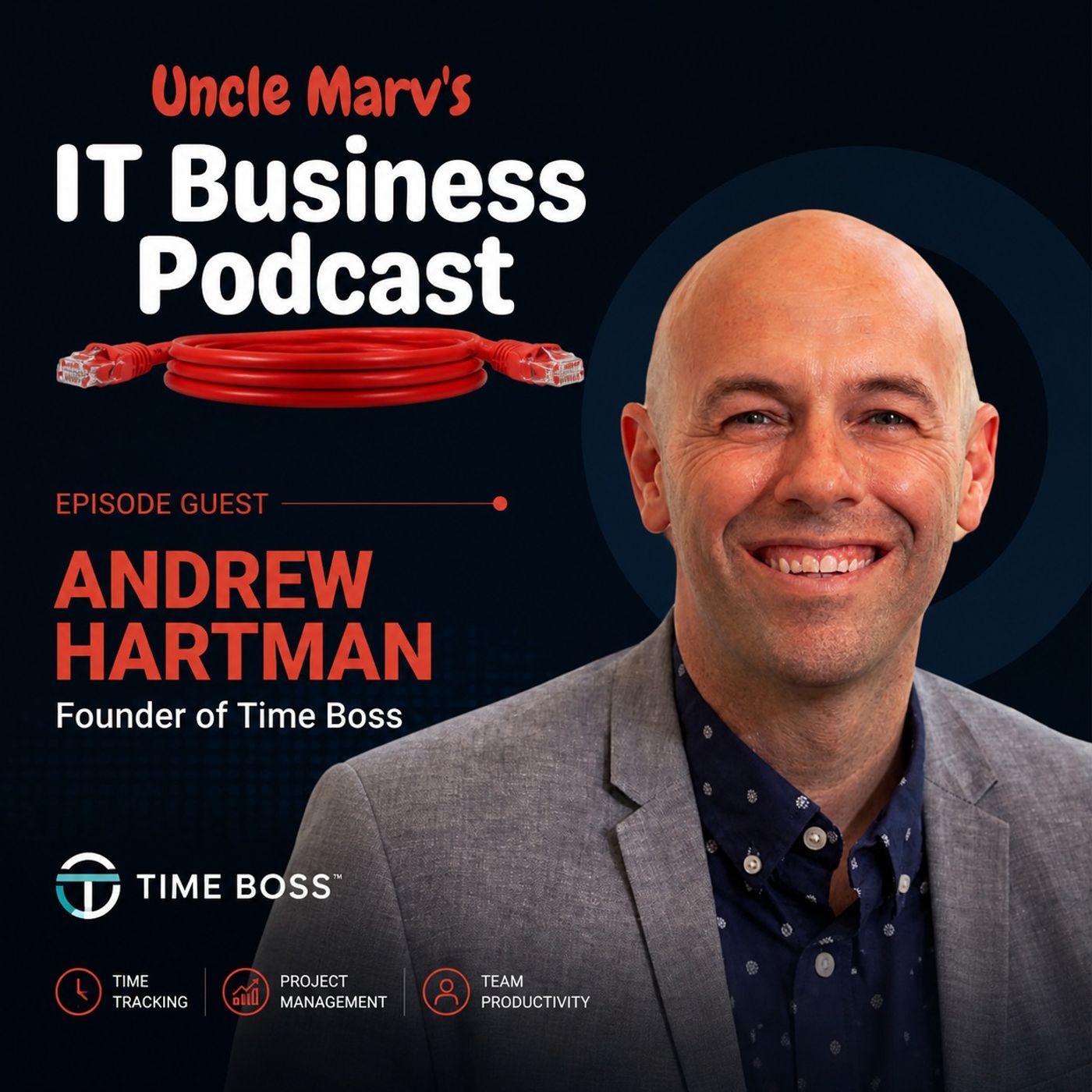
Andrew Hartman, founder of Time Boss, shares how he built a framework to help MSP leaders escape burnout and regain five hours per week while reducing stress by treating time like cash instead of credit. His system delivers a 40% productivity jump by creating peace instead of chaos, even for solo techs drowning in client fires.
Andrew Hartman knows what it's like to wake up at 4:25 a.m. in a cold sweat, already behind before the day starts. As a former fractional COO of an MSP in Orange County, he watched stress destroy his health, relationships, and peace until he built Time Boss, a framework that's helped 95% of participants experience more peace and reclaim five hours per week. What stuck with me was his "time is cash, not credit" philosophy because we MSPs keep swiping that time credit card without knowing if we have enough hours to pay it off. Andrew breaks down how to architect your week with weekly planning and daily review habits, how to deputize fires to your team instead of living as a firefighter forever, and why solo techs need to protect focused time even when servers are burning. The framework handles the three things coming at all of us: recurring tasks, one-time tasks, and the chaos we didn't see at 6 a.m. that becomes our priority by 10 a.m..
Chapters
- 00:29 Time Is Cash
- 02:28 Burnout Built the System
- 05:12 Cash, Not Credit
- 07:26 Why TimeBoss Stands Out
- 12:02 Burnout at Dawn
- 14:28 Build Firewalls, Not Chaos
- 16:12 Solo Tech Survival
- 24:06 Weekly Rhythm Matters
- 26:21 The Four Choices
- 28:53 The Framework Is Complete
- 31:20 Course Correct Constantly
=== Guest: Andrew Hartman, Time Boss
- Website: https://www.timeboss.us
- LinkedIn: https://www.linkedin.com/in/andrewhartman
- Time Boss Masterclass: https://www.timeboss.us/the-time-boss-weekly-operating-system-masterclass
=== Companies / Vendors / Products / Books
- Getting Things Done (GTD): https://gettingthingsdone.com
- Book: Getting Things Done (By David Allen): https://amzn.to/4dDtcJk
- Franklin Planner / Franklin Covey: https://www.franklinplanner.com
- Franklin Planner – Monthly Calendar Tabs: https://amzn.to/4dUoJAK
- The 4-Hour Workweek: https://fourhourworkweek.com
- Book: The 4-Hour Work Week (by Timothy Ferriss): https://amzn.to/4xeGtjk
- Buy Back Your Time: https://www.buybackyourtime.com
- Book: Buy Back Your Time (by Dan Martell): https://amzn.to/4vhybVV
=== SPONSORS:
- Livestream Partner, ThreatLocker: https://www.itbusinesspodcast.com/threatlocker
- Technology Partner, NetAlly: https://www.itbusinesspodcast.com/netally/
- Technology Partner: Bvoip: https://www.itbusinesspodcast.com/bvoip
- Travel Partner: TruGrid: https://www.itbusinesspodcast.com/trugrid
- Digital Partner, Designer Ready: http://itbusinesspodcast.com/designerready
=== SHOW MUSIC:
- Item Title: Upbeat & Fun Sports Rock Logo
- Item URL: https://elements.envato.com/upbeat-fun-sports-rock-logo-CSR3UET
- Author Username: AlexanderRufire
- Item License Code: 7X9F52DNML
=== Connect with Uncle Marv
🌐 Website: https://www.itbusinesspodcast.com/
🎙 Host: Marvin Bee
🛒 Uncle Marv’s Amazon Store (gear & tools I recommend): https://amzn.to/3EiyKoZ
☕ Support the show: https://ko-fi.com/itbusinesspodcast
If you found value in this episode, share it with another MSP, IT provider, or tech entrepreneur. Your support helps keep practical, no-nonsense IT business conversations coming every week.
[0:14] Hello, friends, Uncle Marv here, and welcome back to another episode of the IIT Business Podcast, where we keep it real for MSPs and IT business owners trying to build a business that doesn't break them.
[0:29] So today I have a new guest to the show, Andrew Hartman, founder of TimeBoss. He went through the grind of venture-backed startups and a COOC right into burnout, and then decided, I'm going to build a simple system to help leaders take back control of their time. So this should be an interesting episode. So Andrew, welcome to the show. Thanks so much, Mark. Glad to be here. Really been looking forward to this. Okay. So my first question out of the box is going to be, I know you've been on the show with a couple of other people in our space, but let me ask, in terms of content relevant to the IT profession and stuff like that, how do you really relate that type of stuff to us? Yeah, absolutely. So I should share my background. I spent two years as a fractional COO of an MSP here in Orange County, California. We've had a number of MSP clients go through the TimeBoss program, where I'm the founder, and that have actually implemented TimeBoss. So we have quite a bit of MSP experience, both very firsthand in the trenches, and then also from the outside looking in, helping people implement TimeBoss. The thing about time is that the rules apply everywhere. And the question becomes, what do we do when we have more to do than time to do it?
[1:58] And MSPs in particular, like many industries, have way more to do than time to do it. And it just cooks our brain if we don't have the right ways to think about that. So I think it's incredibly implicable in that space. Okay. So I did know that you were with an MSP. I just didn't know in what capacity. So I was going to ask if the framework was built with that initially in mind, and did you expand it out later, or did it just...
[2:25] You know, blossom into where it is on its own? Yeah. So I built the framework in early stage venture-backed startups, like you mentioned, software startups. So I was a COO in those environments, burning out. People on my teams were burning out. And I just thought to myself, this is ridiculous.
[2:43] It's robbing us of our mental health. It's robbing us of our relationships. In some cases, it was robbing us of our physical health. I actually experienced so much stress at one point that I lost my sense of smell for six months, a decade before COVID. I am not patient zero of COVID, but a decade before COVID, stress-related loss of my sense of smell, which you ask enough people, you'll hear unending headaches, irritable bowel syndrome, back tension, sleep issues, all kinds of things when we get overwhelmed. It just comes for our health. So I built in that environment and then had ultimately built it into a framework. I can share that whole story if it's helpful. And so the framework was really fully complete when I became COO of this MSP. And so we implemented it at that MSP, at the leadership team level, and they experienced incredible outcomes. The power of the framework is it focuses in on how do we think about the work that we have to get done. And the primary outcomes are a dramatic reduction in stress. And the way that I frame that is an increase in peace. And I think we all want more peace. Imagine having peace in your workday, especially as an MSP leader. And when we experience more peace, we actually make incredible progress. So peace is the engine of progress.
[4:06] We'd see 95% of participants across all types of organizations, not just MSPs, but 95% experience more peace. When they experience more peace, they see a 40% plus jump in productivity. Perceptively, they feel like they get five hours back in their week. And so it's, Really, we are tolerating so much overwhelm and so much stress, and it is killing our results, it's killing our relationships, it's impacting our health, and there's just another way, and that's what I built Time Boss for. Okay. So, let me ask the devil's advocate question. Sure, please. Because a lot of people sometimes just look at their life and say, you know what? I'm just trying to do too much, period. It's not that I need to organize it better, it's just that I just need to say no to some stuff. Prioritize me over all these things, maybe take a less stressful job and stuff like that. How do you deal with people that are in that mode as opposed to people that, they're just chaotic. They want to get more done. They want to be more efficient. How do you blend those two styles?
[5:12] Yeah, so a big idea in Time Boss is this idea that time is cash, not credit. And what that means is most people say yes to things without knowing if they have enough time or not.
[5:23] And it's no different than swiping a credit card where I may swipe that credit card not knowing if I have the cash to pay it off. You know and we swipe credit cards all the time we pay it off we all look points you know i'm not saying don't swipe your credit card but if you're only swiping your credit card eventually you're just trying to keep your head above water and you halt yourself financially because eventually you're just making interest payments on interest you're not actually moving forward financially and the same is true with time so we'll we'll say yes to things that we don't know if there's enough time and we do that long enough and we're just trying to keep our head above water and so people go two ways with that. Some go to like, I've got to figure out a better, I want to be in it. I care about my contribution. I want to make things happen. How do I solve for that? And some people go like, I just need to get out of this and do a less stressful job. But to me, and I found this in my own experience, changing jobs doesn't solve the problem. Eventually, you're just going to keep saying yes. And regardless of the environment, particularly in knowledge work, which is what all MSPs are, we get paid for moving information and for the decisions we make, the work is infinite. You could always do more work. And so you have to decide how much of your life are you willing to give to work. And that truly becomes your cash budget. That's where this idea of time is cash, not credit. And then once you make that decision, you've got to decide what do I do with that time to create the most value.
[6:45] And more importantly, in my opinion, what do I do with all the stuff that doesn't fit? Because that's the stuff that overwhelms us, the stuff that we're afraid that we're not going to get to. We're afraid it's going to hurt us if we don't work on it. So we feel like we just have to constantly keep working.
[6:58] Okay. Now, having gotten that answer, let me ask a question this way. A lot of us have tried different things in the past. I mean, I'm going to go back to the day timer, the Franklin planner. We've come up with all these different types of to-do lists and project managers and stuff like that. So what makes this different? Or where do these other things that we've tried fail? Yeah.
[7:27] So I think if you, so I tried all those things as well, particularly in building Timeboss. And I think where it comes from is every platform, FranklinCovey, getting things done, the four hour work week, buy back your time, all of them come from a perspective on time. They are a product that's trying to solve a problem. And so for me, when I built Timeboss, the problem that I was trying to solve was this. I wanted to get incredible results that I was proud of. I wanted to contribute at a very high level to things that I believed in deeply. And my guess is the MSP leaders that are listening to this podcast are probably very similar to that. They probably identify with that. They care about their contributions.
[8:09] The other half of that problem I was trying to solve was, I want to do that from a place of peace, freedom, and clarity, not stress, fear, and anxiety. Because I knew that stress, fear, and anxiety was going to rob me of the life that I wanted.
[8:22] So Time Boss is fundamentally structured to give you incredible results with an experience of life that you actually want. And so that's how I feel like it differs from those. So an example might be, and I bet there's a number of individuals listening that have used the system getting things done. And I have tremendous respect for getting things done as a system. I think what David Allen did well, as he said, like work in our head creates these loops and open loops create stress for us. And so David Allen's strong recommendation was you need to get those out of your head into a system. And I fundamentally agree with that. TimeBoss is a system that you need to get things out of your head into that system. The challenge is getting things done as an example, doesn't solve for capacity. And so I will get some work done in the getting things done model, but there's going to be much work that I don't get to that is going to make me continually feel overwhelmed because I'm afraid that if I don't work on that work, it's going to hurt me or it's going to hurt someone that I care about. And so in Time Boss, again, coming back to it as a product, fundamentally, I felt like we had to solve for capacity. How much time do I have? What is their time to get done? And then I also had to solve for what do I do with the things that don't fit? Because those are the things that are going to haunt my subconscious, make me worry, make me fearful. I'm afraid they're going to break my business.
[9:42] And Time Boss systematically goes and deals with those items so that they don't do that, that they don't haunt our subconscious, that you can be fully present to the work that you actually choose to do. And you have a plan for those things that don't fit.
[9:56] Okay, so a lot of this stuff, folks, I will just go ahead and make sure that I say the website up front here so it's not squeezing at the end. Timeboss.us is the site, and there's a whole bunch of stuff on there.
[10:12] It's not just a time management system. You've got group coaching on there. You've got a workshop, digital course, all of that stuff.
[10:22] Let's look at this real quick and then we'll come back to the conversation when somebody goes to your site where do they start, yeah so I encourage people so as we're talking today to your point Marv it is just a fundamentally different way to look at time and so if this is interesting if you think wow, I would like to get better results from a place of peace freedom and clarity not stress fear and anxiety I'd encourage people to check out the master class, 75 minutes it is the entire framework start to finish, we share it very openly with people and the reason we do so is because some people are going to go watch that and it will be the thing that they need and they will implement it and they'll be off and running others are going to watch that and think I really want this but I know my team needs help to make it happen and that's when you can reach out to Timeboss that's when we get involved but again if you're curious I would just check that out I think that's a great place to start, And a lot of people will look at that and say, 75 minutes, oh, I don't have that kind of time. That's right. And for those people, I say, open it up in YouTube, ask for a summary and toss it into your AI of choice. It'll give you all the details you need. There we go. All right. So now let's go back to, you know, you've talked about this fundamental shift in how we think about it. So let me go back now to ask you.
[11:44] When you were going through this and you were like, okay, something's got to change. Yeah. I can imagine in my head kind of what your typical day or week was like, but can you share that for the listeners so that they know this is where you were? Oh, sure. That you make a change.
[12:02] Yeah. So I'd wake up at 425 a.m. in a cold sweat, worried about the things I wasn't getting to. I'd start checking my email at 445 because they already felt behind. Mind i my kids would wake up and i try to be as present as i can worrying about the projects that i was going to have to manage that day i'd skip my workout because i had a morning meeting that i'd have to prep for i'd be in the middle of that meeting and a client call would with a fire and i would feel stressed feeling like i have to be in two places at a time i'd go back to my messages and and know that there was important work that i need to make happen but i was constantly being distracted by the messages that were popping up all day long a server would go down website would go down. I wanted to get a bunch of great work happen that day. And I just got pulled in every single direction, putting out fires all day long. I'd be home 30 minutes late for dinner with my family, have a frustrated wife. I'd be sitting at dinner trying to be as present as I could, knowing that as soon as my kids go to bed, I'm just opening up my laptop and I'm going to work again. Open up my laptop, my wife would be looking at me saying, are we doing this again? And I would shrug my shoulders because I didn't know what to do because I cared deeply. I wanted to do great work and I didn't know what to do and the work was there and I just felt like I had to make it happen.
[13:14] Worked till 1.30, tried to go to sleep, feeling the weight of the things that I didn't get done even though I worked all day long and then I would wake up the next day and I would just do it all over again. So... Yes, overwhelm had a death hold grip on my life because I cared. Not because I was bad at my job, not because I was not smart, not because I was not talented, because I cared deeply. And I had stopped creating any boundaries for me that would protect me from the sheer amount of things that were coming from my time.
[13:49] Boundaries, that's an interesting word. Yeah. I've learned to use that. I've learned to say no, but listen, IT providers, we live in a world where you mentioned a situation that we're familiar with. Server went down. Yeah. Doesn't matter what I planned for the day, that server down takes precedent. So how would you, I guess, kind of get somebody just to do maybe a first step pivot with how we manage
[14:21] those types of situations versus what we want to guard as, you know, principal time? Yeah. So I think what's critical for people to understand is how they create value. And so as a business in MSP, you create value by being responsive. Obviously, there's a tremendous amount of proactivity, but from a client experience perspective, when something breaks, you want to make sure that you can solve that problem because that business is down, it's painful for them.
[14:49] Obviously, that's the way that you're going to get compensated. And so knowing that, someone in the business must be organized around responsiveness. Someone in the business must be organized to handle that server when it goes down. The question that I would ask the MSP leader that's listening is, does that have to be you? And so for some of us, we say, yes, it absolutely has to be me. I'm the only one that knows. And if that's true, then you're going to continually be pulled in those directions. You're going to have to be responsive.
[15:20] If that's a critical, the way that you create value, I might encourage the individual listening to say, who else might I assign where they can become the first line of defense to those needs, where that creates, you know, no pun intended, a firewall that allows me as a leader to be focused on something else, knowing that that need is handled. The reason why those needs overwhelm us is because we don't have the ability to shut them off. We can't just say no. We know we have to say yes, or someone has to say yes. And so if you have deputized someone else to say yes, and someone else can take high ownership of that, and you trust that individual, then that gives you the emotional freedom, literally the mental clarity, to be focused and present on something else. And so we're simply creating systems and structures that allow us to be fully present to one thing at a time, knowing someone else is triaging and handling that critical fire that a client needs to respond to immediately.
[16:13] All right, so for a mid to large size MSP, that sounds great, I'm going to just say this a lot of my listeners are either solo techs or it may just be one other tech in the business so it's just two of them and stuff but they want to also figure out how to you know get back their time and stuff how do you, address people like that yeah some so for an individual and i and i totally understand that um a reasonable portion of me building time boss i was the only one involved and so you just kind of handle all the things i totally get it so mental models that i would encourage people to think about is often we will orient our world around everything being a fire meaning we make ourselves constantly available all the time.
[17:04] Because what's happened is in the past, an urgent need came up that either had we not seen it, it would have hurt us really badly. Like server goes down and I didn't see it. That would have hurt me really badly if I didn't see it. Or an incredible opportunity came through via one of those channels, you know, be it teams or your email or a phone call, whatever. And so what that has wired our brain to do is never stop looking. Because our brain is constantly trying to answer the question, will this hurt me or will this help me? And so for that individual that's listening, my guess is you are constantly looking at your email, you are constantly on Teams, you are constantly being pulled in a million directions. And the mental experiment I would encourage you to run is what do you do when you have a one hour sales call with a client. And my guess is what you do is you shut Teams and you're not looking at your email inbox because the most valuable thing you can do in that one hour phone call is to be fully present to the client to help them meet their need. I would encourage the individual listening to consider other priorities that they need to work on with that same value where you might shut your inboxes, you might shut Teams, you might put your phone on do not disturb mode, trusting that if it's absolutely on fire, that thing is going to come to you. But 95% of the time, those notifications can wait until you are done, at least for an hour, with a critical task that's gonna move your business forward.
[18:31] My encouragement to anyone listening is, if you want to operate as a firefighter the rest of your life, don't change anything. If you're fine with where your life's at, you're good. Like, don't let Time Boss even impact you. Okay. But in your heart of hearts, if you want it to be different, the only way it's different is if you make change. You have to change your approach to time, your habits related to time, if you want it to be different.
[18:56] So you did mention a couple of things that I'm sure people have talked about and maybe haven't been able to implement. I've been able to do most of it, I'll be honest. The big thing was setting, you know, setting those hours, you know, where, you know, letting people know that, no, our business shuts down at 530.
[19:19] Don't try to call at 7 o'clock asking us to, hey can you take a quick look at this unless the server is on fire we're not going to respond that sort of thing so that was probably a huge shift and letting people know that, one of the quotes that we used to say on the show is when people would always ask if you want me to install something. And they're like, well, can you do it over lunch? And it's like, I'll be at lunch too. Yeah. Right. Because they always think, well, you do it, you know, when it's convenient for me, not when it's convenient for you. Yeah.
[20:06] So let's go back. I like the analogy that you talked about where, you know, it's kind of like swiping a credit card. Yeah. Like a time credit card. Yep. So from the MSP perspective, you said you did a bulk of this while you were at that MSP. Were you able to take that specific analogy and tie it directly to tasks that you guys were doing or things like that? Yeah, absolutely. Absolutely. So you think about it, it's the one of the things I said that I think is so critical, Marv, is asking the question, how do I create value? And so if you think about like an l1 tech at an msp they create value by being available that person is a firefighter that is their entire job if the ticket comes in if the phone rings like they're available and so it's totally inappropriate for that individual to calendar block all day long with a bunch of priorities besides helping clients like we're strategically orienting them to be available for the leader who needs to grow the business. And again, my assumption is, you know, even for the individual listening is, um.
[21:17] They want to run this business in a way that's sustainable for them, where they're getting the results that they want with an experience of life they want. I just have a fundamental belief that that's how people want to operate, that both of those things need to be true. It needs to be financially valuable to me or whatever value I'm trying to create, and it needs to be an experience of life I want. I think for that individual, again, the question becomes, how do you create value? And you need to make a decision of how much of your life you want to give to your MSP. And for some individuals, it's the average person, it's between 40 to 60 hours, you know, I've done enough implementations to know that's generally where it falls. Okay and so if that's true then that is now your budget and so the question becomes how should you structure that time to create value for you to get the results that you want the experience of life that you want and so some you know if you're a solo msp some portion of that is going to need to be responsive time tickets are going to be coming in the phone's going to be ringing but you if you are looking to grow that business or you're looking to make that business sustainable I think you have got to find times that you protect, where you can actually work on the business, where you are not, I mean, unless it is absolutely on fire, the server is down, you are not paying attention to those items. And you're, you're spending your time like cash, and you're investing some of that time into working on the business and whatever that means in your particular environment. And so, you know, the MSP I was at.
[22:46] And the MSPs where we've done implementations have been somewhere between, we had one that was a team of three, we had a team of 20, and we had a team of 45 in the three MSPs where we've done full implementations, like they fully installed it in their world. And in those environments, they operate very differently. And the team of three, which sounds similar to, I think, what a number of your listeners might be, Marv, that individual had hours where they were on, meaning they were available. They intentionally structured their time where they were essentially just available to the chaos. Whatever comes, I'm going to deal with it. And then they had other portions of their time where they were fully offline. And they were working on the business. And so that might mean for the individual listening, you may need an answering service that you have the ability to go on where that person can triage for you. And if it's absolutely on fire, they will call you on the phone and interrupt you. But otherwise, they're going to triage any need for a customer. The customer is going to feel very well taken care of. And when you're ready to come back and open yourself back up to the chaos, you can respond to that ticket and you can get back to them. But it's going to afford you time to focus. But again, I think the fundamental question to ask is, what results do I want? What experience of life do I want? And then based off the answer to that question, do the work to architect your time accordingly.
[24:07] Okay, how much of that falls into what I think I read this somewhere that building repeatable rhythms. Yeah. Is that that protection time that you're talking about? Or does that include a whole bunch of other stuff?
[24:25] That's a part of it. Yeah, so the two time boss is fundamentally structured around two habits one is a weekly planning meeting habit and one is a daily review meeting happen so the weekly planning you're, literally architecting your week around how you create value. And then the daily review meeting habit is how you shut it down at the end of the day simply to allow you to emotionally separate from work so you can actually go home and rest and recover, you know, and not just cope all night, but you're actually resting and recovering. And when you do that weekly plan, the goal of that weekly planning process is where the name Time Boss comes from, and it's this. Your future self is like an employee that you manage. They are 100% subservient to the planning or lack of planning that you do on their behalf. And so by having a habit where I'm thinking thoughtfully about my week, what does my future self need to be successful? How will I create value this week? What falls out of that very naturally as well, that my future self is probably going to need some time where he can focus on his critical priorities, where he is protected from the chaos. And he has other times where he needs to be available to the chaos because there are urgent and important items coming that I cannot predict that I know I just need to budget time for.
[25:38] Again, time is cash, not credit. We think of it like a budget. For some of you on the call, it may be 90% of your time you're making yourself available to the chaos. But 10% of the time, we're going to protect for you to actually work on the business. As you get more people involved in your MSP, you get more protection. So as an example, the senior leadership of two of the MSPs I was working with, they had a significant portion of their week where they could focus their attention on whatever they wanted, because they had done the work to defend their attention by having other individuals that were deputized to handle fires. But for smaller MSPs, you know, obviously that they may need to budget more time to be available for that chaos.
[26:21] Is that the term you use, deputized? So if you think about it, so the reason why we get overwhelmed, so our brain, whether you believe we were created or we evolved this way, it doesn't matter. If you look at the structure of our brain, it is designed to be fully present to one thing at a time. It is built to pay attention to the thing in front of me. No multitasking. No multitasking. It is asking the question, will this hurt me or will it help me? And so when we multitask, So we technically can multitask, but what we're really doing is we are rapidly changing what we're giving our attention to. Only one thing can hold the stage of our brain at a time. And so what happens is we...
[27:03] We don't respect that fact and we start treating our brain like a storage device and we allow it to just collect things that we're worrying about. And the science would show you can only hold five to seven things in your brain at a time. And, you know, most of us have so many more than five to seven. You know, the average person has 121 items that they're worried about or thinking about or they're on a to-do list somewhere or something.
[27:26] And that's what creates that overwhelm. And so for me, if we're going to be present in one thing at a time, you literally have four options. There's only four things you can do. You can either date it, put it on your calendar. Like, I can't do this right now, but I'm going to do it tomorrow at 10 a.m. And that allows myself to have mental freedom from that task because I've made a plan for it. You can defer it. I'm going to do this later or tomorrow or next week or next month or next quarter or whatever. You can delegate it. I can literally give it to someone else to do it. And that's that deputizing. Like, I'm no longer responsible for that fire. That person is responsible for that fire. Or you can delete it. You can just say, i'm not going to do it those are your those are literally your only options those are the only things you can do delegating can also be to ai now obviously ai is getting better and better at supporting us with those things but you have to have i think the key is there marv you have to have systems that own the thing that that aren't your prefrontal cortex you you're trying to keep your prefrontal cortex that your brain your conscious mind free to be present to whatever that thing is in front of you, a server that's on fire, or that critical strategic priority you need to move forward in your business, or that sales meeting you're having with your client, you just want to be fully present to one thing at a time. And when we do that, if we can operate that way, it dramatically reduces our stress, and we get incredible results simply by being able to bring our full mental faculties to one thing at a time.
[28:54] Very nice. All right, so I saw on the website that this is 15 years of learning. Yeah. Now I'm going to ask this question. Do you think you're done with the system? Oh, yes. Oh, I don't think I'm done personally. I think the framework is whole and complete. Okay. I think there are three things that are coming for all of us. There are recurring things, things we have to do every single day, every single week, every single month. You know, our businesses are often built on those things. There's one-time tasks, things that I check off and I'm done. And then there's what I call unknown tasks. It's the chaos. It's the, at 6 a.m. I didn't know it was going to be my priority, but by 10 a.m. it's my priority. That's our entire world. It's just those three things. And Time Boss is a whittled down, simple system to contend with those three things coming at us. So from a framework perspective, I think it is very sound. I mean, certainly you're always iterating. You're always adjusting. You know, we made add things, delete things here as we go.
[30:01] For me personally, the challenge of all this is that we have to show up and do it, right? And so this is why I so strongly encourage people to have a weekly planning meeting habit where on a week-to-week basis, you can be reflective of how the last week meant. You can make some tiny adjustments based off, you know, course correct as needed. And then you can be thoughtful on behalf of your future self as what does my future self need to be successful this week? And then you're simply architecting that in your calendar to set them up. So every single week, Marv, I'm making adjustments based off how last week went, because it's just impossible for humans to walk a straight line. We are always swinging past center. And the game is, how do I course correct as needed to stay as closely aligned to my goals and values with the way that I use my time?
[30:49] I heard another person describe it as, how can you make sure that you are staying true north? Yeah. We're always drifting. Always. Yeah. If you look at a, so when a plane takes off from LA to fly to New York, they're not flying in a straight line. They are, they are constant adjustments in that, in that fashion. And so the goal is to ultimately get to New York, but they're not going in, I mean, they're going in a close to straight line, but they are always course correcting constantly. Those instruments are constantly paying attention to making adjustments.
[31:21] All right. Well, Andrew, thank you very much. Folks, again, the website, timeboss.us. And listen, even if you don't want to take that 75-minute course, which you should, there are some free tools under the resources tab that you may want to start with. There's a blog there. And you might want to catch some of the other podcasts that Andrew's been on. Yeah.
[31:47] Uh, it's like a good lineup there. It's been fun. We've had to get around. All right, Andrew, thank you very much. I appreciate this. And folks, if you, uh, want to get back some time, uh, this is a good place to start. And, uh, I think I know a lot of, uh, MSP owners, uh, and leaders listening. Um, we all, we all feel that crunch too much to do and not enough time to do it. So yeah, be a good framework. So if you want to go deeper, folks, check out Andrew's Free Time Boss Masterclass and the resources over there. Connect with him on LinkedIn. His information will be in the show notes. Tell him I've sent you. And that'll do it for this episode of the IT Business Podcast. We'll see you soon. And until next time, Holla!

Founder
Andrew Hartman is the founder of Time Boss, a transformational system that empowers leaders and their teams to take control of their time, increase productivity, and operate at their Highest Sustainable Pace. After experiencing burnout multiple times in fast-paced startups - at one point even losing his sense of smell - Andrew created Time Boss to help others avoid the same pitfalls and build lives marked by greater clarity, peace, and progress on what matters most.
Over the past 10+ years, Andrew has served as a COO for early-stage startups, helping scale software and technology ventures from zero to over $9 million in revenue. His leadership has impacted companies such as Caliber Media Group, Sevenly, Cotribute, Download Youth Ministry, and BRITECITY, in addition to his experience as a multi-unit franchise owner.
Andrew is a sought-after speaker for founder groups, executive teams, and leadership forums including Vistage, Convene, and CBMC, including being selected as 2025 Top New Speaker for Vistage. His sessions are known for delivering practical frameworks, personal insight, and lasting inspiration for leaders who want to align their time with their top priorities and thrive in both business and life.


