

 Apple Podcasts
 PocketCasts
 Overcast
 Spotify
 Podcast Addict
 Amazon Music
 iHeartRadio
 PlayerFM
 TuneIn
 Audible
 Castbox
 Podchaser
 Goodpods
 Pandora
 Audacy
 Deezer
 Spreaker
 Own Your MSP Marketing (EP 1008)
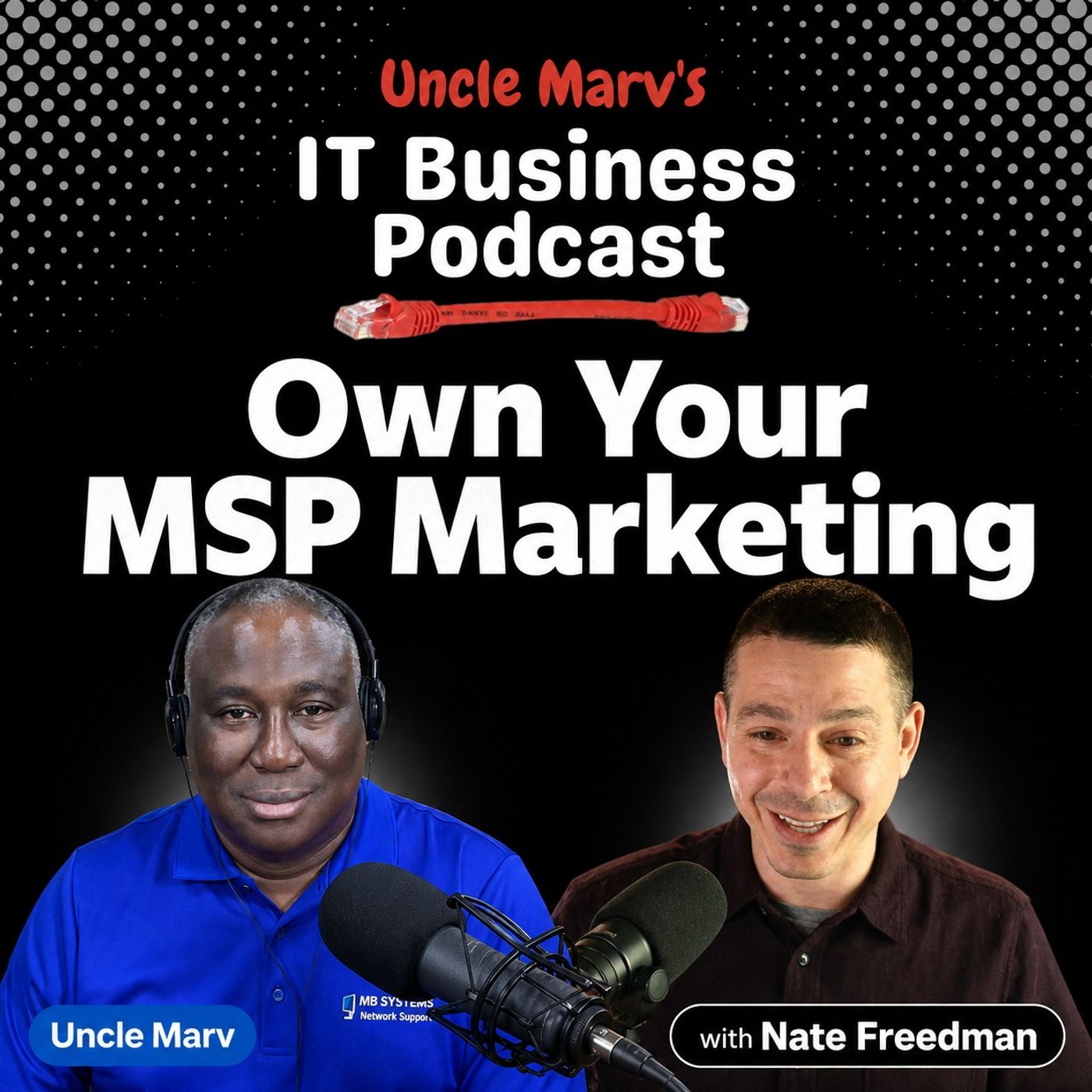
Most MSPs don’t really have a leads problem; they have a “nothing actually happens” problem when prospects find them and never hear back. In this conversation with Nate Freedman from Tech Pro Marketing and MSP Sites, I dig into practical MSP marketing strategies, from SEO and Google Ads to human-to-human outreach and turning one-off projects into long-term recurring revenue.
Referrals are slowing down, phones are too quiet, and every vendor swears they have the magic funnel that will fix your pipeline—for a nice monthly fee, of course. Meanwhile, most MSP websites are still glorified digital business cards, and when a real prospect does reach out, that inquiry can sit in an inbox long enough for them to sign with another provider before you even know they exist. In this episode, I sit down with Nate Freedman from Tech Pro Marketing and MSP Sites to talk about what actually works for sub–5 million dollar MSPs that want predictable growth without handing their future over to yet another “black box” agency.
We get into modern SEO (or “search everywhere optimization”), why key phrases beat single keywords, and how MSPs can realistically show up when prospects search terms like “IT services company near me” instead of chasing vanity terms they’ll never rank for. Nate explains how top MSPs think about Google Ads, lifetime value and customer acquisition cost, and why private-equity-backed rollups are willing to pay 80 dollars a click while smaller providers need different, more human strategies to compete. We also talk about directories, Google Business Profiles, inbound call handling, and why speed to lead is still one of the most underrated growth levers in the MSP space.
Chapters
- 00:36 SEO for MSP Growth
- 06:26 Search Everywhere Strategy
- 10:46 Reverse Engineering Search Results
- 15:33 Winning With Marketing Math
- 19:08 Human-to-Human Marketing
- 24:03 Owning Your Marketing
- 27:57 MSP Sites Boot Camp
- 30:12 Speed to Lead Matters
- 33:01 Turning Projects Into Recurring Revenue
- 40:56 Facebook Reels Momentum
=== Guest: Nate Freedman
- Tech Pro Marketing / MSP Sites – https://www.techpromarketing.com
- LinkedIn: https://www.linkedin.com/in/natefreedman
=== Shout-outs
- Paco Lebron: https://www.linkedin.com/in/pacolebron
- Karl Palachuk: https://www.linkedin.com/in/karlpalachuk/
- Mike Bakaic: https://www.linkedin.com/in/michael-bakaic/
- Sean Inman: https://www.linkedin.com/in/seaninman/
=== Companies / Vendors / Products / Books
- MSP Sites – https://mspsites.com
- Clutch (Clutch.co) – https://clutch.co
- UpCity – https://upcity.com
- CloudTango – https://www.cloudtango.net
- Thumbtack – https://www.thumbtack.com
- Gravity Forms – https://www.gravityforms.com
- TechCon Unplugged – https://www.techconunplugged.com
=== SPONSORS:
- Livestream Partner, ThreatLocker: https://www.itbusinesspodcast.com/threatlocker
- Technology Partner, NetAlly: https://www.itbusinesspodcast.com/netally/
- Technology Partner: Bvoip: https://www.itbusinesspodcast.com/bvoip
- Travel Partner: TruGrid: https://www.itbusinesspodcast.com/trugrid
- Digital Partner, Designer Ready: http://itbusinesspodcast.com/designerready
=== SHOW MUSIC:
- Item Title: Upbeat & Fun Sports Rock Logo
- Item URL: https://elements.envato.com/upbeat-fun-sports-rock-logo-CSR3UET
- Author Username: AlexanderRufire
- Item License Code: 7X9F52DNML
=== Connect with Uncle Marv
🌐 Website: https://www.itbusinesspodcast.com/
🎙 Host: Marvin Bee
🛒 Uncle Marv’s Amazon Store (gear & tools I recommend): https://amzn.to/3EiyKoZ
☕ Support the show: https://ko-fi.com/itbusinesspodcast
If you found value in this episode, share it with another MSP, IT provider, or tech entrepreneur. Your support helps keep practical, no-nonsense IT business conversations coming every week.
[0:24] Hello, friends. Uncle Marv here with another episode of the IT Business Podcast, a show for IT professionals and managed service providers. We help you run your
[0:33] business better, smarter, and faster. And as you can see, if you are watching on the YouTube, We are continuing with our series, Money, Marketing, and Growth here in the month of May. And we're going to talk about some good stuff here. Most MSPs, of course, really don't have a leads problem on paper.
[0:57] They have a nothing's actually happening problem in real life. So a lot of us started our businesses and grew with referrals, and that well is starting to dry up. It's not what it used to be. The phones are a little too quiet, and every vendor you talk to swears they've got the secret sauce to fix it, usually for a nice monthly fee. Meanwhile, your website just sits there like a digital business card from 2012 or even 2002, if you looked at my site in previous years. And when a prospect does reach out, they might sit in someone's inbox for a few hours before anybody notices. By then, though.
[1:44] They've already talked to two other providers and you never even knew you were in the running so today we are going to be talking about that we're going to figure out how to move the needle uh getting found by the right people responding so fast you basically erase the competition and turning those hey can you fix our server calls into long-term recurring revenue so i don't think we're going to be talking about magic funnels today uh no guru buzzwords uh hopefully just some practical moves that will uh help a sub five million dollar MSP actually execute so today I m bringing on a first-time guest to the show Nate Freedman from tech pro marketing and MSP sites we'll talk about that and he's in the trenches helping MSPs it uh do exactly that own their marketing, not rent it, and turn it into real money and growth. So here we go. Nate, welcome to the show.
[2:46] Thank you so much, Marv. I'm super excited to be here. For me, I've kind of followed the MSP podcast world a little bit. So I've been, for me, I think there's kind of three, like the OG MSP growth podcast from The Real Practitioners, and it's Paco LeBron and Rick Braun on their podcast. Then you've got Carl Palachuk. I've been on both of those. So I'm really happy to get onto your podcast today. And I feel like for me, I've kind of hit my trifecta of podcasts that I would love to be on it when I first started. And we're finally accomplishing that goal. So thank you for having me. Well, that's probably my fault. I probably wasn't poking around enough looking for everybody. And I did that this year, found you, and thank you for agreeing to come on. Absolutely.
[3:34] So let's go ahead and start. Obviously, you've been doing this for a while. It's not like you're new to the industry, but you're new to the show. So a lot of my viewers and listeners don't know about you. You actually are from the tech world, if I remember correctly. You started in computer repair. Is that correct? Yeah. So me, my first job ever was at Bay State Computer Repair. You won't know that. That was just the local computer repair shop around the block from me when I was a kid. So I started working there when I was 15. And for me, I've been, I think like a lot of, MSPs, like early on throughout high school, throughout college, was doing like some break fix work, break fix work on the side. And I was also doing a lot of web design work on the side. And for me, when I kind of wanted to open my own business and get into this world on my own, I actually started more on the website design and CRM implementation side of things. Although I definitely had some clients where I didn't know the difference between managing their IT and managing their marketing. So we were doing everything and I was definitely the default IT person for a long time. But now we're strictly in the, marketing technology side of it. All right. So what was it that made you kind of flip that switch and say, we're going to go all in on marketing instead of continuing in the service provider role?
[5:02] Yeah, for me, I think it was, I, I did really start on the technical side of things, but it was probably the feeling and no one's ever asked me that before. So really cool question. I think for me, it was the feeling of one of my clients. It's Acker's Vending Service. They're still a client today, but they're a vending machine service company and we were doing everything. But on the lead gen side of things, they actually got a lead and I didn't quite know what I was doing at the time. I was just doing SEO. I didn't understand business to the point where it was like, hey, if you spend this much and then you get this big a contract back, that's really good. I was kind of like, all right, let's just see if we can get you some clients. But we did some SEO work for him and he actually got a really big contract that they're still servicing today with like, you know, a hundred vending machines or something. They must've made millions and millions off this one deal. And they were so excited about it. Like Nate, like let's do more of that. And I kind of liked that feeling as opposed to Nate, I haven't been able to get an email for three days. What's going on with my email server? So yeah, you can see from my perspective, why I chose to go to marketing. Okay. So you mentioned SEO and SEO is a term that gets talked about a lot.
[6:22] People think they understand it. They think it's just a matter of posting and all that stuff. So let's kind of break that down a little bit from your perspective and talk about SEO and, give it to me in the simplest form on how you approach it okay so for SEO it's search engine optimization and i would say today we know there's also people not just using the traditional search engines but they're also using an ai chat like ChatGPT or Gemini or copilot and they're asking at direct questions, what IT provider should I work with? IT services company near me. And when people are searching for these things, so search engine optimization, maybe today we want to call it like search everywhere optimization because people are not just searching in the traditional search engines. But basically what we're trying to do is when someone is searching for a commercial intent search term, like someone typing into Google.
[7:27] IT services company near me, which I believe for most MSPs is going to be the number one search term that you're going to want to show up for, it's making sure that you're visible in that search. So your first step is identifying what do I want to actually show up for when people search? And believe it or not, this is where I see people go wrong the most. Is they're like, well, I guess I want to show up for cybersecurity.
[7:57] But if you go type into Google cybersecurity, is any local IT service company going to show up on the first page? Not at all. Wikipedia is going to show up. Microsoft is going to show up. Like these massive kind of informational databases are going to show up. But if someone types in cybersecurity for small businesses in Chicago, that's where an IT service provider might show up. So once you've kind of thought through what are the realistic search terms that a business might search in Google or ChatGPT.
[8:37] You identify those, and then you actually do the search yourself. And this is another major mistake that I see businesses make, is they try to rank for something without knowing what that search results page looks like. Interesting. So let me just ask this question, because when I last did research on SEO, It was all about key words, meaning a single word and you stuff as many of them as you can in the organic content of your site. Not at that bottom layer where you're, you know, everybody's trying to stuff keywords in the visible site there. You're talking about key phrases, right? Yes. So I try to avoid the word keyword because I think it's kind of confusing and it's going to do exactly what you're describing. It's going to encourage people to choose like one word. So I would call it a search term. Other phrases might be a long tail keyword or a key phrase, like you said. But really what a buyer is going to search for, they're going to search for a string of words. Someone who is doing research may search for just a single word. Okay.
[10:01] All right I ve already found a rabbit i want to chase so i had a prospect reach out to me, who said they found me in a google search nice but they weren't near me they were 30 miles away in south Miami which is someplace i I ll be honest i really don't want to go there Only because it's a lot of travel, it's a lot of traffic, and I'm sure there's 200 MSPs between me and her. But I came up in that search, and I'll be honest, I don't do much in terms of SEO stuff. I don't do much marketing and stuff.
[10:42] How does that work? I mean, how are people in other places finding me? So there are, when you do the search, so this is where step two, it's, you're going to reverse engineer what that page looks like. And when you do a search for something like IT services near me or IT services, Miami, which may be what you should, you showed up for, you are going to see the first top is going to be ads, right? And Google, like over the years, they've just made that bigger, bigger, bigger, bigger. Now it takes up almost the entire page. So if you're serious about showing up in search, I recommend putting money into the ads. That's a different conversation, but that's the first spot. After that, you're going to see the maps pack. And this is the local pack. And this is not the local pack. It's not actually directly related to your website. that's what's connected to your Google business profile. So this is where hyper-local search engine optimization comes in. So I'm going to try to reverse engineer yours, but first I'm going to explain the typical situation. You'll see the...
[11:58] You'll see the maps, and then you'll see the people closest to you that have their Google business profile optimized for your keywords. After that, you're going to see the organic results. And the organic results is like what you're traditionally thinking about, what is SEO? Now, in between there, depending on the search, now there might also be an AI summary.
[12:24] My sense is that because you are so prolific online my sense is she may have found you through an ai summary that's like my initial hunch but without doing a little bit of research i can't really be sure the other way she may have found you is in the organic listings like the free google listings below the maps which are really suppressed these days you even have to scroll to get to the first organic listing, a lot of times the first and second listing are not actually MSPs, but they're directories that list MSPs. So potentially, if you have a listing that's doing well in Yelp or Clutch or UpCity or CloudTango, these are all names of directories. Even Thumbtack has it sometimes. If you're in one of those, maybe she found you that way. Okay. I have to go back and look, because I don't think I'm in any of those. I actually.
[13:21] I actually have told them take me off their list because i don't know if i want to be on those directories but you're saying that's actually a good source uh to be on it depends about your ideal customer profile and what's showing up in your area so like i think clutch.co is a very good one that is like all it service companies the people on that directory are serious businesses.
[13:49] But Clutch.co doesn't have a very strong presence in every single market. But in some markets, they're ranked number one. You just have to check yourself. Similar with UpCity, I think the issue that you'll face with Yelp, and I don't, I mean, I'm up in the air on it. I think if you're on Yelp, you're going to get a lot of micro businesses and home users calling you for IT support. and you're probably not going to want to work with 90% of them. But I don't see anything wrong with having an inbound call filtering system where you are ranked number one in Yelp and Yelp's ranked number one. You get all the calls from everybody, big and small. Most of them are going to be small. But for the really small ones, you say, thank you so much for calling. Unfortunately, we only work with businesses that have three or four users or five users, something like that. We don't work with micro-home businesses. But what I can do is I can refer you to our partner who does a great job with micro-businesses. And then, or maybe you don't want to call it micro-businesses. That's more our language. But however you want to phrase it in a nice way. And then you build a great referral partnership with somebody who loves working with small businesses like that.
[15:09] And then when they get a deal that's too big for them, they refer it back to you. So that would be my clutch strategy or my Yelp strategy would be to kind of build a referral engine out of it. But I understand not every business has like an inbound filtering machine like I do. So for me, I have one person that answers calls, follows up on calls.
[15:32] That's all she does all day. And she would do great with that. But I understand if you're strapped for time, you don't want to get calls that are not an ideal fit all day every day okay uh let's uh let's try to change gears and get as much as we can in here i want to ask this question and hopefully it's general enough that you can take me in the direction we need to go but beyond SEO and all the things that we've been taught to do in marketing over the years um in your mind what are some of the things that the best MSPs that are growing that are getting results with marketing? What are some of the things that they're doing right that the rest of us should take notice of?
[16:16] I think there are two trends right now in marketing that the top MSPs are doing. I think the first one is they are basically removing cash flow as a restriction to their marketing, and they are doing good sales. So what I mean by that is like Google ads right now for if you wanted to get a click, a single click from IT services company near me in Miami, like how much do you think one, one click is right now? In Miami? Yeah. I don't know. Just a click. I don't know. Five bucks. Eighty.
[16:59] $80 for one click. That's right. It's high. That's absurd. It's absurd, but here's what the top IT service companies are doing. And the reason why it's $80. It's not $80 because Google says it's $80. It's $80 because that's what the bid is going up to. It's an auction. And what's happening is the very strong MSPs are saying, okay, well, if I can get, you know, let's say 100 of those clicks, it's $8,000. And I can get one deal from 100 clicks, I can get a new client out of 100 clicks. Well, a new client to me is worth $300,000.
[17:44] So if I offered you $300,000, and you offered me $8,000 back, I think we would all take that. So this is the first thing. And this is the reason why marketing is getting expensive and getting challenging. So basically, the good MSPs from a financial perspective, the ones that are doing really well with marketing, they're doing three things. Number one, they're having enough cash up front to pay for marketing, and they can stomach it. You know, they're not feeling it. So I think one of the reasons why ads have gotten so expensive is because there is so much private equity in the MSP space, and they just don't care. You know, they're just looking at it slowly from the numbers. They're not feeling it like me and you, where it's like $80 for a click. No, but they're not feeling it the same way emotionally. I think the second thing is they have a really good way of converting those leads into new high-paying clients.
[18:44] And then the third thing is they're just doing the math. So that's the first thing, is they're taking a much more mathematical approach to getting clients, So you're going to have to be $2,000, $3,000, $4 million in revenue to play that game. You're not going to play that game at $500,000. It's going to be very hard to have enough cash. It's high risk. I wouldn't recommend it.
[19:08] But what you can do is you can do something called human-to-human marketing. And one of our partners, a good friend of mine, his name is Mike Bacaych. I don't know if you've had him on yet. I haven't seen him on. I don't know. I don't think I've run into Mike. I recommend you have him on soon. And he's one of the guys in our program. He does a lot of coaching for us. And he's really kind of bringing back human-to-human marketing in IT services.
[19:42] And marketing, in a lot of ways, is very cyclical. So you know like 30 or 40 years ago there was a lot of people doing door-to-door sales it was very popular and then what happened is offices got very sick of people doing door-to-door sales and getting interrupted all day so they put up these signs that say no soliciting and like we've seen them like they're kind of around these days but they're not as much right so then everyone's like well if i can't do that I ll call and then people go a call someone's calling me this is interesting maybe like 40 years ago like that's nice I m getting a call from somebody this is a new form of engagement and that worked for a little while and then people started having their secretaries turn into gatekeepers and then cold calling stopped working when i first did LinkedIn.
[20:41] LinkedIn DMing as a tactic like eight years ago for the first client I did this, we got like 20 leads a month. Nobody was DMing you on LinkedIn and saying, hey, what are you doing for IT support? Nowadays, everybody is doing that. And it's not working as well anymore. I mean, we must be so annoyed with LinkedIn. Yeah, I was going to say, I just looked at a message before we started the show. Somebody who's DMed me, you know, four days in a row. And I'm like, I don't want to respond because I don't want to start that conversation.
[21:15] So yeah, my results have, they're a fraction of what they were. So marketing is cyclical like this. So right now, I think people are very AI'd out. They're very cold called out. They're very like sick of automated messages. We can see it. We know even when you do the personalization, Nate, I love your thoughts on just leave me alone, please. It is so annoying, but that opens the door for human to human marketing. So the early stage MSPs that are doing fantastic with this, they are sponsoring golf tournaments for their local business community. What's cool about a golf tournament as compared to any other local event is you're set up at a tee box. Every group passes through four at a time. You have a quick chat with four people, four times human to human each time. MSPs that are dropping things off, doing door knocking again. One thing that we're doing, maybe some of the listeners are going to get one of these from us we found a company called Nelly's Ice Cream, they ship ice cream a six pack of ice cream it's one of the best ice cream companies in America they ship it with dry ice.
[22:41] We're shipping a six-pack of ice cream to the prospects we want to work with. When you call someone up and you didn't send them, you didn't cold call them, you didn't annoy them with some AI chat, you didn't send them some, quite frankly, lumpy mail, which was a great tactic invented by Dan Kennedy 20 years ago, worked really well 20 years ago. We've all been lumpy mailed out. But we haven't been ice creamed out. So I think if I sent you a six pack of ice cream, Marv, wouldn't you be like, this is kind of cool. Who sent me this? My office might be happy. I'm not an ice cream person, but I get the point. It's the same thing people are doing with, hey, just drop off some donuts.
[23:23] And don't pitch them with the donuts. Just drop them off, say, hey, just got these here, wanted to leave them off and have a nice day. There we go. So human to human marketing. I think is making a comeback. So we've got two things. Tactic one, lifetime value to customer acquisition cost ratio. Understanding those two numbers, what they are, and understanding how much you can spend. Number two, human to human tactic. Okay. When we talked earlier, the phrase own your own marketing came up.
[24:00] And I wanted to dig into that a little bit. And first of all, Describe to the listeners what you told me about what that means.
[24:12] So this is a little bit challenging. And it's for me as a marketing agency, we're very similar to managed services providers. And it's like, we want that MRR, the monthly recurring revenue. Like, I think everyone listening to this, we know what it is. And that's what we want. And we really try to find ways to, if we're honest with ourselves, we try to find ways to package our offer in a way that is going to deliver the most MRR to us. But it might not be the absolute best way for the client. And for me, what had been happening is I had built my business around monthly recurring revenue, and we still have tons of monthly recurring revenue packages. We've given up on it, but we had built it in a way that I think is tempting to do that I don't think is the right way, where we kind of put it inside a black box that only we have access to. And we control it and we don't let you see it. And for certain clients, this is the right thing. But I thought about the way that I work with agencies and I work with, you know, I run a marketing agency, but I can't do everything that I need to do for myself in-house. I work with many marketing agencies, but whenever I do it.
[25:34] I own it, right? I'm not like going to an agency, get me new clients and leaving it up to somebody else to get me the new clients. Because the truth is like that, I'm not going to say it never works. It works like 10% of the time. Do you know what I mean? So when you see these agencies like, yeah, we have all these success stories like they do, but it has to be the exact perfect situation. But for me, you're probably a similar way. It's like, I kind of need to know how everything works in my business. And I think that is like a CEO's role. Maybe if you've really graduated to owner and you don't need to know how every little thing works. I think as a CEO, in order to make an informed decision about what agency you're going to work with, about who you're going to hire, you need to kind of know the ins and outs and you need to drive the strategy.
[26:22] So for me, I made this shift of, and it was hard because believe it or not, like, although I love owning my marketing. And I think like your growth, like the growing part of your business, getting new customers for me, that's the most exciting part. The delivery is also very exciting. There are a lot of it companies that are like, no, I don't want to know anything about it. I want it in a black box. Like I prefer it to be in a black box. I prefer, I just want to do the, I just want to run my business. You give me the new clients. The truth is that's a very, very high risk way of getting new clients. And I think, you know, you can probably talk to, you talk to nine out of 10 MSPs, at least I do, nine of them will say, yeah, that didn't work for me. And one will say, what are you talking about? That worked great. Yeah, absolutely. Absolutely.
[27:16] So the process, obviously, is we need to take stock in the process and not hand everything off. So I like that. I want to make sure that I pimp your sites and stuff here. I don't want to wait till the end. So techpromarketing.com, folks, is where you're going to go to see Nate on the website. We are going to have some contact information both in the show notes and on the webpage. You'll have a guest profile up there, so you can do all that.
[27:52] And I know I mentioned the MSP sites earlier. Yeah and that kind of i mean that's not what we're talking about here specifically but just real quick tell us about that so you know for me when i kind of got onto this mission of like i want MSPs to own their marketing the same way i own my marketing i actually like went so far as to create a new brand and that's what MSP sites is and instead of being just like hey you hand it off to us and we handle everything, which a little bit more what Tech Pro Marketing still is for those clients that are the right fit for that.
[28:31] It is training, technology, coaching, support, community, really everything you need. So when you sign up with MSP sites, the first thing we do is we put you through a six-week marketing boot camp. You're not going to get everything done, but you will know how the whole program works.
[28:53] We put all the technology that we know works to help you get new clients. And I know you mentioned at the beginning, maybe we'll have time. That's really mostly focused on lead collection and speed to lead, putting human into your marketing. So for us, one of the first things we do is we don't always do a website redesign. We don't need to build from scratch, but we apply our framework to your website. And most of that is having you do a photo shoot and putting your photos, making your stuff real. I think one of the big pet peeves I have with marketing is if your website could have been put up by someone the day before, like, that's not good. And then you're really not going to look like you're, yeah. You don't like those stock photos? Is that what you're saying? I have a rule of no stock photos with people. That's kind of where I stop. And I would avoid as many stock photos of server racks as well. But if you are doing security cameras and that's part of your core offering, let's put a photo of the security camera you use. But I would much rather have a photo of you installing the security camera at a local Miami business. I mean, how much more powerful is that? That works. Yeah. Yeah.
[30:12] So real quick, let's talk about, I did open it by talking about the steps to preventing that thing where somebody sends you an email, you know, asking for service. You don't see the email. By the time you get back to it, they've already talked to, you know, somebody else and moved on and stuff. You mentioned speed to lead. Yeah. But I think it's really more of what happens after that when you get the lead, how fast can you make that happen? So talk about that process. So I think a few things we want to do is, number one, MSPs, we're really interested in backup. I really recommend that your lead notification system, you set up two. So not just one, especially if your website is on WordPress and you're using like gravity forms. Has anyone here had a email deliverability issue coming out of WordPress? Probably, right? So I want you to have multiple ways of any lead getting to you. I also want it to go through email and I want you to receive it as a text message. This is for a form or a chat on your website. I want it to go to your phone. i want it to go to your head of sales phone if you've got multiple people and then i want to make sure that if you have a.
[31:37] You should have two phone numbers, right? Whether it's goes through a phone tree or you just have two on the website, right? Press one for sales, two for support. Like that's fine. I'd recommend just having a direct sales line on the phone, on the website. I want that to be a tracked phone number. And I want that to go directly to the sales team and I want them to answer it no matter what. Right. So even if I was in this podcast with you right now, if I had a sales lead coming and I could see it's a good one, I might just be like, unless I was in another sales call, I would probably be like, would you excuse me for one minute? It'll take you two minutes to answer it. The thing is, we're not getting that many leads, you guys. It's hard to get a lead. So let's respond back to it as quickly as possible. Interesting. All right. I do have a couple of stories of clients and other MSPs that have used me for work that the sole reason that i got it was because somebody answered the phone or somebody called them back i mean it still works, it's the it's honestly the number one thing you can do i would say and that's like for us with all the marketing automation and CRM stuff that's like that's the core thing that we're working on yeah.
[32:55] Um, we are coming up to time here, but I do want to go back. Um, I want you to share.
[33:01] Yeah, we're going to go along. Um, I want you to share a story that you had told me about somebody that earned a one-time server project into recurring revenue. I love this. Remember that story? Yeah, of course. So I think we've got something in our program. It's called the 100K Manifesto. And it's to be able to sell a $100,000 contract. It's these kind of 10 rules of sales that you have to hold yourself to. And one of them is, I know my prospects cannot express their true need in a single interaction.
[33:41] So what this means is that your prospects probably have really big issues, and they probably do need a big project, and they need managed services, but no one's ever taken the time to explain to them what's possible, and what is needed, and just anything about the value that they're going to get. So I was listening. I saw an MSP on LinkedIn the other day. They did a video, and they were getting interviewed, and they're like, who's your ideal client? Well, my ideal client, our client, our businesses that value IT and they already know the value of IT. And I'm like, so the ones that like already have internal IT or have a really great relationship with their MSB. It's like, so you're going for nobody. The truth is they don't know what they don't know yet. So here's what I want you guys to do. And this is the story with Sean Inman, a client of mine, a great friend of mine now. Just absolutely love this guy. He's getting into the high six figures.
[34:41] Grew his MSP from scratch. And this is how he won the deal. He had a phone call come in. We were actually about to, we were at a live event. We were at an event. We were about to record something. And he's like, hold on. I just got a lead. We're like, call them back. He called them back within one minute, I would say. And when he called them back, it was a front desk person, office manager for a law firm and they my favorite some people like it some people you know i think, If you slow it down, they're not so bad. So with a law firm and he said, you know, what's going on? He's like, well, we're a two person law firm. It's me and the lawyer and our server is down right now. I'm in San Antonio and the lawyer is in Fort Worth. It's a six hour drive. And last time the server went down, I had to drive from San Antonio to Fort Worth to, you know, like get the server repaired. And he's like, well, why isn't like your current IT company doing it? So, well, we can't work with them anymore because they don't work hourly. They told us that we have to convert to a monthly contract and we don't want to do it. So we're looking for someone who will work hourly.
[36:00] Sean slowed it down. He didn't believe them. Right. Of course, I don't want to spend money. Everyone's going to say that when you get into the sales process. He said, OK, well, you know, definitely fixing your server, something we can help with. It also sounds like you've got this big issue where you're driving across the state to deal with this small thing. Why don't I just come out when I'm back in town on Wednesday? I'll take a look at everything I'll speak to you guys. Long story short, he went out there. He spent three hours chatting with her, listening to her, hearing her out, talking to the lawyer, hearing him out. They had big plans of things they wanted to do with AI, with these massive server requirements or doing something with geology. There was all these other opportunities. There was a third user she didn't tell him about. He found all these holes. They were all these things they were paying for that they weren't using. When he finished the sales process about a week after that, he signed them to a $54,000 agreement.
[36:59] Okay, now $54,000 sounds like a lot, but that sounds like it is a monthly recurring revenue setup. Yep, yep. Three years, $1,500 a month. But, you know, I'd take $54,000. We want somebody that works hourly. Exactly. And I can't tell you how many people have come to me and they've said, Nate, I just need a website. I don't need SEO. No, no, I don't want to. I just need your help with your website. Cool. Let us help you with the website. at the end of the website they're like well you did what was that thing you told us about with the SEO i think hold on wait i think we need more you know so you just build relationships over time and he could have just done the project first he went into a great discovery with them and kind of uncovered everything right away but your prospects my pro i know my prospects can't express their true needs in a single interaction so i think there's a big issue with qualification right now, and I'm telling you guys the other thing is, how much you charge or how many users.
[38:03] Your endpoints you're managing is, it's not a reflection of your self-worth. Do you know what I'm saying? So like some people are like charge what you're worth. Don't even talk to anybody if they're not willing to spend, you know, this much money. It's like, bro, like just have a conversation with them. Even if it's, it's less than you want, like it can still be very profitable and you don't get caught up in all this stuff of like, I love the idea of charge what you're worth. It's right for the right situation. Like I think there are people that undercharge because they've got some head trash about how much value they're providing. So for the right time, but I think people take that way too far and they end up disqualifying fantastic opportunities that could, they could make tons of money on. Yeah. Uh, I've got a story that some of the listeners will remember. Uh, it was a client of mine that got bought by another law firm or it's a legal entity, not an actual law firm, but they still wanted me to manage their stuff inside of this other organization. I said, sure. Now, that was probably just over a year ago, maybe longer.
[39:19] And late last year, the parent company contacted me to say, hey, we want you to take over our stuff. We're not happy with what we got. So now I have this new organization. I'm still charging both separately, by the way. I didn't get rolled into one.
[39:36] And my client, when they got absorbed, they were like, oh, they're never going to spend money. They always are cheap. They will blah, blah, blah. Well, turns out they're not cheap. They just don't want to be taken advantage of. And actually, I'm about ready to add a new service. And this is for, I don't know, I forget how many people. I was told there was 12, but actually there's more, kind of like what your buddy said. And they're going to be spending just over $2,000 a month with me for somebody who was cheap and didn't want to spend money. And a lot of people would be like, no, they're too cheap. I m not I m not that that's below me like i get it charge what you're worth but let's also give people some grace you know let's just talk to them as humans yeah uh so Nate tech promarketing.com uh we also talked about an Instagram that where you said you do a lot of your stuff there uh Nate helps MSPs on the ig and I m going to uh head out the door with this last question this morning i know Facebook listens i know that because in my reels this morning is you talking about stuff so let me ask from a marketing perspective.
[40:56] As somebody who, you know, works with and coaches MSPs, how's the Facebook Reels thing going for you? So well, I really believe it's one of the most powerful things we can do right now. So I would say I may be a little bit over invested in it. So you might see me a little bit too much and I might be, you know, hitting a attack with a jackhammer or whatever. But yes, like the feedback we're getting from our clients who are doing something similar is they're like, we're getting more referrals, right? Our clients are coming to us and they're excited that they saw us and they're proud of working with us. And then our prospects are seeing us and they're telling us during the sales process. So I think it's one of those things where it's like, you can't, you don't need to necessarily like super measure every little piece of ROI when it comes to it. Did I get this out of this? but just know that it's going to help your business on the whole and it'll give you that momentum. So I'm heavily invested in your, now you're sucked in and you're going to see a lot more of me. So glad to be on your, on your feed, Mark.
[42:03] Facebook listens. There we go. All right, everybody. Uh, Nate Freedman, tech pro marketing. Nate, it was good to, to chat with you. And again, I apologize for being late to the show. Uh, but glad to see my buddy Paco got a hold of you. Oh, I love Paco. I'm going to TechCon Unplugged this year. Really? I'm so excited for that. Yeah. All right. We have an announcement coming up on that in a little bit. So might see you there. Oh, very cool. Awesome, Marv. Thank you for having me. All right. That's going to do it, folks, for this episode of the podcast, part of our Money Marketing and Growth series. We'll have some more in there, before the end of the month. So you want to take advantage of Nate, If you liked what he said about SEO owning your own marketing, I think that's a very good approach. And, um.
[42:51] I don't know if this is a little shtick you got going but a nice calm demeanor there so uh, calm down slow it down let's do all that i appreciate that uh so thanks for being on the show Nate thank you mark all right folks and we'll be back soon with more and until then holla.

Nate Freedman is the CEO of Tech Pro Marketing and founder of MSP Sites, where he’s on a mission to turn IT companies into marketing-led growth machines. Known for blending direct-response marketing, aggressive experimentation, and real-world MSP sales psychology, Nate has helped hundreds of managed service providers generate leads through webinars, SEO, paid ads, outbound campaigns, and conversion-focused websites that act more like sales systems than digital brochures.
An Inc. 5000 agency owner and one of the voices pushing MSPs to think bigger about growth, Nate is known for challenging industry norms, sharing brutally practical advice, and building systems that prioritize revenue over vanity metrics. His work combines lessons from the worlds of direct response, SaaS, sales, and creator-led marketing, all adapted specifically for the MSP space.


