

 Apple Podcasts
 PocketCasts
 Overcast
 Spotify
 Podcast Addict
 Amazon Music
 iHeartRadio
 PlayerFM
 TuneIn
 Audible
 Castbox
 Podchaser
 Goodpods
 Pandora
 Audacy
 Deezer
 Spreaker
 Cameron Brister: Democratizing Technology for SMBs ( EP 946)
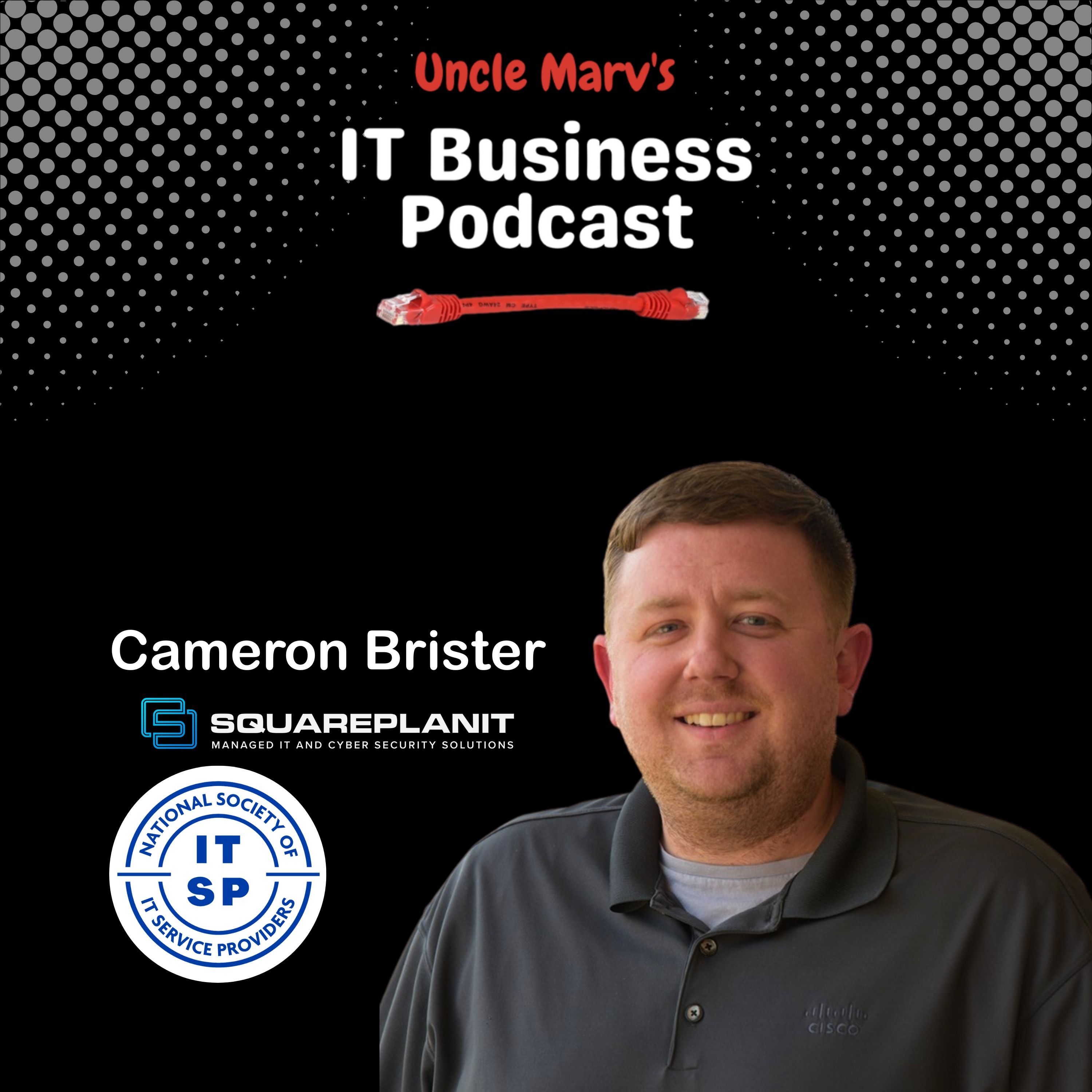
In this NSITSP Member Spotlight, Uncle Marv sits down with Cameron Brister of Square PlanIT, an MSP based in Monroe, Louisiana, to trace his journey from college intern and web developer to full-time MSP owner. Cameron shares how a long-running side hustle turned into a thriving managed services business, the role of automation in landing early clients, and why he believes in democratizing technology instead of just “saying no” as IT.
This NSITSP Member Spotlight dives into Cameron’s journey through higher education IT, a Fortune 500 manufacturing role, church AV/IT, and ultimately going all-in on his MSP in 2020. The conversation explores building recurring revenue from legacy software automation, setting financial and personal boundaries for leaving corporate, and elevating MSP professionalism so clients see you as a trusted strategic partner—not just the person who fixes printers.
Why listen:
- Learn how Cameron turned a nights-and-weekends web gig into a full MSP practice.
- Hear how early automation and SQL scripting work led directly to full IT management contracts.
- Get practical advice on when to leave corporate and what financial guardrails to have in place.
- Discover why “not all business is good business” and how to define a good-fit client.
- Understand Cameron’s view on democratizing technology instead of just blocking users.
- See how The Tech Tribe and peer groups shaped his growth and decision-making.
- Learn what NSITSP is doing to raise professionalism and give IT providers a voice with regulators.
Links from the show:
- Square PlanIT: https://squareplanetit.com
- National Society of IT Service Providers (NSITSP): https://nsitsp.org
- The Tech Tribe: https://thetechtribe.com
- Immybot: https://immy.bot
- ScaleCon: https://scalecon.com
- University of Louisiana at Monroe: https://ulm.edu
- Karl Palachuk: https://smallbizthoughts.com
- American Bar Association: https://americanbar.org
- David Phillips: https://dependableitservices.com/
SPONSORS:
- Livestream Partner, ThreatLocker: https://www.itbusinesspodcast.com/threatlocker
- Legacy Partner, NetAlly: https://www.itbusinesspodcast.com/netally/
- Internet Provider, Rythmz: https://www.itbusinesspodcast.com/rythmz
- Production Gear Partner, Liongard: https://www.itbusinesspodcast.com/liongard
- Travel Partner: Bvoip: https://www.itbusinesspodcast.com/bvoip
- Travel Partner: TruGrid: https://www.itbusinesspodcast.com/trugrid
- Digital Partner, Designer Ready: http://itbusinesspodcast.com/designerready
SHOW MUSIC:
- Item Title: Upbeat & Fun Sports Rock Logo
- Item URL: https://elements.envato.com/upbeat-fun-sports-rock-logo-CSR3UET
- Author Username: AlexanderRufire
- Item License Code: 7X9F52DNML
SHOW INFORMATION:
- Website: https://www.itbusinesspodcast.com/
- Host: Marvin Bee
- Uncle Marv’s Amazon Store: https://amzn.to/3EiyKoZ
- Become a monthly supporter: https://ko-fi.com/itbusinesspodcast
Hello friends, Uncle Marv here with another episode of the IT Business Podcast, the show for IT professionals and managed service providers, where we help you run your business better, smarter, and faster. And we are here with another audio podcast. Today, we are going to be doing an NSITSP member spotlight.
And I have with me Cameron Brister from Square PlanIT out of Monroe, Louisiana. And Cameron is the newly elected chair of the marketing committee over at NSITSP. But we're going to try to talk a little bit about his company, the name he came up with, and all the stuff that they're doing out of Louisiana.
Cameron, welcome to the show. Thanks for having me, Marv. Happy to be here.
All right. So we've met, I don't remember the first time we met. I'm assuming it was at the NSITSP, one of those meetings.
But was it just a few months ago or was it last year? Probably last year. I think when Amy had come on board as the committee chair at the time, I think it was around the time that you joined the marketing committee, right? That's probably when we first had our first meeting there. Okay.
But I would sit in the background and not say anything. Right. So Cameron and I had a little chuckle before the show.
So his company is in Louisiana. I was born in Louisiana, not far from where your company is. So it's a little interesting that your company is there.
I would not imagine an IT company thriving in that part of the state. So let me ask about how you got there and what made you decide to start a business? Yeah. So I started the company back in 2009 and it was truly a side hustle, right? It was a nights and weekends thing.
At the time, I was attending the University of Louisiana at Monroe in the computer science program and also working as an intern in the IT department at the local community college. So I really enjoyed what I was doing there. I had some really great opportunities that I probably didn't appreciate as much at the time, as I've come to appreciate later in life and as my career has progressed.
But I was able to get a lot of exposure in my time as an intern in that IT department, that a lot of exposure to different tools and technologies and facets of IT. And one of those things at the time was I was responsible for the community college's website that all fell in the IT department. And I enjoyed doing that.
And I ended up finding people who learned that I managed that for the community college and wanted to hire me to build a website for them. And so that's kind of how my company started was very much nights and weekends, side hustle, a way to get to leverage some skills outside of my day job and then outside of the education. And it kind of grew from there.
But again, it was a way for some additional income and additional exercising of skills. Interesting. So I did a little bit of work in my college, but we didn't have an IT department for the school.
First of all, it was a small private school. And they did have a computer lab, but I don't, hopefully this doesn't age me that much, but we didn't have an IT department for the school. The lab was pretty much the computer department there.
I was just a tutor in that. But my roommate, when I first went there, was helping out with the school computers and stuff. And we weren't networked or anything back then.
So interesting that you got a chance to do that at the school while you were doing your studies. You know, it's really funny. So I've told this story.
And again, I've come to appreciate so much of that experience as I've progressed in my career. I remember the IT manager at the time who I was acquaintance through another acquaintance. I worked for him and he offered me the internship.
And so day one, we're at the community college. I'm in the IT department. It's small.
There was probably four or five of us total in IT, including the IT director at the time. And we had a user come in and I was having trouble. I don't remember what it was, maybe a printer or something kind of basic, right? And I jumped up.
I'm like, oh, let me help you. Now, I had no idea what I was doing. I was eager.
I was ready to jump in and get to it. But quite frankly, I didn't necessarily have any prior experience, but I was always happy to get in there and learn. And so I started to walk to her office.
And then I turned around and I went back to one of the system administrators. I said, hey, in case I need to log in as an administrator, what's that username and password so I can log in as that? And he said, oh, you're a domain administrator. Your account set up as a domain administrator.
And I said, OK, what's that? Day one as an intern in the IT department, I was granted domain admin rights and had no idea what that meant at the time, right? Yeah. So cringing today, I was going to say that's probably something that today would be like, oh, hell no domain admin. But it really again, that was kind of the start to my career.
And I really have to give credit to the guy that hired me there and gave me that opportunity because, again, we were really able to do so much. I was able to grow with the college. You know, there's a lot of great experiences there.
I eventually graduated from the university and went to work full time for a brief while at the community college in the IT department. And then that really just kind of kickstarted my career in my business. I'll continue to work the business on the side, nights and weekends, gaining more clients, expanding into more technology, you know, really more on the IT side outside of just web development and app development.
And continue to grow that while working through other parts of my career. I've worked so in higher education, moved into running IT and then audio video production for a fairly large church for about a year or so, and then moved into IT for a Fortune 500 manufacturing company, which I really enjoyed and did that for many years before moving into the role full time to grow my company back in 2020. OK, so I was going to ask because I could not see the correlation in the jump from web dev and software dev into IT.
And when you were mentioned, you know, the side hustle thing, most side hustles that I know, you know, we are the trunk slammers of the IT world and helping, you know, some residential, some small business, if you're lucky and stuff like that. So, yeah, that that that information helped me fill the gap. So thank you for that.
Yep. So by education, I have a degree in computer science, which is really heavily on the programming development side. And we do that in our company.
We do actually have a division that actually handles custom programming and development outside of the traditional managed IT services space. Now, when you made the shift to, you know, really focusing on this in 2020, was it before or after the year of our COVID was announced? It was it was technically after, but really right there at the very beginning, it was July 17th, 2020, actually was my last day in corporate America. And it really wasn't necessarily driven by COVID, but it was definitely like I've been working up to the point of being ready to make that shift from, you know, full time employee with side hustle to full time, you know, business owner and running my own company full time and building that.
So it's something I've been working up to for several years. It just I guess the stars aligned. And, you know, there we are.
Right now, I know if somebody goes to your website now, they'll see your site showing you as, you know, full blown MSP, managed IT, co-managed, you know, Internet phone systems and stuff like that. But when you make the transition in 2020, did you have a focus or did you have a core set of clients that you knew what you were going to be doing? We did. And by that point, we were really, really heavily on the IT side.
And that's really the area of the business that I've worked to grow in the last five years. You know, I've been fortunate enough that over the years I've made enough connections and we've worked with enough people that we've got so much word of mouth comes in on the kind of web and app development side. And so we do that but really have been focusing on the on the MSP specific space for the last five years.
What makes us a little bit different, though, is we can do all of it. Nice. Let me ask this.
A while back, I had Immybot on the show and they're based out of Louisiana and stuff. Obviously, they focus on automation and integration and deployments and stuff just because they're in your state. Have you heard of them? Do you use them? So I have heard of Immybot.
I didn't know until recently. In fact, I think it was at ScaleCon a few weeks ago when I discovered that they were actually in Louisiana. Otherwise, I mean, I've heard of them.
We've never used them but didn't realize they were so close to home. And talking about automation, actually, I'll just take a brief sidebar there. That really, I think, helped get me in the door, especially in the earlier days of my business when it was still kind of on the side back to those kind of programming and development routes.
We did a lot of I say we at the time it was just me. I did a lot of automation, internal automation for clients. I can think of one in particular that has or at the time they had this very legacy software was no longer supported.
It ran their entire business, but there was zero automation capability in it. And so actually, I would come in and build custom scripts. It was all SQL server based would come in and do automation around their business processes.
And we were able to reduce their kind of admin overhead, their admin headcount that allowed them to refocus their energy and their workforce into things that were more value added for the company. And so from that relationship stemmed into just taking over actually their entire IT from a managed IT perspective. And so when I think about kind of the history of growing the company and where we've been, a lot of that kind of led its way into the IT side where we started in from the kind of software consulting automation perspective at the time, very rudimentary stuff with things like T-SQL, SQL agent jobs, things that really just run in the background to modify the application database.
Those things are critical. I remember when I was getting started and I was able to figure out things for my law firms, just things to help them build even 0.1 faster, that made a big difference for them. So very nice.
Looking back, let me ask you this question. This probably wasn't planned too well, but you talked about doing that transition as a side hustle. It sounded like you did the side hustle thing for a long time before you made the full jump.
What are some things in your mind that if you look back and looked at your process and then you saw somebody today who was looking to either start the side hustle or take the side hustle and turn it full time, what's some of the advice that you think you would give them? You know, for me, if I think back to that process, I had the goal in mind for a really long time that ultimately my ultimate goal was to run my business full time and to grow my business full time just outside of myself, right? It needed to be something more than just me. But that doesn't happen overnight. And I was never okay with letting performance at my day job be sacrificed in favor of growing my business, right? So there for a while, I had a full time job and a part time job.
And then it turned into having two full time jobs, you know, and then it felt like almost two and a half full time jobs. And finally, my wife was like, you can't keep doing both of those things, right? So, you know, I would say that if that's your goal, like work towards it, it doesn't necessarily have to happen overnight. And quite frankly, it probably won't happen overnight.
But if you put these structure and the plans in place and work towards it, it can happen. You know, for me, a lot of it came down to just simple financials, right? Being able to make that jump and still be able to eat, right? That's a big thing. It doesn't matter so much that you have these goals and aspirations and dreams.
But the reality of, you know, paying the bills and keeping the lights on is a lot of it. Preston Pyshka All right. So you are in the full swing of it in 2020.
Here we are, it's only 2025. But you obviously have evolved enough that you are, you know, in the full swing of the MSP stuff. What organizations besides NSITSP had you been involved with that kind of, you know, rolled you into this one? David Tenenbaum Yeah.
So I think probably the first, you know, IT member organization, kind of in our space that I can recall being part of would be the Tech Tribe. And I joined the Tech Tribe in, gosh, I think it was 2019, maybe 2019, 2020, right in there somewhere. And that kind of kicked things off.
And I tell you, one of the most impactful things that I ever did was joining the Tech Tribe. Because when I joined the Tech Tribe, suddenly that unlocked access to other professionals in our industry. It unlocked access to people that, you know, you can bounce ideas off of, that you can toss out a problem and get some feedback on how would you handle this.
And then what I would attribute, probably the most impact that that organization has had on me and my businesses, we were part of the very first round of peer groups that the Tech Tribe put together. In fact, I think our peer group was number six. It was in that first batch.
And that introduced me to other IT business owners in different markets that similar size, similar stage in business as I was at the time. And kind of helped have that regular feedback loop of, hey, here's a challenge I'm having. What ideas do you have that could maybe address this? Or have you faced the same challenge? And what do you do to address it or to resolve it? And actually, still to this day, five years later, I think that was in 2020 that that peer group started.
It was 2020 or 2021. But still today, there's three of us of the original five members of that group that still meet every two weeks. In fact, one of those people is David Phillips, who you also know through the NSITSP.
That's how David and I became acquainted and became, honestly, today, good friends. And now David's a close personal friend. All right.
Very nice. Now, I ask that because it's not very often that you find somebody where their first exposure is to a group like NSITSP. So I always want to get the background as to what you were doing before that.
So now the question, of course, is how did you hear about NSITSP? Yeah. Yeah. So I was thinking about this, actually.
I thought this would probably come up. I really don't recall exactly the first time I heard about it. I feel like it was through Karl Palachuk.
And I can't remember exactly where, but maybe one of Karl's videos or a social post. I really can't recall. But it was through Karl.
And I saw, hey, here's what the organization is about. I think this is a good idea. Let me just see what it's about.
Let me check it out. So that's kind of how that got started. That later turned into me becoming a member of the marketing committee, at David's insistence, actually.
David was a member of the marketing committee before I was. And he said, hey, you should join me on this. And so I did.
And then eventually, I ran for an elected position on the committee. That was two years ago. And then just recently ran for re-election to the committee.
And as you noted, was elected to become the chair of the committee. So that's kind of the history there of the NSITSP. All right.
So I'm going to skip a whole bunch of stuff in there and just go to the fact that now you're the chair. And have you had time to kind of sit and assess what your goals might be for the committee and where you think things should be heading? Well, I have. And I did miss one little piece there.
There was a brief period of time before Amy came in to the committee where I had served as an interim committee chair. The former chair stepped down, just didn't have the time to dedicate to it. And I stepped up in an interim capacity.
And then Amy came on board. I think for me, where I would like to see our committee go is really being a supportive role for the other committees and for the organization as a whole. For me, I don't think it's so much about necessarily what my vision for it is.
I think the vision for the committee has been set by the committee charter and then also by the strategic plan that's been put together by the board. And so for us, I think it's all about execution, not necessarily if Cameron has great ideas about this or that or the other. I certainly don't want to change our course because I think we lose momentum that way, right? It's really more about how can we take what's already kind of been defined as our mission, what's our charter, and then how do we use that to push the organization forward? All right.
It's a question I'd just like to ask because it helps me because I'm still considering myself sitting on the outside looking in and love to hear each person's perspective as to what should be our guiding light, in a sense, of the organization. So now going back to David insisting you be a part of it, obviously he felt that you were in a position with your business that you would exemplify that professionalism that we are looking to try to build up in our industry and stuff. What was any other point that he tried to drive home as to why you should be involved? Do you remember? David makes a really great point and I'm sure he'll talk about this.
I hope that he'll talk through this when you guys have an opportunity to chat because he's got some great ideas on this. But I'm going to steal his example and then he can go into the detail. He equates the NSITSP to IT providers as the American Bar Association is for attorneys.
And David's vertical is primarily in the legal space working with attorneys. And I think that's a really great analogy as to what our potential is as an organization and kind of where a lot of our focus should be. In general, personally, I'm generally of the opinion that smaller government and less regulation is better.
However, we all know that if we don't have a seat at the table, then things will happen to us rather than happening with our input and with our involvement and with our voice. And so I think that's one opportunity that the society has is to really be that voice of the industry, right? To promote professionalism in our space and to help drive those things so that we're not being driven by people that probably have good intentions, but quite frankly, just are not the industry experts. Now, with that, we talk about the two things happening to us when it comes to regulations.
We talk about establishing professionalism. Outside of those things, what do you see as some of the biggest challenges, hurdles that we need to kind of address in our managed services space? So I'll give the example. When I think about what does it mean to be a professional in your industry, right? What does it mean to implement that in your managed services business? For me, a lesson that I had to learn, quite frankly, the hard way, and I know a lot of others have done this too, is not all business is good business.
Not all clients are good clients. And not everyone is the right fit for you for a number of reasons. I think that if you're truly working hard to do the right things, being that professional in our industry, then you should be seen not as the guy that fixes my broken computer, but the guy that can help me propel my business forward through that strategic partnership, through the strategic planning from an IT or technology standpoint, versus, hey, our printer's broken.
Can you fix it right quick? I tell people all the time, what sets us apart from the IT company down the street? It's, yeah, we'll keep the lights on. We're going to keep your computers running and your printers printing. That's table stakes.
But really, we want to understand your business. We want to understand your industry. And we want to provide that strategic partnership.
We want to provide the strategic guidance where we are experts on the technology side. How can we help you through technology achieve your business goals, right? And so I think that a lot of times, it's easy to take on a client who doesn't value that relationship, that doesn't value that experience and knowledge. And for me, that would be a bad client, right? Nothing, not to say that they're a bad company or don't know what they're doing.
But I think that we should work with people who value our input as professionals. I know when I'm looking for a professional service, I'll be the first to admit that I might have an idea or I might have an opinion or maybe some thoughts or maybe I've done some research. But at the end of the day, I really want to leave work to the professionals, right? I want to find a professional that I can trust.
And then I want to let them do their job and do it to the best of their ability. And that's what we should be striving as IT providers to work with clients who value what we have to offer, value our input and look at us as that trusted partner. So I am going to take what you just said and see if I can roll this into this question and tell me if I'm making the correlation.
When I was looking up information about you, I came across a statement that you believe in democratizing technology. Is that correct? And what is the way that you would officially define that? So for me, democratizing technology, IT in general, and this holds true, I think, for organizations with the traditional IT department and for organizations that work with outsourced IT, IT can often have a bad rap because they say, IT says no, right? No, you can't have this. No, we're not going to do that.
No, security this, security that. To me, democratizing access to technology is more about how do we as the IT professional empower the business and empower the end users within a company to do their job and to do it well while providing the security that they need and the technology that they need. There's a way that we can do both, right? We can provide secure access to the tools and services that people need to do their work, right? All right.
Sounds good. Cameron, I think I'm going to go ahead and end there. I have a thought and I'm like, no, that's going to take us another 10 minutes.
So maybe we'll look to have you come back and chat about this later. But thank you for joining me. Thank you for sharing your thoughts about not only your business, but about the NSITSP and even those additional thoughts about where we should be going as an industry.
I appreciate that. Thanks for having me, Marv. It's been a pleasure.
All right. I will have Cameron's information in the show notes, folks, as well as a link to the organization we're talking about, the National Society of IT Service Professionals, NSITSP. And check everything out on the website.
On behalf of Cameron, I thank you for joining us. We'll see you soon. Until next time, Holla!

CEO, SquarePlanIT
I'm the founder and CEO of SquarePlanIT (pronounced like “square planet”). a professional IT services firm based in Monroe, Louisiana. Founded in 2009, we provide IT support, custom programming and app development, and strategic technology consulting to small and mid-size businesses, and a few local government agencies.
My hobbies include scuba diving, flying (I have a pilots license), and traveling with my wife.
I'm involved in a a few local non-profit organizations that promote beautification, recycling and litter abatement in our community, and I serve on the board of directors for my local chamber of commerce. I'm also on the board of our local workforce development board.
I am a founding member of the NSITSP and currently serve as the Marketing Committee chair.


