

 Apple Podcasts
 PocketCasts
 Overcast
 Spotify
 Podcast Addict
 Amazon Music
 iHeartRadio
 PlayerFM
 TuneIn
 Audible
 Castbox
 Podchaser
 Goodpods
 Pandora
 Audacy
 Deezer
 Spreaker
 Building an MSP People Trust (EP 1072)
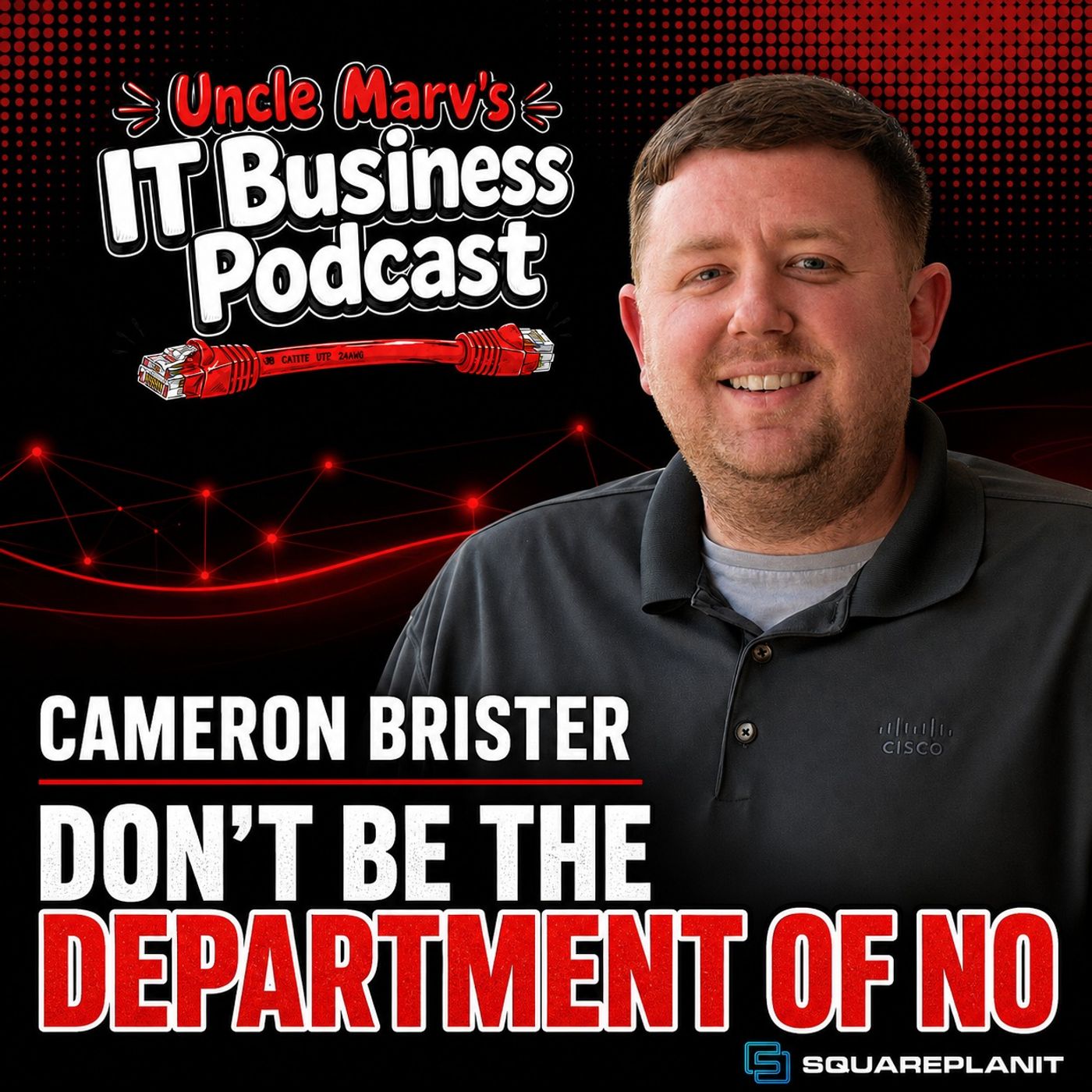
Not every new tool deserves a migration, and not every prospect is the right client. Cameron shares how SquarePlanIT is weighing AI, PSA and RMM changes, community marketing, and client fit without losing focus on what already works.
I sat down with Cameron Brister from SquarePlanIT to talk about the real-world decisions MSP owners are making right now. AI is changing fast, clients want to use new tools yesterday, and we still have to think about security, permissions, data, and supportability. Cameron makes a great point that we cannot become the department of no, but we also cannot pretend every shiny new tool is ready to roll out to clients.
We also get into the less glamorous but very real work of running an IT business: migrating from Autotask to Halo, planning a move from Datto RMM to Ninja, dealing with relentless vendor outreach, and figuring out whether marketing is actually working. Cameron shares why he sees AI as a back-office helper for things like ticket triage and research, why community involvement builds long-term trust, and why saying no to the wrong client can be a sign of operational maturity instead of a missed opportunity.
=== Chapters
- 00:23 Meet Cameron Brister of SquarePlanIT
- 01:43 Democratizing Technology for Clients
- 04:04 AI Guardrails Without Becoming the Department of No
- 05:57 Microsoft Copilot and AI Implementation Challenges
- 08:38 PSA Migration: Autotask to Halo
- 11:13 RMM Changes and Avoiding Shiny-Object Decisions
- 16:08 Vendor Outreach, Privacy, and Call Screening
- 27:08 MSP Marketing, Community Visibility, and Networking
- 39:41 Qualifying Clients and Knowing When to Say No
=== Guest: Cameron Brister
- Website: https://squareplanit.com/
- LinkedIn: https://www.linkedin.com/in/jcameronbrister/
=== Resources / Companies / Products / Books / Podcasts
- HaloPSA: https://halopsa.com/
- Autotask: https://www.datto.com/
- Datto RMM: https://www.datto.com/
- NinjaOne: https://www.ninjaone.com/
- Avanan: https://www.checkpoint.com/harmony/email-security/
- Clio: https://www.clio.com/
- ZoomInfo: https://www.zoominfo.com/
- Apple iOS: https://www.apple.com/ios/
- National Society of IT Service Providers: https://nsitsp.org/
- West Monroe-West Ouachita Chamber of Commerce: https://westmonroechamber.org/
=== SPONSORS:
- Technology Partner, NetAlly: https://www.itbusinesspodcast.com/netally/
- Technology Partner: Bvoip: https://www.itbusinesspodcast.com/bvoip
- Travel Partner: TruGrid: https://www.itbusinesspodcast.com/trugrid
- Digital Partner, Designer Ready: http://itbusinesspodcast.com/designerready
=== SHOW MUSIC:
- Item Title: Upbeat & Fun Sports Rock Logo
- Item URL: https://elements.envato.com/upbeat-fun-sports-rock-logo-CSR3UET
- Author Username: AlexanderRufire
- Item License Code: 7X9F52DNML
=== Connect with Uncle Marv
🌐 Website: https://www.itbusinesspodcast.com/
🎙 Host: Marvin Bee
🛒 Uncle Marv’s Amazon Store (gear & tools I recommend): https://amzn.to/3EiyKoZ
☕ Support the show: https://ko-fi.com/itbusinesspodcast
If you found value in this episode, share it with another MSP, IT provider, or tech entrepreneur. Your support helps keep practical, no-nonsense IT business conversations coming every week.
[0:10] Hello, friends. Uncle Marv here with another episode of the IT Business Podcast, the show for IT professionals and managed service providers, where we help you run your business better, smarter, and faster.
[0:23] Well, I want to thank you all for tuning in. We are continuing with our series this month of August, where I'm trying to talk to all MSPs and IT business owners. And today we are joined by a guest that was asked on back in December uh Cameron Brister from uh SquarePlanIT, or do you say Square Plan IT I we talked about this I forgot we did talk about it yeah no you had it right the first time SquarePlanIT I always tell people it's about 50, uh and you know for better or worse that's what I decided to name the company and that's is part of the deal, but that's okay. Now you, you had it right. Okay. Yep. So SquarePlanIT, uh, with the IT capitalized, if you go and, uh, look it up, but SquarePlanIT, uh.
[1:13] Dot com right that's right yep should have brought that up in prep for the show or anything yeah uh, so for those that have not listened to that show uh you may want to go back and listen but we'll give you just a very quick recap Cameron and i uh are serving, on the marketing committee of nsitsp, and Cameron has, happily become our uh committee chair.
[1:43] I think it was more of a voluntold situation when it happened but that's okay you know we're all working uh the same direction and for a good cause so happy to help where i can okay, so without going too much into our last podcast one of the things that we just discovered is the way that i named the podcast democratizing, technology apparently we started to talk about that, But then we didn't really get too far into it. I think we were so enamored with the NSITSP talk and everything that I thought, you know, we should go back and flesh out that more and really dig in deep. So I want to start with, first of all, when we say democratizing technology, what do we mean? You know for me the first thing that comes to mind is really empowering our clients right empowering our clients and their team members, through technology to get done what they need to get done and that's never been more prevalent than it is today so for me it's more about that technology enablement and all of the things that come with that security and, you know the guardrails that come with that but really it's really about empowerment and enablement.
[2:59] So let me, let me ask this because empowerment from my, the way I would see that is customers want to be empowered with their technology. They want to be able to do the things they want to do. They don't want to be restricted, which they feel a lot of times we do. We hold them back. And especially in this time of AI where things are moving so fast, it's almost like we're, we're putting the brakes on them and they're like wait a minute why are you the ones you're supposed to be the techies aren't you know the ones that should be pushing us more towards this and for the first time in a very long time, we're kind of on our heels like wait we don't know what this is going to do yep, Yeah, I think you said it best where it's hard for even professionals like us to stay on top of this stuff as rapidly as it's changing, right?
[3:58] Even just an awareness of what's out there, not to mention the potential security
[4:02] implications and everything else that comes along with that. So one thing that I like to tell people is, you know, we don't want to be known as the department of no, right? And oftentimes IT, whether that's an internal IT department or, you know, a co-managed engagement or a fully outsourced managed services provider.
[4:23] It can very easily come across the perception our client can be that we're the department of no. I think most professionals don't intend for that to be the case. It's certainly never been my intention for us to just say no and that's it. But as Marv, as you know, I mean, we're concerned with the security implications, first and foremost, for anything that we support, anything that we implement, anything that we're partnering with our clients to allow them to implement and use. And so I think that's where strong communication comes into play. And I mean, that's where I've had conversations with clients. It's like, look, we're figuring this out with you, right, in a lot of cases, because for one, the number of options out there are just so broad and forever changing. I mean, even if you stuck within one or two of the well-known AI, you know, ecosystems clawed or open AI, the number of new models that are coming out and the changes to those day in and day out, it's just really hard for anybody to stay on top of. So I think that's where a good communication and a good mutual understanding of what your client's trying to achieve and where they're trying to go strategically and them understanding that. Your position on it, not coming from a position of we don't want to turn this on for you, but we're concerned for you and we want to make sure that this is.
[5:51] A secured solution and all of the things that come along with that.
[5:57] Where are you guys at with AI implementation in your office?
[6:05] I feel like we're perpetually behind. I feel like we can't even keep up with that internally. And I've spoken to a number of peers in the industry, several that I know that you know as well, who are also involved in the NSITSP. And we're very much trying to figure this out as we go, both internally and then how do we implement that and deploy that for clients. You know, we've looked at different tools and we internally, we use Copilot. But that's an easy one from a security standpoint because it lives within your Microsoft 365 tenant, right? If you're in that ecosystem, that's one that I can feel relatively good about very easily just because it's in that controlled environment that, you know, you can apply DLP policies to. And, you know, you can kind of put some easy guardrails on that. We've looked at some of the third party tools like Hats AI. And while that's cool from a business standpoint shifting maybe away from the technology piece but like from a business standpoint we're still trying to figure out how do we.
[7:09] How do we turn that into a business model, right? I mean, personally, I don't necessarily just want to resell AI to clients, right? I want there to be a value-added service to that. We want to make sure that it's not just us reselling a tool, but, you know, that we can support and implement it and provide more value there. So it's tough. I mean, quite frankly, most of the folks that I've talked to in our space, you know, other MSP owners, I don't know that anyone has truly figured it out and come up with the model, right? Right.
[7:39] So that's really tough. I think from a strategic standpoint and kind of maybe a broader vision, where I would like to see AI as it relates to us as a service provider is automating and streamlining internal processes that are not client-facing. I never want to lose that personal touch as it relates to our interaction with our client. I would rather focus on being able to streamline backend processes on the back end of, you know, ticket triage and research and stuff like that. And that really be a kind of a back office function. That's, you know, I don't envision a day where you ever are going to call our main line and have to talk through a series of AI auto attendants to get your information and open a ticket for you and all that kind of thing. I really like that human touch. So when you call our office number, you're going to get a person. And I don't see that changing. I look at the AI and some of the automation as being stronger in the background to help us have more time for that personal interaction.
[8:39] Have you started connecting any of the MCP servers to any of your stack tools?
[8:47] A little bit. I've been a little hesitant to do that just from a security and permission standpoint. So in the midst of all that, too, we are just starting a PSA migration, right? So we're moving from RMM Autotask over to Halo. And even for a small team like ours, that is, I mean, that's just a monumental shift, right? I mean, that's the core of our business from the service desk, You know, ticketing, contracts and billing, everything, right, is centrally kind of housed in the PSA. So it's put a little bit of a pause on some of that stuff as it relates to that because we want to get through that migration here in the next few months and then turn on some of that. The other thing, too, not to talk too much about specific vendors or tools, but Halo has a lot of native capabilities that Autotask doesn't. So trying to get the most out of our.
[9:40] Native capabilities once we make that shift and then figure out where we need
[9:44] to bolt on solutions that maybe it doesn't have natively. Okay, well, I was going to ask you to dig deep on that. I'm not afraid to talk vendors here. So I was going to ask, you know, what is it that would make you switch from Autotask to Halo? Um, we've been with, uh, with Autotask for quite a while. In fact, we were with Autotask when it was the company Autotask. And then we were an acquired Datto customer and now we're an acquired Kaseya customer. Um, and so functionally, you know, Autotask is a very robust product. Um, what's great about it is I pretty much know how to think like Autotask. And so we've been able to make it work like we need it to work in a lot of scenarios. The shift to halo is largely to overcome some limitations in in workflows, that we just can't do some of the things you just cannot do in Autotask natively and maybe you could bolt on some things and through their Api and do it, outside of the MSP business and professional services you know it business, we also do a good bit of custom web and application development So those workflows are very different from a support standpoint.
[10:59] From a project tracking standpoint. There's two very different things, and there's just a lot more customization we can have around those workflows within Halo, mostly on the ticketing and project side that we just can't get out of Autotask.
[11:14] Are you using Ninja for your RMM? We're not, but that actually is the planned migration path from Datto RMM where we are today. Dude, you're leaving Kmart, man. We're leaving the mothership. Okay. I'm an acquired Kaseya customer. I've never chosen to be there. The, um, oh, cause you've, you had products that they acquired. Yeah. I mean, like I said, we started with Autotask. It was the company Autotask owned the product Autotask. And then it was Autotask Endpoint Manager, which then became, you know, when Datto purchased them, that became Datto RMM. And then Kaseya purchased them and, you know, here we are. Well, that's how I was with, uh, let's see, I had IT Glue, which actually was monkey box way back in the day. I don't know if you ever knew that. You know, I've not heard of that one. Okay. yeah monkey box in like 2014 that was my first documentation system and then it glue bought them and Kaseya got it glue, i had open mesh was the networking product before Datto, RMM or Datto networking acquired all that so yeah I m in the same position and, i was a Datto person as well and.
[12:34] Uh not anymore so where are you today on that rmpsa that stuff so I m still with enable insight not central and insight and that was gfi hound dog you know back in the day oh right gosh i forgot about that i hadn't heard that one in a while yeah and i listen, i tell people I ve looked at other products it's but enable insight does what i need it else it's simple yeah it's it doesn't have a great uh psa integration with their own product, which I ll be on i hate i hate i don't even remember the name of it i tried it and it was it just didn't work, I don't do a typical ticket system so a PSA really wasn't, you know foremost on my mind it's not something I ve had to have although there are some things that I m looking at doing where i may have to do it halo psa is in that box that if i start looking they're going to be in there, but right now between what I m doing, i mean i rarely talk to a customer, i mean we'll probably take three to well probably let's say we average five calls a day but it's not that bad the threat locker i use that that's probably.
[13:59] The second most used thing that we do but people know how to submit the requests i just click approve or not approve and if it's something i don't recognize or have an issue with i just i call them and we're good there so everything, all our systems just work for some reason i mean I m not to say that my stack is great i just think, where i am with my customers it works you know and i think that's the more important thing i think a lot of times it's really easy for us as, you know, IT guys at the core to be interested in the shiny new thing, right? And what's the new hotness?
[14:38] And that is, you know, I mean, that's one thing that makes us great, but it's also one thing that's probably detrimental to productivity, right? And so for me, you know, like I said, even for a small company like mine, you know, moving PSAs is a monumental task to do it right. I sat down and kind of mapped out all of the different integrations that we have with Autotask and Datto RMM, and all of those are going to have to move, right? And that's a lot of stuff happening that we've automated for alerting and some billing integrations and things like that. There's just a lot of moving parts there. And so that's not something I don't plan to do that again next year or the next year or the next year, right? You know, we were with Autotask for, I think, right at nine years now. And, you know, that's, to me, it's I want to do that once every nine years maybe, or maybe this will be the last, right? I don't look to move that. Everything...
[15:38] You know, you look at the shiny objects, like there's a lot of cool stuff about some of the new things, but it's not always something that you can't work around or that is really worth taking the time. Because, again, it's such a time suck. It's such a, you know, it's taking a lot of focus away from other projects that I'd like to do. But this is the big project right now for us. So I think there's nothing wrong. I think when you find something that you like and it's kind of quiet and it just works, like that means you've got the right setup. Yeah.
[16:08] How many, how many vendor calls and emails do you get a day?
[16:13] As far as, you know, trying to pitch the new thing. Oh yeah. Yeah. Well, we use Avanon for filtering, so much of that stuff gets pulled out and I don't have to see it. Oh, man. I'm also kind of militant about giving out my email address for that kind of thing. So admittedly, I don't necessarily get bombarded with most of that stuff. I mean, it happens, but I don't know that I can measure it in a number per day. It's much less frequent than that. Okay. All right. So I got a call.
[16:46] Did yesterday or Thursday? we're recording on a Saturday uh this probably won't be released till Tuesday so it's one of the few times i won't publish right away uh so Thursday or Friday i got a call who was it oh.
[17:02] So Clio the legal uh case management software called me and said hey one of your clients, is looking to evaluate our software and we've got a partner program that we'd like you to consider and I m like first of all i only knew of one client that was actively looking at software i purposely did not reach out to Clio to be one of them, not because of anything on Clio s fault because the type of law that they had i know, what software packages closely fit what they what they use and Clio just didn't fit them so i thought it was that customer somehow and i told him i said Well, not yet, blah, blah, blah. So that person followed up, you know, with the email, like she said she would. And then she put the client's name in there because she wouldn't tell me on the phone. Okay. But she did in the email. And it put it in writing, but it's usually it's the other way around. Right. I don't know. I just, I, and I probably should have thought, well, which client, but I think I was, I was so defensive of my control.
[18:09] But it turns out it was another law firm and they were looking for, uh, Clio has a research product, which I think they're going to add some AI into and stuff like that. So this client was looking at Clio for that. And I just said, oh, okay, well then from that, I'll go and look. So I emailed her back and said, oh yeah, I'm interested. Let me look at the program. So, you know, she scheduled that, you know, call right away.
[18:35] So it must have been Thursday was the call and then Friday we were actually on the thing and i said you know you probably should have told me the client name, you know and this would have done a lot easier and afterwards you know she wanted to send me the stuff for the program and stuff and she goes let me make sure i have all your information corrected she started reading off you know the company name and address and the address I m like no that's not correct and, and she was looking off of a zoom info database, which you know a lot of those databases don't get updated we've been at this location almost 10 years yeah and I m like no that's not it i don't know you guys have got to update your stuff, right it's like um but it's just it's amazing how vendors and i don't know how, they found out that i was associated with that client because it wasn't a, the customer didn't talk to them really okay so that's kind of wild i kind of asked her and she said i don't know you're in the database I m like okay so somebody is selling my information, and it is everywhere so client calls uh vendor calls are just, i don't want to say they're getting out of hand but we're going to expect more especially with ai.
[19:57] Yeah, and, you know, that's a two-sided, sword, I think, in a lot of ways because, you know, one of the things that we, and my company have tried to kind of work on here is being a little more, you know.
[20:15] Doing things with a little more, you know, purposeful around some of our marketing, right? We are trying to make sure that we're targeting who we think are our ideal clients. And we've never done this, but I know that Zoom Info is an example. I mean, you can go subscribe to that and go put in the parameters for what you're looking for and download a list today. And I think that's where a lot of this stuff comes from, right? Them and their competitors. And for the most part, it's like, I didn't opt into that. I would rather not be included in that. I get calls where I do get a lot of calls, probably more calls than emails, actually, is to my personal cell phone, which I have not published anywhere, in years and years and years. And forever and ever and ever ago, before we had a business number, that was what was everything, right? It was Cameron's cell phone. It was just Cameron and call my cell and whatever. I don't even know how long we've had a business number. And that number has not been published. All the vendors that we use have been updated, all of that. And still, all the time, you know, I get an unsolicited call, you know, wanting to sell me something. I will say, though, in the latest version of iOS, I don't know if you're an iOS or an Android user. I don't know that we've ever talked about that. Yep, I got the iPhone. Okay, good. We can still be friends then.
[21:35] If you said Android, I may have to question some things. But, you know, in the latest version of iOS, the call screening feature is phenomenal. I don't know if you've tried that, but while, I mean, that has cut down on the number of interruptions that I get drastically for vendors unsolicited, you know, calling my phone. I don't want you to call my cell. I'm not publishing it. Please, please remove me from the list. But that's, that's been hugely helpful.
[22:02] Yeah i haven't had to do much with it i did see it because my cell phone has not been public since probably 2000. Um interesting story i had a customer call me Sunday morning at like eight o'clock one day because their mouse wasn't working oh, and i was like you know what I m not doing this anymore. So, uh, and that was a bothersome customer anyway. So I fired that customer, stopped using my cell phone. But what happens over the years, you're in these databases and people are selling your information and, you know, zoom info or a buzz file or whatever that business, all those things, they connect. And, you know, if you are, you know, the president, CEO, you know director.
[22:55] Then they're like oh let's go look at other databases that have this person's personal information and let's find relatives and stuff because you know my wife's cell phone has gotten called by vendors, and her numbers yeah nowhere and I know I know where it started and it was my mistake I put it as an emergency contact, And so this last, I just filled out another conference info, uh, sign up and, and asked for the emergency contact. So I put her name in the company phone number. Yep. So I hope nothing ever happens at night.
[23:34] Right well you know it's funny because um i you know again i don't publish my phone in fact a large probably most of our clients don't have my phone i mean a lot of them do because from back in the day right i mean I ve still got the occasional client that'll text me for something and you know we want to take care of people uh and most of the time we just take care of that but um, it's kind of a especially if you're in our position we're like you're the owner of the company like it's different than like i would never and will never allow anybody on my team to have their cell number given out to somebody their work cell number nobody should ever have that like that's for our communication that's so they can get into the tools they need and all that but if you know if you need anything if you need to call SquarePlanIT we, we publish that number you can call us anytime and we're there and somebody will get to you um but like if you know if the, uh.
[24:23] CEO of, uh, of one of your clients is like, Hey, you know, personal sell, I'm not going to say, no, I don't hand that out. Right. But with the expectation that that's respected, like, you know, if your mouse is not working at 8am on a Sunday, that's not a call Cameron thing. Right. Uh, we'll take care of your first thing Monday morning. But, uh, you know, if we're, if something's on fire and you're not getting what you need or, or we just need to have another conversation, you know, sure, give me, give me a call. Um, I would rather an email or, you know, call the office. Uh, it, so it's kind of a, kind of a catch 22. I never want to be perceived. I was thinking about this actually yesterday. I had one of our clients who, um.
[25:05] The lady that texted me actually was a friend of mine before we ever worked, with the company that she works for, right before they were ever a client. So we had each other's cell number, and it just so happens that her company's IT provider now. And so she's really good about respecting that. Like if she needs something, she goes through one of the official channels. And, uh, they recently had some turnover in leadership and their new, um, uh, their new executive director was like, Hey, can you give me a Cameron cell number? And she's like, Hey, can I give you, can I, you know, can I give her your number? And I was like, yeah, you know, uh, but, uh, it's one of those with great power comes great responsibility, right? Like, uh, just don't, don't abuse it. So i did have um, so I ve had probably two or three times where i have given the cell number to the owner you know if you know you know if you've got 150 person law firm and, you know uh you don't complain about my invoices you didn't have the cell phone number right but my deal with him was, don't give it out to anybody right and if they do, if they're an employee and they call me of that cell phone number, you're getting it billed for that call.
[26:23] And that's happened one time, and he did not believe me. And another attorney called one day, and it was like a weekend night or something. I was playing basketball or whatever, and I get a call, and I'm like, how did you get this number? And I'm like, all right. And then I put on the next bill, so one-hour billable call. And the firm admin was like, what is this charge? I told her, I said, I told him, if anybody ever called my cell, you're getting a bill. And I bet it never happened again did not happen again well and you know what I would assume that if anyone in any industry could understand that it would be an attorney yeah I mean they're billing in what six a minute increments right most of the time so yeah.
[27:09] So let me go back because I made a note here you talked about uh doing stuff with LinkedIn and marketing How is that going? Because I hear a lot of people saying that they're doing it and they're not getting any traction. You know, that's a hard one to measure, and some marketing person will probably tell me that I'm wrong. But me as an IT business owner, I feel like it's hard to measure. I do feel like it's meaningful and impactful, and to me, it's kind of about the long game. I don't think you're going to turn on marketing in any medium, whether that's a snail mail or email or phone call or whatever it is you're doing. I don't think you're going to turn on the money faucet by doing that for three days. For us, our marketing.
[27:58] Has kind of grown progressively as we've had the capacity to. So we first started with just posting tech tips and weekly tech updates on our blog. From there, we started emailing out to prospective clients. From there, we started sending out postcards in the mail, if you can believe that an actual printed thing in the mail. Physical mail? Come on. Yeah, yeah, to clients. And then, you know, we publish a monthly newsletter, the Technology Insider Newsletter, and that goes on our website. But we also send that in the mail to our clients. And I don't think I can attribute any new business directly saying, oh, my God, you sent me one postcard and this is everything I'm looking for. Shut up and take my money, right? Like, we've not had that. But I'll tell you what, it's happened, and it's happened more frequently because we've really only been doing this for the past probably 18 to 24 months in any capacity in the last couple of years.
[28:54] But several times recently and with multiple clients, I'll just be at a client's office one day, and they'll say, oh, hey, we loved your newsletter this month. I was with a client a couple of weeks ago, and it's a co-managed client that got an IT department and an IT director. and so their IT director gets our printed newsletter, And the lady that kind of handles all the mail coming in and who distributes it out stopped me in the hall. And she said, You know, we just love reading your newsletter. And so me and this other lady always, you know, take it out of the mail first and read it before we give it to the IT director. And it's that kind of thing right there where you can't measure that. There's no metric or statistic that's going to tell you that's effective. But clearly something's happening in a good way, right, in a positive way. So um you know for me it's like okay hearing that feedback it's like okay what we're doing is positive and it's good even if i can't attribute i sent 3 000 postcards and got x new clients or whatever it is um i think it's staying in front of people and staying kind of top of mind and for our clients the flip side of that is.
[30:04] You know i want our clients to hear from us and see us outside of them having a problem, right? If the interaction with us is only when something's wrong or something's not working, that's not ideal for anybody, right? That subliminally, I think, puts it just kind of a bad taste or a bad perception in your mouth, like, oh, I'm only ever dealing with these people when something's wrong. We want to make sure that you're hearing from us and seeing things from us when nothing's wrong, right? Yeah.
[30:31] Do you do things locally in your community as SquarePlanIT? Yeah, so we work with a number of nonprofit organizations in our communities. Some are clients, some we just are involved in directly. I personally am very involved.
[30:52] With a couple of nonprofit organizations, serve on the board. I'm very engaged in my local chamber of commerce and serve on the board of directors there. So that's one of, you know, one of the things that's really important to us as a company is community engagement, giving back and being involved. In fact, you know, one of the perks that we offer team members here is we'll give you 12 hours a year of community engagement leave. So if you want to go volunteer at the food bank on a, you know, Thursday afternoon for an hour or two, or you want to go work with some other nonprofit, you know, that's during work time that you would otherwise not be able to get away, like we'll support that with you. So that's very important to me and to who we are. Nice.
[31:37] Very interesting. I asked that because I wanted to kind of gauge. I find that companies that are actually involved in the community actually get exactly what you were talking about on the LinkedIn space where people are starting to recognize and see, you know, yeah, it's just a newsletter and they may not do anything with it, but, there's consistency there. There's familiarity there. There's a comfort there.
[32:04] I have a couple people that listen to this podcast that are clients, and I'm like, why are you listening?
[32:11] This is not for you. Sometimes it's about you. Um, but it's, it's, it's an authority and they, you know, when they refer me to somebody, it's like, oh yeah, this, he knows what he's talking about now.
[32:25] That may not always be true, but it feels good for you. Well, you know, actually I have another example of, of exactly that. So, um, recently, a few weeks ago, we partnered with our chamber of commerce to put on a workshop for small businesses and nonprofits specific to grant writing. So my wife, who's our project manager, also is very familiar in the world of grant writing with higher education, with nonprofits. She's done a lot of that. She's a whiz at this stuff. And I was just having a conversation with our chamber CEO one day talking about grants and some things. And it kind of came up in conversation. And he's like, hey, what if we put on a workshop?
[33:06] And so we sponsored that. We sponsored that. Amelia was able to present that workshop. And it was awesome. We were hoping that 25 people would show up and they finally had to cap registration at 47 and they ended up having to move the venue because the chamber office wasn't large enough to hold everybody. They partnered with the school board to be able to use one of their spaces and it was an awesome event. It was a four-hour workshop, some really great impact that we had there on those folks And it was the next week I had.
[33:43] A prospective new client actually reach out in a small municipality. And I went out and met with them. And we just kind of talked about our service and what we do and kind of our philosophy to things. And somehow we got to talking about grants and they mentioned that they were very largely grant funded in a lot of ways. And the mayor said, I saw on y'all social media that y'all put on a grant workshop. That is really, really cool. And it was like, I mean, I didn't promote that. I didn't say that. I didn't lead with that. But to your point, you know, that visibility there and people are seeing that, right? Even if you don't necessarily get the direct feedback,
[34:20] like that's leaving an impression. So some really cool things happening there. Yeah, it's all something. I had another call the other day. I started another podcast. Don't say anything. But it's local. And I was talking to a prospective guest, a not-for-profit that wanted to come on and promote some stuff. And as we're finishing up the call, it was, by the way, your daytime job is IT, right?
[34:49] We need help. so it was funny that we went through the entire pre-show call, and then they didn't bring that up to the very end so it's a small not-for-profit but, maybe it'll happen maybe not but uh even with the local podcast people are starting to, to know the name. So that's, that's nice. And I don't know how you, I'm curious how you feel about this. Me, I've never considered myself a salesman. I, I kind of hate sales. Like I'm not the one who wants to go out and convince you to do something. I definitely want to help people. That's, that's why we, uh, that's why we exist. Um, and we want to, we want to really take care of people. But like, as far as like actively, what you think of traditionally is like outgoing, outbound sales, like, oh, shoot me in the face. Right. Like I want to provide great service. We want to provide great support. We want to, of course, I want to grow and do, but I'm not that direct, let me ask you for your business guy, right? But I have been able to make connections and ultimately pick up clients as a result of that networking and very indirect, you know, kind of method of like, hey, we're engaged in this organization. And it comes up more natural conversation, which is more natural for me, just my personality, right? So I'm curious, you know, do you see the same?
[36:06] So i don't know how to explain this i was very good at sales.
[36:16] Part of it i don't know if it was because of my you know extracurricular growing up being involved in sports student government um i was always outgoing, uh always talked to people And for some reason, I was good at sales. So good that my very first call. So I was an insurance salesman for a minute. Really? Okay. Yes. For about three months. That's okay. But we get the, got, went through the training and did all that. And my very first call, and this is, this is how bad it was. This is where, so we're going, this was 90, 90. 95 okay 1995 we had to make phone calls out of the phone book oh yeah our first day, and i did a call and the manager you know was there in the room and, there were i think three or four of us that had just finished the training and stuff and i was the second or third person to call and boom got an appointment and the first manager was like, hell no that doesn't happen you know you know nobody gets a an appointment on their first call um.
[37:35] Try again right yeah you don't you don't get off that easy but it was something where in the beginning when i started my little corporate slash sales thing, yeah i was good but i always felt slimy about, because it was always from a standpoint of I'm going to talk you into buying this. You don't know that you need it or, you know, whatever, you know, perspective you're coming from. I always loved the idea of sports and student government where everybody wanted to be there. Everybody wanted to help. You wanted to be a part of something. And that was, you know, doing the sales thing just felt the complete opposite. It was almost tricking you to do stuff. So I've never wanted to be a salesperson. You know, I would rather you, if you have a need and I can help you, let's figure out a way to make that happen. Now, the problem always is, how do you find those people? But it's one of those things where if you are visible enough.
[38:39] People will find you. Yeah. And that's, that's how I prefer to handle it too. A buddy of mine is like, you've got to ask for the sale. I'm like, I don't know. That's just not natural for me, right? Like I know we can deliver. I know we can provide the best service. Like that's what I want to do. I don't want to, I don't want to be the, let me go ask for the sale guy. Like I want you to want to be here and I want to work with you and let's just do it. Yeah. There is a difference though. There are some people that I've sat across the table from And they're like, you're not asking for my business. You're not, I'm like...
[39:11] I'm here. That's my ask. My thing I want to do is make sure we're a good fit. Yep. Because that's another thing. Whereas I don't want to be that pushy for us to just rush into something and have it not work. I'd rather, I'd rather say no now than six months from now when we're both unhappy with something that happened and stuff. So it's a weird little thing. So yeah, that's, that's one reason why I'm not good at marketing. I'm not good at sales anymore.
[39:41] You know, though, I think that that's really the sign of operational maturity, though. Everybody starts out and every business, every little bit of business is good business, or at least you think, right? You've got to be scrappy. You've got to keep the lights on. But I think once you get past that point, you realize that not every business is good business and not every client is good client.
[40:06] And not to say that it's that there's anything bad inherently with that organization or those people, but it's just not a good fit. And so I'm 100 percent with you. Anytime I'm talking to a prospect and I'll tell them, I'll be the first to tell them, hey, we want to make sure that we are a good mutual fit. We want to be the best fit for you, and we want to feel like you're the best fit for us. And if I don't get that vibe, if it doesn't seem like we're aligned, I will be the first to call that out and say, hey, look, I appreciate the opportunity, but I really think that there's another provider that's a better fit for you out there. And if I know of one, I mean, if I know of somebody locally that seems like they would be a better fit for, I'll be the first to refer them to a competitor.
[40:51] If I truly feel like that's a better fit for what they're looking for. I have no problems with that. Yeah. Have you ever said no to somebody that got referred to you by somebody that, you know , good client, good people, good intentions, and they just, you know, raved about you so much that you're like, ooh, I wish you hadn't have done that. Right. Yeah, that has happened. And, and it's, it's flattering, right? It's like, wow, I'm, I'm so glad somebody thinks highly enough of me or of our company, of our service to, to do that. But, you know, when they're making that recommendation to their contact, it's without the context of, you know, who's a good fit for us and who are we geared to support? You know, it's like if we had a prospect that had 5,000 employees, like I would love to service them tomorrow, but we're not equipped to, you know, turn on 5,000 more support staff today, right? And so, yeah, that has definitely happened. That's always hard because you don't want to damage the relationship. And how I've tried to handle that is, you know, I'll have a conversation and say, hey, thank you so much for referring these folks to me. Like it really means a lot. You know, I had a good conversation with them and I, I think that we're probably not the best fit for what they're looking for. So I always like to address that so that it's not like, uh, kind of hanging out there like, Oh, what happened? You know, we, we sent these guys over to talk to Cameron and you know, that didn't happen. So I think that there again, I think it's just a good communication, a good exercise in communication. Yeah.
[42:21] All right, Cameron. Well, uh, we're going to need to wrap this up soon, but I, I saved this one last topic, uh, just to, to kind of catch you off guard and see what you thought. Uh, we are a couple of weeks away from the start of college football.
[42:40] Lane Kiffin is now in your state there, new head coach of LSU. What do you think about that? I may throw you off here because I do not follow sports of any kind. I watch a good football game. I'll go to a good LSU game, you know, but it has to be with friends. More of a let's get a couple of guys together and go watch a game, but I don't follow the players. I don't follow the coaches. I don't follow the teams. Like, I do enjoy watching a good football game, but that's where it starts and that's where it ends. So, I don't know that I have any opinion one way or the other. Has that not been the talk of the town, though, throughout the entire state? I have heard that from a few people, and quite honestly, I will be the first to tell you, the first time I heard that, somebody said something about Lane Kiffin, and I said, Who is Lane Kiffin? I'm very sorry to disappoint. That's all right. That's okay. It's typical tech, right? Yeah so yeah all right uh so folks if you want to uh catch up with Cameron SquarePlanIT it.com uh, he is a member of the national society of it service providers uh his business is a clean business partner, down there in Louisiana and what's this other banner you've got here the west.
[44:03] West Monroe, Chamber of Commerce, yep. All right, very active there. So, Cameron, thank you for hanging out, my friend. Well, thank you for the invitation, Marv. It's always a pleasure. And we'll see you at the next committee meeting there for NSITSP, and we'll have you back on again. And I wrote a couple of notes of stuff that I want to continue to chat about, so we'll do that. Yeah, let's do it. All right, folks, that is going to do it for this episode of the IT Business Podcast. part of All MSP August, where we talk with other techs, IT business owners, and just chat like Cameron and I just did. If you'd like to be a part of the show, follow us over at itbusinesspodcast.com. If you know somebody who you think should be on the show, let me know. We'll get them on. And we will see you guys out and about. And until next time, Holla!

CEO, SquarePlanIT
I'm the founder and CEO of SquarePlanIT (pronounced like “square planet”). a professional IT services firm based in Monroe, Louisiana. Founded in 2009, we provide IT support, custom programming and app development, and strategic technology consulting to small and mid-size businesses, and a few local government agencies.
My hobbies include scuba diving, flying (I have a pilots license), and traveling with my wife.
I'm involved in a a few local non-profit organizations that promote beautification, recycling and litter abatement in our community, and I serve on the board of directors for my local chamber of commerce. I'm also on the board of our local workforce development board.
I am a founding member of the NSITSP and currently serve as the Marketing Committee chair.


